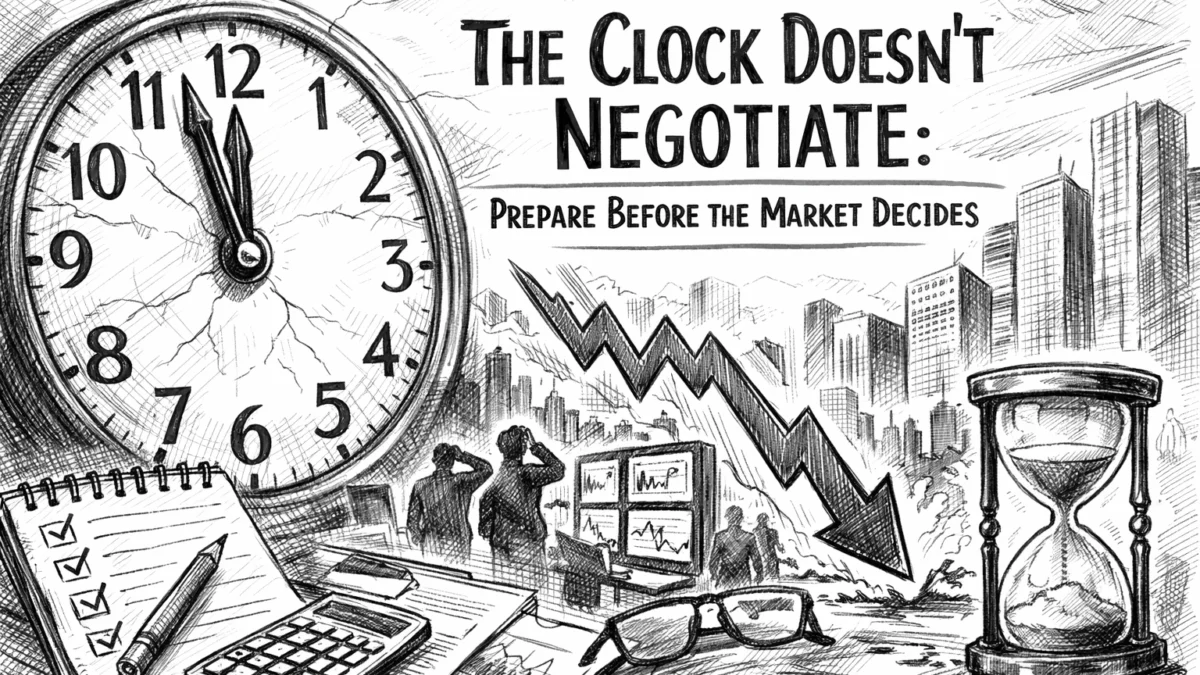
You think you have time.
You think you are the one holding the stopwatch.
You believe that because you built the company, you get to decide exactly when the story ends.
You are wrong.
In the world of business, the clock is the only player that never blinks. It doesn’t care about your legacy. It doesn't care about your "five-year plan." It certainly doesn't care if you feel "ready."
The market is a predator. It waits for the moment you are most vulnerable: a health scare, a sudden economic shift, or a hungry competitor: to dictate the terms of your exit.
If you don't decide your exit now, the clock will decide it for you. And the clock is a terrible negotiator.
The Illusion of "Someday"
Most business owners live in a state of permanent delay.
They call it "waiting for the right time." I call it gambling with bad odds.
They wait for the revenue to hit a certain number. They wait for the kids to grow up. They wait for the "perfect" buyer to come knocking on the door with a check and a smile.
Preparation is not the same as quitting.
Preparation is about power. It is about moving from a position of necessity to a position of choice.
If you wait until you have to sell, you have already lost. The buyer smells the blood in the water. They see the urgency in your eyes. They know you’re tired.
And they will price your business accordingly.

The Three Predators of Your Equity
There are three forces constantly working to devalue what you’ve built. They don't send a calendar invite. They just show up.
1. The Body.
You are the engine of your business. If the engine throws a rod, the car stops. Your health is the single biggest "unforced error" in business valuation. If you are the only one who knows how to run the show, and you can’t show up tomorrow, your business value drops to zero overnight.
2. The Economy.
Markets cycle. This isn't a theory; it’s history. You might have a great business in a dying market. If you wait for the "peak" to start planning, you’ve already missed it. The time to prepare is when the sun is shining, not when the storm hits.
3. The Disruptor.
Somewhere, someone younger, hungrier, and with more capital is trying to automate what you do manually. They don't want to buy you; they want to replace you. If you haven't built an owner-optional business, you are an easy target.
What Breaks if You Disappear?
Ask yourself this: What happens to the revenue if you take a six-month vacation starting right now?
Do the phones stop ringing?
Do the clients leave?
Does the staff freeze because they don’t know how to make a decision without your approval?
If the answer is "everything," then you don't own a business. You own a high-stress job that you can't quit.
Buyers don't buy jobs. They buy systems.
They buy predictable cash flow that doesn't depend on the founder's charisma or 80-hour work weeks. If you are the bottleneck, you are the risk. And risk is a massive discount on your final check.
Most business owners wait too long to realize that they are the primary obstacle to a successful sale.
The Math of Delay: The "One More Year" Trap
Owners love to say, "I’ll just do one more year. I'll get the EBITDA up and then I'll go."
Let’s look at the math.
If you spend that "one more year" grinding but fail to document your processes or diversify your client base, you haven't added value. You’ve just aged.
If the market shifts during that year, your 5x multiple becomes a 3x multiple.
If/Then Logic:
- IF you prepare today, THEN you can walk away on your terms when a buyer appears.
- IF you wait for the "perfect time," THEN you are at the mercy of the buyer's timeline.
You are trading the certainty of a controlled exit for the hope of a slightly higher number later. Hope is not a strategy. It is a liability.
Exit Planning is Growth Strategy (In Disguise)
Here is a hard truth: The things you do to prepare for a sale are the exact same things you should be doing to run a better company today.
It isn't about "getting out." It's about "getting right."
- Cleaning up the books? That’s just good management.
- Building a management team? That’s just scaling.
- Diversifying your revenue? That’s just survival.
When you prepare for the market to decide, you accidentally create a company that you might actually want to keep. But you have to do the work before the pressure is on.

The 5 Steps to Taking the Clock’s Batteries Out
You can’t stop time, but you can stop time from owning you.
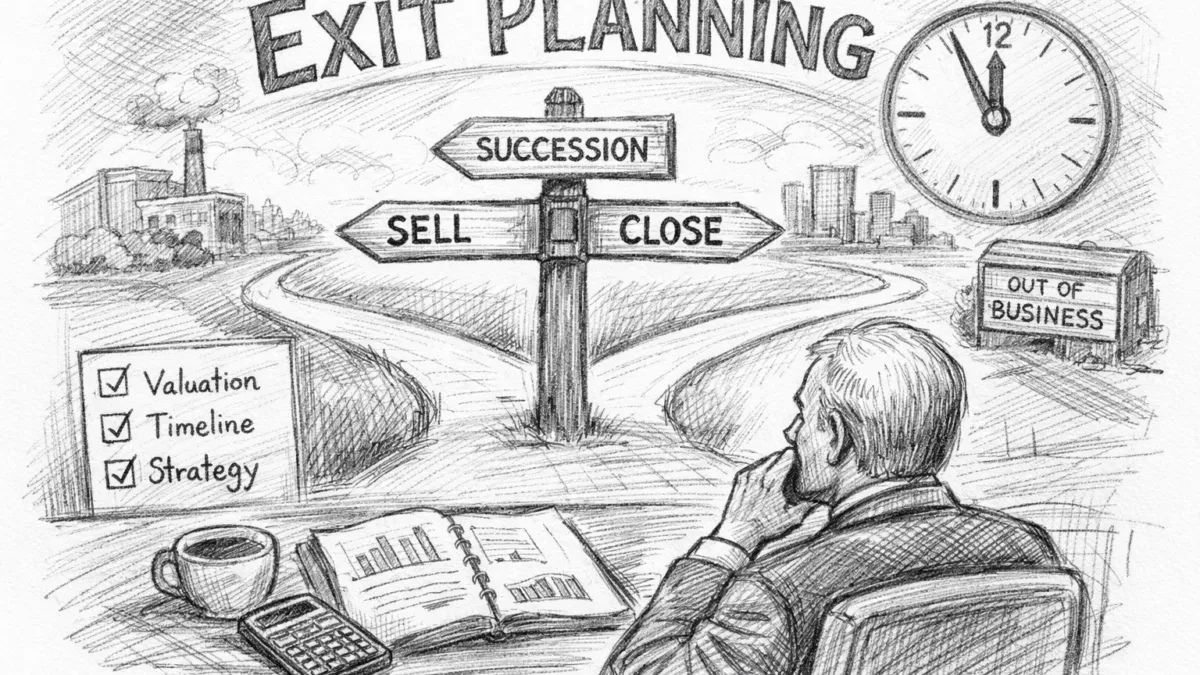
- Get a Real Valuation. Stop guessing. Most owners have an inflated sense of what their "blood, sweat, and tears" are worth. The market doesn't pay for sweat. It pays for math. Understand what your business is really worth now, so you aren't shocked later.
- Fire Yourself. Start delegating the critical decisions. If you are involved in every $500 purchase or every client dispute, you are lowering your enterprise value.
- Audit Your Risks. Who are your top three customers? If one leaves, do you survive? If not, fix it.
- Document Everything. If it’s in your head, it’s worthless to a buyer. If it’s in a manual, it’s an asset.
- Set a "Drop-Dead" Date. Pick a date. Not a "maybe" date. A firm deadline where you will have the business ready to sell, regardless of whether you actually pull the trigger.

Control vs. External Force
This is the central tension of your professional life.
On one side is Control: Proactive planning, disciplined systems, and a clear-eyed view of reality.
On the other side is External Force: Sickness, recession, technological obsolescence, and burnout.
Every day you don't spend preparing, you are surrendering a piece of your control to the external forces. You are letting the clock wind down.
You’ve spent decades building this. Don't let the final chapter be written by a market downturn or a doctor's note.
Take the pen back.
The clock is ticking. It doesn't care if you're listening. But you should be.

Your Move.
Go to our resources page and start the diagnostic. Stop wondering what might happen and start deciding what will happen.
The clock is waiting. Are you?