You’ve spent decades building a business.
Now, you’re looking at the exit. You’ve been told the gold standard is the "strategic acquirer", some faceless corporation or private equity group that will swoop in, hand you a massive check, and let you ride off into the sunset.
That is the dream. The reality is often a nightmare.
The truth is that 76% of business owners experience profound regret within a year of selling to an external party. They watch their culture get gutted, their employees get "restructured," and their legacy get turned into a line item on a spreadsheet.
There is another way. It’s called the internal buyout.
It isn't as flashy. It doesn't make the front page of the industry journals. But for many, it is the only way to leave with your soul, and your legacy, intact.
The Ego Trap of the "Highest Bidder"
Most owners are addicted to the idea of the highest possible valuation.
We tie our self-worth to a multiple of EBITDA. If a competitor offers 5x and your management team can only swing 3.5x, your ego tells you to take the 5x every single time.
But money is only one part of the equation.
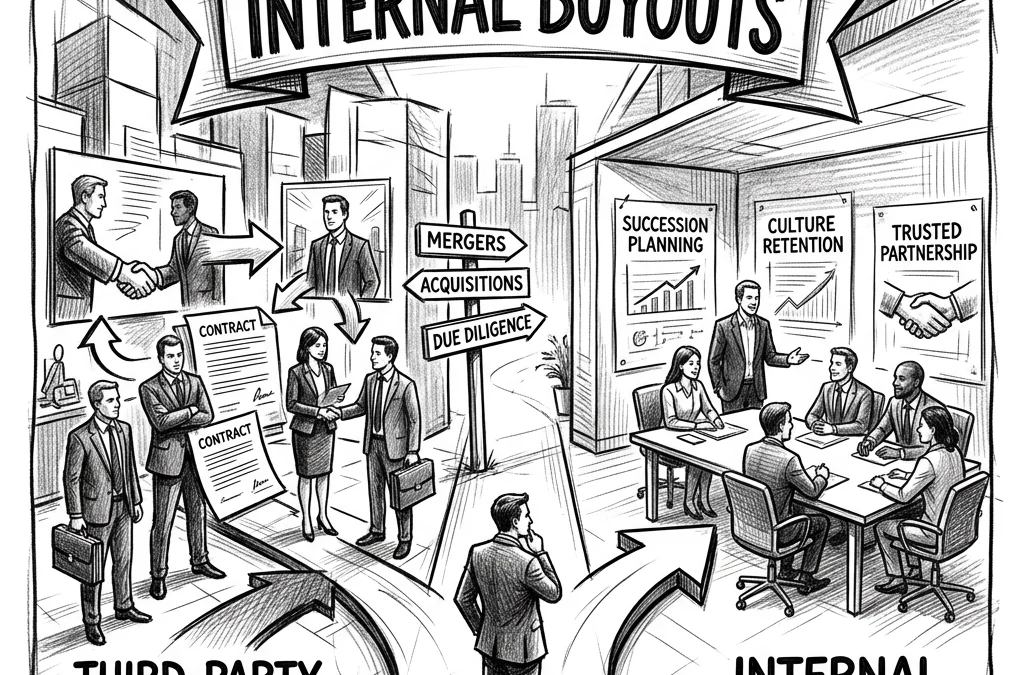
An external sale is a transaction. An internal buyout is a transition.
If you sell to an outsider, you lose control the moment the ink dries. They don’t care how you did things. They care about how they can squeeze more margin out of what you built.
If you sell to your team, you are choosing your successor. You are preserving the DNA of the company. You are ensuring that the people who helped you build the house actually get to live in it.

The Math: What You Lose in Cash, You Gain in Certainty
Let’s be blunt about the numbers.
If you sell to an external buyer, you might get 100% of your revenue as a valuation. If you sell internally, you’re likely looking at 75-80%.
Why the gap?
- External sales benefit from market competition. Multiple bidders drive the price up.
- Internal buyouts have a "sweetheart" factor. You want your team to succeed, so you aren't going to bleed them dry on day one.
- Risk mitigation. Remaining partners aren't going to sign up for a debt load that kills the company.
Then there is the timeline.
An external buyer usually pays you out over 4 to 6 years. An internal buyout often stretches to 10 years or more.
The internal buyer is paying you out of the cash flow of the business you built.
If the business fails two years after you leave, your payout stops. This forces a level of honesty that external sales lack. You can’t "window dress" the books for an internal team. They know where the bodies are buried. They know if the equipment is held together by duct tape.
If you want the absolute top dollar and don't care if the company exists in 24 months, sell to a competitor. If you want a sustainable exit, look inside.
What Breaks if You Disappear?
Before you even think about an internal buyout, you have to ask yourself a hard question:
Is this a business, or is it just a job you created for yourself?
If the business relies on your personal relationships, your specific technical "genius," or your daily presence to function, an internal buyout will fail. Your management team isn't buying a company; they are buying a liability.
You need to move from being the "bottleneck" to the "builder."

An internal buyout requires a management team that is actually capable of managing.
- Can they close deals without your name on the email?
- Do they understand the P&L as well as you do?
- Do they have the "owner's mindset," or are they just high-level employees?
If you haven't mentored them, you can't sell to them. It’s that simple. If you're looking for resources on how to start this transition, check out our free resources.
The Emotional ROI
We talk a lot about money, but we don't talk enough about the "Who am I?" problem.
When you sell to an outsider, you are usually escorted out of the building. Your key card stops working. Your email is deactivated. You are a ghost.
In an internal buyout, the transition is gradual.
- Year 1: You are the CEO.
- Year 3: You are the Chairman.
- Year 5: You are a Consultant.
- Year 10: You are the Founder Emeritus.
You get to phase out. You get to keep your identity while your bank account grows. You get to see your proteges win.
That emotional ROI is why internal sellers report much higher satisfaction scores than those who took the "big check" from a private equity group.

The Risk of the Failed Internal Bid
Don't mistake "internal" for "easy."
An internal buyout attempt can be a grenade. If your management team puts together a bid and you reject it because it’s too low, you have a problem.
You have just told your top leadership that you don't value them as much as the market does.
They now know you are looking to leave.
They feel insulted.
A failed internal bid often leads to a mass exodus of talent. If your key people leave because the deal went south, your business value craters. You might find yourself unable to sell to anyone because the "brains" of the operation walked out the door.
This is why you don't "wing it." You need a structured process. You need a valuation that everyone agrees on before the emotions get involved. You can see how we help owners navigate these specific landmines at Work With Mike.
Diagnostic Questions: Is an Internal Buyout Right for You?
Be honest. Answer these right now:
- Does my team actually want to own this, or do they just want a paycheck? Ownership requires a different level of stress tolerance.
- Can the business survive the debt service of buying me out? If the payments to you starve the company of growth capital, you are killing the golden goose.
- Am I willing to take a lower price in exchange for a higher probability of legacy? If the answer is "no," stop talking to your team and call a broker.
- Can I stay out of the way? Nothing kills an internal buyout faster than a former owner who can't stop "fixing" things from the sidelines.
The Choice is Yours: Until the Clock Decides
The biggest mistake owners make is waiting too long to choose a path.
If you wait until you are burnt out, sick, or desperate, an internal buyout is off the table. Your team will smell the desperation. They won't have the 10 years needed to pay you out.
You will be forced to sell to the highest bidder: or worse, just close the doors.
Don't let the clock decide for you. Whether you want to sell to your employees or find a strategic buyer, you need a plan that starts now. If you're looking for a deeper dive into the reality of these transitions, I wrote an entire book on it. You can find it here.

Your Move
1. Assess your bench.
Sit down today and list the three people in your company who could potentially lead it. If that list is empty, an internal buyout is not an option for you yet.
2. Get a "Hard Truth" valuation.
Stop guessing what your business is worth. Get a realistic valuation that accounts for an internal vs. external sale.
3. Start the conversation.
You don't have to commit to a deal today. But you do have to ask your leadership team: "Where do you see yourself in five years? Do you have the appetite for ownership?"
The answer might surprise you. It might also save your legacy.
If you're still not sure where to start, take a look at our books and resources to see how other owners have handled this exact crossroads. Be the owner who plans, not the one who reacts.