You’ve spent decades building something out of nothing.
Now, the clock is ticking. You can feel it.
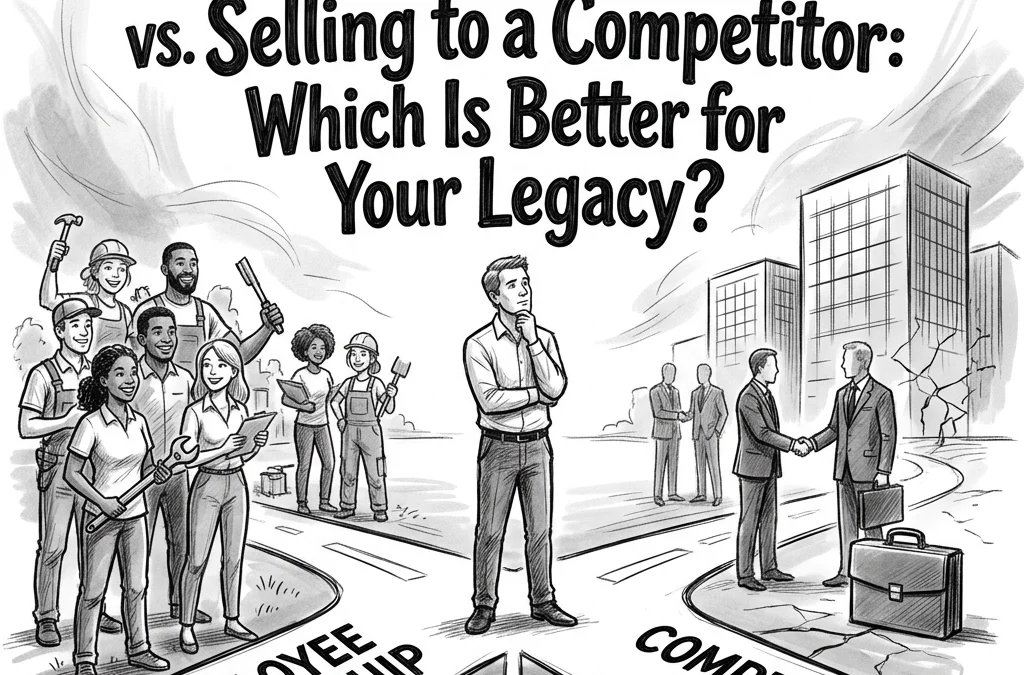
You have two doors in front of you.
Behind Door Number One is a competitor. They have a big checkbook, a fleet of lawyers, and a plan to absorb you.
Behind Door Number Two are your employees. They have the sweat equity, the institutional knowledge, and a much smaller bank account.
Most owners think this is a financial decision. It isn’t.
It is a legacy decision.
And if you get it wrong, the business you spent your life building will be dismantled before the ink on the contract is even dry.
The Brutal Reality of the Competitor Exit
Let’s stop pretending.
When a competitor buys your business, they aren't buying your "vision." They aren't buying your "culture."
They are buying your market share.
They want your customer list. They want your proprietary tech. They want to eliminate a rival.
The moment the deal closes, you are no longer the captain of the ship. You are a line item on an integration spreadsheet.
Within 18 months, your brand name will likely be gone. Your key staff will be "redundant." Your community ties will be severed in favor of "efficiency."
If you want the highest possible exit price, sell to a competitor. They have the "synergies" to justify a premium.
But if you care about what happens to the people who helped you build the house, selling to a competitor is often a betrayal wrapped in a wire transfer.

The Employee Buyout: Preserving the Soul
Selling to your employees, whether through an ESOP (Employee Stock Ownership Plan) or a direct management buyout, is a different animal.
It is the only way to ensure your values survive you.
Employees buy to preserve. Competitors buy to extract.
Your team already knows how you work. They understand the "why" behind your decisions. They have skin in the game because their mortgages depend on the business staying healthy.
When you sell to your employees, you aren't just exiting. You are crowning successors.
It is the ultimate vote of confidence in the culture you’ve built.
However, there is a catch. And it’s a big one.
The Trade-Off: Cash vs. Continuity
Here is the truth most consultants won't tell you: An employee buyout will almost always net you less cash upfront.
Employees don’t have millions in liquid capital sitting in a vault.
This usually means you, the owner, will have to act as the bank. You will take a "seller note." You will get paid over five, seven, or ten years out of the company’s future profits.
You are betting on their success to get your full payout.
If the business fails after you leave, your retirement goes with it.
This is why you must build a business that runs without you long before you try to sell it to the staff. If they can't manage it while you’re there, they definitely can’t manage it when you’re gone.
What Legacy Actually Is (And What It Isn't)
Most owners confuse "legacy" with "ego."
Legacy isn't your name on the building. It isn't a gold watch or a framed photo in the lobby.
Legacy is the survival of your standards.
If you sell to a competitor and they fire half your staff to save on payroll, your legacy is gone.
If you sell to your employees and the business thrives for another twenty years, your legacy is alive.
It’s that simple.
You need to decide what matters more: The size of the check or the survival of the mission.

Diagnostic: Which Path Are You On?
Ask yourself these four questions. Be honest.
- If I disappeared tomorrow, would the business be worth anything to my employees? (If the answer is no, you haven't built a business; you've built a job.)
- Does my competitor want my people, or just my customers? (Hint: It’s almost always the customers.)
- Am I willing to stay "tethered" to the business via seller financing to ensure my team takes over?
- Is my business actually profitable enough to pay for its own buyout?
If your business isn't "Owner-Optional," an employee buyout is a fantasy. You are essentially handing them a ticking time bomb.
You can read more about why this matters in our guide on the owner-optional business.
The Financial Fog
Competitors will dazzle you with multiples. They will talk about EBITDA and strategic premiums.
But remember: many of these deals are loaded with "earn-outs."
An earn-out is a promise to pay you if the business hits certain targets under their management.
Guess what? Most owners never see their full earn-out.
The competitor changes the accounting, moves the goalposts, and suddenly your "record-breaking exit" looks like a bargain-basement sale.
When you sell to employees, the structure is often simpler, even if the timeline is longer. You know who you are dealing with. You know if they have the guts to finish the race.

The Risk of Inaction
The worst thing you can do is wait until you are burnt out to decide.
When you are tired, you make desperate moves. You take the first check that comes along.
Waiting too long is the most expensive mistake you can make.
If you want to sell to your employees, you need to start training them now. You need to open the books. You need to let them make mistakes while you are still around to fix them.
If you want to sell to a competitor, you need to clean up your operations and maximize your margins now so you can demand a higher price.
Indecision is a decision. It’s a decision to let the market (or your health) dictate your exit.
Comparison At A Glance
| Feature | Selling to a Competitor | Selling to Employees |
|---|---|---|
| Valuation | Higher (Strategic Premium) | Lower (Fair Market Value) |
| Speed | Faster (3-9 months) | Slower (Years of prep) |
| Legacy | Low (Absorption/Rebranding) | High (Mission Continuity) |
| Staff Security | Low (Redundancies) | High (Equity/Stability) |
| Tax Benefits | Standard | High (ESOP tax advantages) |
The Truth About "Fairness"
Owners often feel they are being "unfair" to their families if they don't take the highest possible check from a competitor.
"I owe it to my kids to get every cent," they say.
But what do you owe to the community that supported you? What do you owe to the employees who worked late on Christmas Eve so you could grow?
Legacy is a multi-dimensional calculation. Money is only one variable.
If you need help navigating these waters, my book, Before the Clock Decides, walks you through the emotional and strategic hurdles of this exact transition.

Your Move
Don't wait for a knock on the door from a broker. By then, your options are already narrowing.
1. Determine your "Number."
What do you actually need to live the life you want after the exit? If an employee buyout meets that number, the "extra" money from a competitor is just ego.
2. Audit your leadership.
Do you have a "Successor" or just a "Manager"? A manager follows instructions. A successor takes ownership. If you don't have the latter, an employee buyout is off the table.
3. Get a real valuation.
Stop guessing. Stop using "rules of thumb." Find out what your business is really worth today.
4. Pick a side.
Stop trying to keep both doors open. Decide today if you are building a legacy to be handed down or an asset to be sold off.
The clock is ticking.
Decide before the clock decides for you.