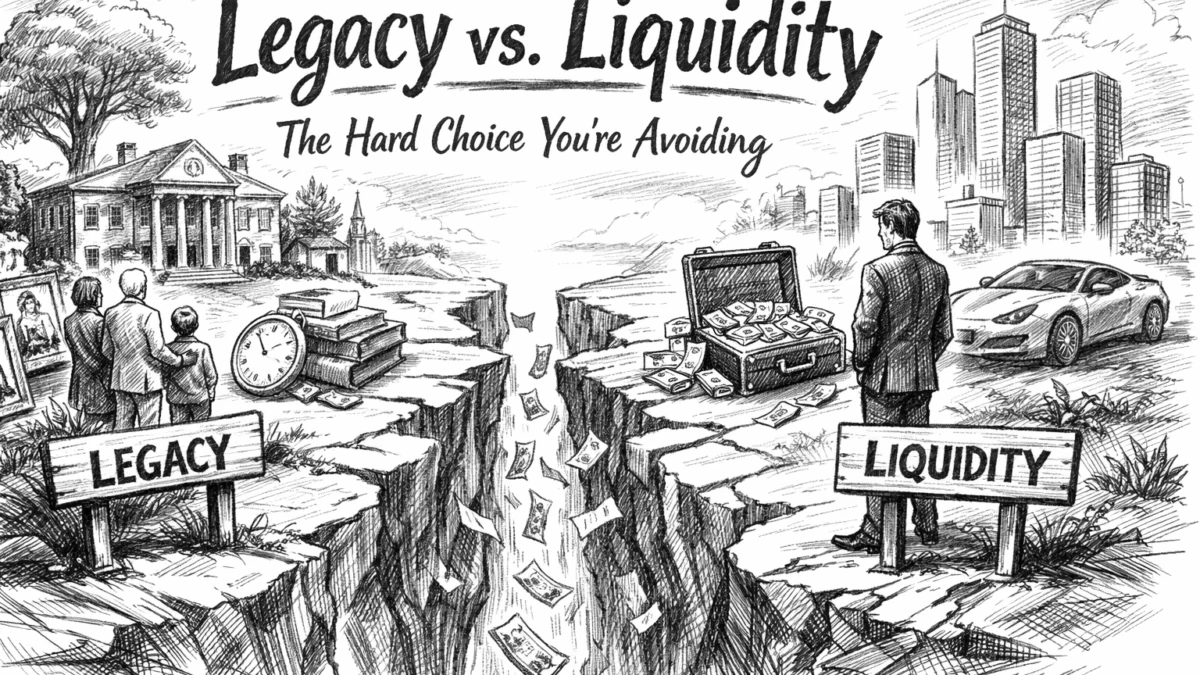
You are sitting on a time bomb.
It doesn't tick. It doesn't hum. It just sits there, wrapped in the glossy veneer of your "family business."
You tell yourself you are building a legacy. You tell your spouse that you are doing this for the kids. You tell your employees they are "part of the family."
But here is the hard truth: Legacy is often just a fancy word for indecision.
You are avoiding a choice. It is the choice between the romantic idea of a multi-generational dynasty and the cold, hard reality of financial liquidity.
Most owners wait until the clock decides for them. They wait until a health scare, a market crash, or a family feud forces their hand. By then, the choice is gone.
If you don't choose your exit, the market will choose it for you.
The Fairytale of the Next Generation
We need to talk about your kids.
You want them to take the reins. You want to see your name stay on the building for another thirty years. It’s a beautiful vision. It is also, in many cases, a delusion.
Your children are not you.
They didn't sleep on the floor of the warehouse. They didn't take the second mortgage to make payroll in 2008. They haven't felt the weight of fifty families' livelihoods on their shoulders every Friday afternoon.
Asking them to take over isn't always a gift. Sometimes, it’s a sentence.
Have you actually asked them if they want it? Not at a holiday dinner where they feel obligated to say yes. Have you asked them in a room where "no" is an acceptable answer?
A business is a tool, not an heirloom.
If your successor lacks the fire, the skill, or the desire, you aren't leaving a legacy. You are leaving a mess. You are handing them a complex machine they don't know how to fix and expecting them to keep it running at top speed.
That is how wealth disappears. That is how families break.
Liquidity: The Taboo Word
In some circles, "liquidity" sounds like selling out.
It sounds like walking away from your people. It sounds like admitting that the journey is over.
Liquidity is not a surrender. It is a harvest.
You spent decades planting. You spent years weeding. You spent a lifetime protecting the crop. At some point, you have to bring the grain to the market, or it will rot in the field.
Cashing out provides something legacy rarely does: Certainty.
Cash doesn't care about market shifts. Cash doesn't have sibling or cousin rivalries. Cash doesn't need to learn how to manage a sales team or navigate supply chain disruptions.
When you prioritize liquidity, you are choosing to turn your sweat equity into transferable freedom. You are choosing to fund your future, and perhaps your children's actual dreams, instead of tethering them to your past.
Legacy is what you leave in people. Liquidity is what you leave in the bank.
You can have both, but only if you stop pretending they are the same thing.
The Cost of the "One More Year" Trap
Owners love the "one more year" strategy.
"I'll get the EBITDA up just a bit more."
"I'll wait until the interest rates drop."
"I'll wait until the youngest finishes college."
Every year you wait is a year of unmanaged risk.
Exit planning is why most business owners wait too long. They think time is an asset. In the world of business valuation, time is a liability.
The older you get, the more the business depends on you. The more it depends on you, the less a buyer wants to pay for it.
If you disappear tomorrow, what happens to the value?
If the answer is "it vanishes," then you don't own a business. You own a high-stress job.
Buyers don't pay for your history. They pay for the future. If that future is tied to your heartbeat, you have no liquidity. You only have a liability.

Hard Truths: A Diagnostic
Stop reading for a second. Answer these questions. Don't rationalize. Just answer.
- Does your chosen successor have the respect of your toughest employee?
- Could your business survive a 6-month absence by you without losing a single client?
- If a buyer offered you 20% less than your "dream number" today, in cash, would you feel relief or anger?
If you felt relief, you are craving liquidity.
If you answered "no" to the first two, your legacy is a house of cards.
You are protecting a ghost.
Many owners stay because they don't know who they are without the title on their business card. That isn't legacy. That’s an identity crisis.
The owner-optional business is the only one that actually has a choice. If the business can't run without you, you can't sell it, and you certainly can't hand it over to a child who isn't ready.
The Myth of the "Perfect" Buyer
You think you'll find a buyer who will treat your employees exactly like you do.
You won't.
You think you'll find someone who will keep the name on the door forever.
They might not.
A buyer is buying a return on investment, not a museum.
If you want to protect your employees, you do that through a structured sale with specific covenants. If you want to protect your name, you build a brand that is bigger than your ego.
But you cannot control the world after you leave the room.
Trying to control the business from the grave is the ultimate ego trip. It’s also the fastest way to kill the value before you ever get out.
Bridging the Gap: The Documented Plan
Only 41% of business owners have a documented exit plan.
The other 59% are "winging it." They are gambling with their life's work.
A plan isn't a 100-page binder that sits on a shelf. A plan is a series of brutal, honest decisions made while you still have the leverage.
- Define your "Enough" number. What is the liquidity required to never think about money again?
- Audit your "Successor." Give them a project. A real one. If they fail, that is your answer.
- Clean the books. Jargon-free, transparent financials are the only language buyers speak.
- Fix the dependencies. Kill the "Hero Culture" where you solve every problem.
If you are the smartest person in your company, your company is worth half of what it should be.
The Clock Doesn't Negotiate
You think you have time. You don't.
Markets shift. Industries get disrupted. Health fails.
The tension between legacy and liquidity isn't something you solve with a "wait and see" approach. You solve it by looking in the mirror and deciding what matters more: the fantasy of forever or the reality of freedom.
Legacy is what people say about you at your funeral.
Liquidity is what allows you to enjoy the twenty years before it.
Don't confuse the two.

Your Move
You’ve spent your life building. Now it’s time to decide what the building was for.
- Schedule a "Truth Session" with your family. Ask your potential heirs if they actually want the business. Tell them "no" is a gift to you both.
- Get a professional valuation. Not a guess. Not what your buddy sold his business for. Get the real number. What your business is really worth is often a wake-up call.
- Read the blueprint. Pick up a copy of Before the Clock Decides and look at the frameworks for an intentional exit.
The clock is running. Decide before it decides for you.