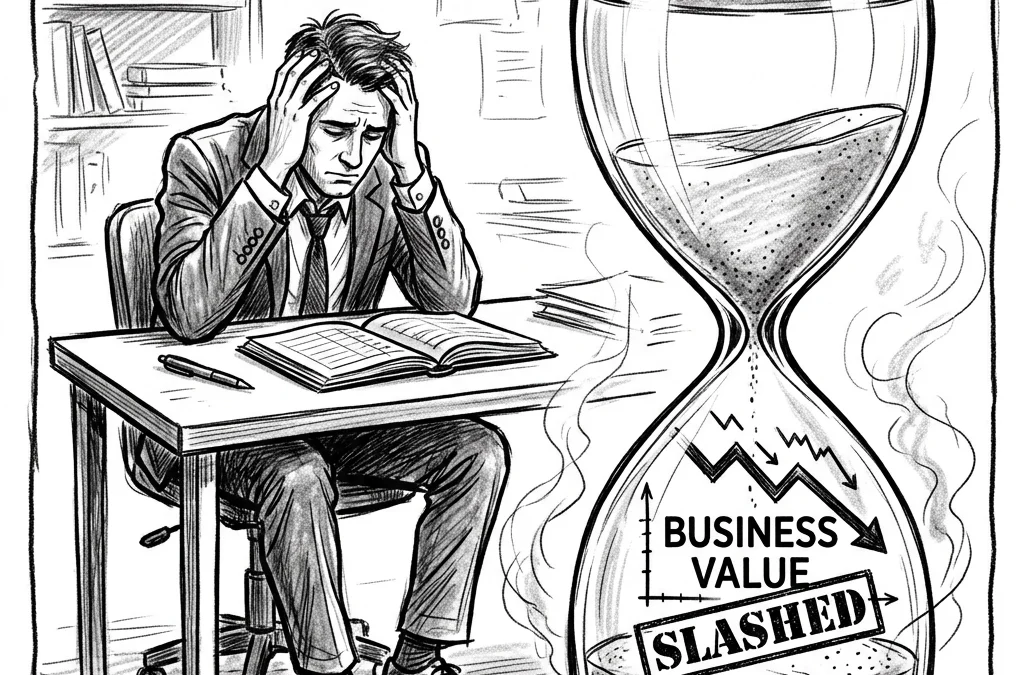
"I’ll just give it one more year."
It sounds responsible. It sounds like a plan. It sounds like you’re squeezing every last drop of value out of the lemon before you toss the rind.
It’s usually a lie.
In reality, "one more year" is often the most expensive phrase in the English language for a business owner. It’s the siren song of the tired founder who is afraid to let go, convincing themselves that they can pick the perfect peak to exit.
But here is the hard truth: The market doesn’t care about your retirement timeline. It doesn’t care that you want to hit a round number in your bank account. The market cares about momentum. And if you stay one year too long, you aren't just losing 12 months of your life, you’re likely slashing the valuation of your business by 20%, 30%, or even 50%.
You are holding a melting ice cube. The longer you stand there admiring it, the less there is to sell.
The Myth of the "Perfect Peak"
Most owners think business value looks like a plateau. They think they can reach the top, hang out there for a few years while they "get their ducks in a row," and then sell at the maximum price whenever they feel like it.
They are wrong.
Business value is a pulse, not a plateau. It’s either moving up or it’s moving down. The moment you stop pushing for growth because you have "one eye on the exit," the decline has already begun.
Buyers aren't paying for what you did three years ago. They aren't even really paying for what you’re doing today. They are paying for the Present Value of Expected Future Cash Flows.
If a buyer senses that you’ve lost your edge, that your growth has flattened, or that you’re just coasting to the finish line, they won't pay a premium. They’ll see a business that is losing its competitive teeth.

Multiple Contraction: The Silent Killer
Let’s talk math, because the math is brutal.
Let’s say your business generates $1M in EBITDA (profit). At your peak, with strong growth and a clean operation, you might command a 5x multiple. That’s a $5M exit.
You decide to stay "one more year." You’re tired. You stop innovating. You stop chasing that big new contract because it seems like too much work. Your EBITDA drops slightly to $900k.
You think, "Okay, I lost $100k in profit, so the business is worth $4.5M now, right?"
Wrong.
Because your growth slowed and the risk increased, the buyer no longer offers a 5x multiple. They offer a 3.5x multiple.
- Year 1: $1M EBITDA x 5 = $5M
- Year 2: $900k EBITDA x 3.5 = $3.15M
By waiting "one more year," you didn't just lose $100k in profit. You lost $1.85 million in enterprise value. That is the "One More Year Tax." It is a penalty for staying past your expiration date.
Why Values Crash When You Stall
Why does the market penalize you so heavily for a slight dip? It’s not just about the money; it’s about the risk.
1. The Execution Credibility Crisis
When a business stalls, buyers start looking under the hood with a microscope. They start asking why production capacity is stagnant. They start wondering if your management team is actually capable of scaling without you. If you haven't expanded when the market was hot, the buyer assumes you can't expand. Once your execution credibility is questioned, the risk premium goes up, and your valuation goes down.
2. The Competitive Vacuum
While you are "coasting," your competitors are sprinting. In sectors like tech, manufacturing, or even specialty services, early expansion allows you to build "customer stickiness." If you wait, you allow a hungrier, younger competitor to grab that market share. By the time you decide to sell, you aren't selling a market leader; you’re selling a target that’s being hunted.
3. Missing the Cyclical Window
Markets move in cycles. There are times when money is cheap, buyers are aggressive, and multiples are high. There are other times when the windows slam shut. If you miss a "hot" window because you wanted one more year of salary, you might find yourself waiting another five to seven years for the next cycle to come around.
The "Owner-Optional" Problem
The biggest reason staying too long kills value is that the owner becomes more "entrenched."
When you’re in "one more year" mode, you often stop investing in the systems and people that make the business owner-optional. You start making all the decisions again because you just want to keep things stable.
A buyer looks at that and sees a job, not an investment. If the business relies on your "magic" to stay profitable, they will demand a massive discount or, worse, a massive earnout that ties you to the desk for three more years.
You wanted one more year. Now you’re stuck for four.
The Physical and Mental Tax
We rarely talk about the cost to the human being behind the desk.
Running a business at 100% capacity is hard. Running a business at 60% capacity while you’re mentally checked out is exhausting.
I’ve seen it dozens of times. An owner stays too long, the business starts to slide, and instead of a "graceful exit," they end up in a frantic, desperate fire sale because they are burnt out and the bank is breathing down their neck.
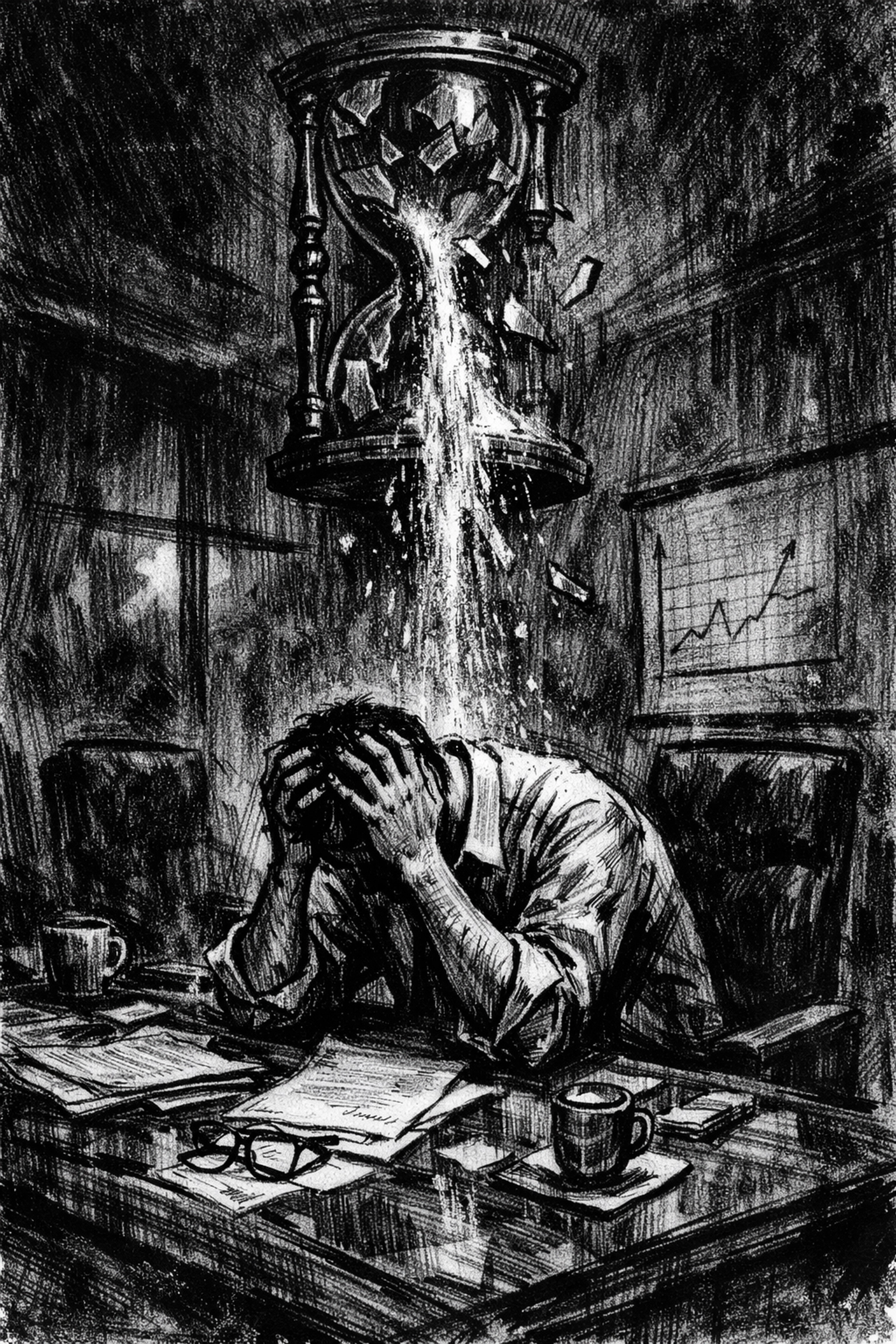
When you are tired, you make bad decisions. You miss the most expensive mistakes. You settle for a worse deal just to make the pain stop.
The best time to sell is when you still have some gas in the tank: enough to help the new owner transition, but not so much that you’re sacrificing your health and your legacy.
Is it Too Late?
If you’re reading this and realizing you might have already passed the peak, don't panic. But stop lying to yourself.
The "One More Year" strategy only works if you use that year to aggressively de-risk the business. That means:
- Standardizing your processes.
- Getting your financials audit-ready.
- Moving yourself out of the day-to-day operations.
If you aren't doing those things, you aren't "waiting for a better price." You are simply watching your net worth evaporate.
Your Move
The clock is moving whether you acknowledge it or not. You need to decide if you are going to be the one to stop it, or if you’re going to let it run until it hits zero.
- Get a Real Valuation: Stop guessing what your business is worth based on a "gut feeling" or what your buddy sold his for. Get a professional opinion of value now.
- Audit Your Momentum: Look at your last 24 months. Is your growth accelerating or decelerating? Be honest. If it’s slowing down, your "one more year" is costing you money every single day.
- Read the Roadmap: If you don't have a plan, you don't have an exit: you have a hope. And hope is not a strategy. Pick up a copy of Before the Clock Decides and start building an intentional transition.
Don't wait until the clock decides for you. The price of "one more year" is too high to pay.
Want to dive deeper into how to prepare? Check out our Exit Category for more blunt truths on leaving your business the right way.