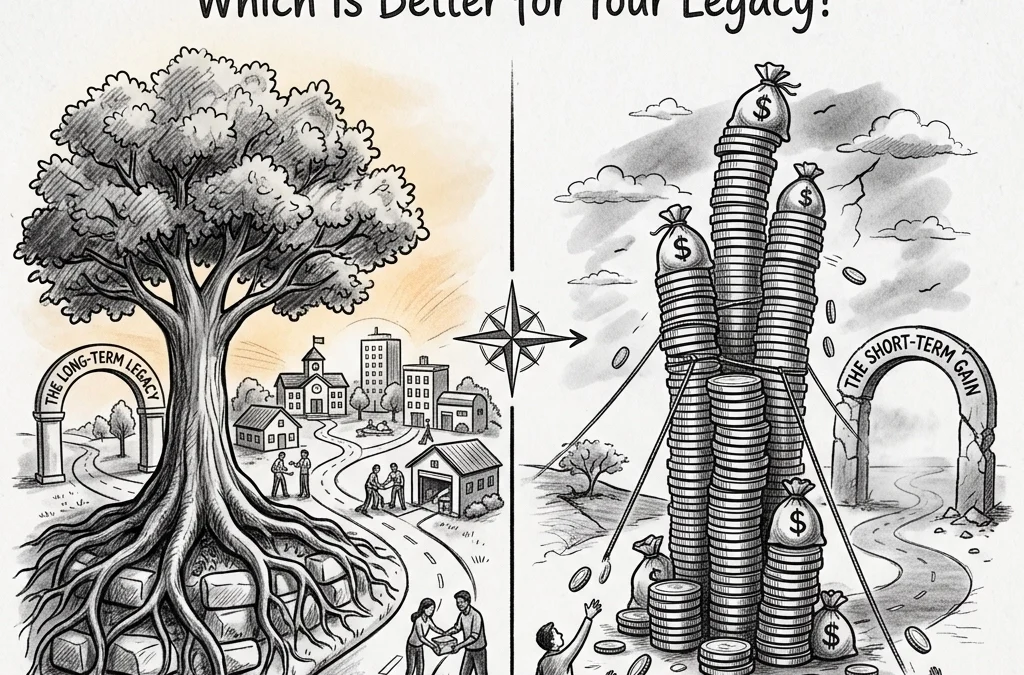
You spent twenty years building a kingdom. Now, you’re ready to hand over the keys.
Two offers sit on your desk.
Offer A is a massive check. It’s the kind of money that makes your eyes water and your retirement look like a permanent vacation on a private island. But the buyer is a "vulture" private equity group known for stripping assets and firing half the staff within ninety days.
Offer B is lower: maybe 20% lower. But the buyer lives and breathes your industry. They want your team. They want your culture. They want to keep your name on the building.
Which one do you take?
Most owners say they’d take the money and run. They’re lying. Or, at the very least, they haven't thought about the morning after the wire hits.
Selling your business isn't just a financial transaction. It’s an identity transplant. If you don't get the "fit" right, that big check will feel like blood money sooner than you think.
The Mirage of the Highest Bid
Let’s be honest: Everyone has a price. But in the world of M&A, the "highest bid" is often a ghost.
Buyers aren't stupid. If they are offering a price that seems too good to be true, it usually is. High-valuation offers are frequently structured with landmines designed to protect the buyer, not you.
I’m talking about earnout traps.
An earnout is a promise to pay you later if the business hits certain goals. If a buyer offers you $10 million, but $4 million of that is tied to performance targets over the next three years, you didn't get a $10 million offer. You got a $6 million offer and a stressful new job where you no longer call the shots.
If you take the highest bid from a buyer who doesn't understand your operations, they will break the very machine that is supposed to generate your earnout.
The highest bid is meaningless if the terms undermine your freedom.

What Strategic Fit Actually Looks Like
"Strategic Fit" sounds like corporate jargon. It isn't.
It’s a simple math equation: 1 + 1 = 3.
A strategic buyer isn't just buying your cash flow; they are buying a missing piece of their own puzzle. Maybe you have the distribution network they lack. Maybe your technology makes their existing product twice as valuable.
When there is a strategic fit, the buyer doesn't need to "gut" your company to make the numbers work. They want the engine running exactly as it is, just at a larger scale.
Strategic fit isn't about being nice; it's about alignment.
When the buyer’s goals align with the way you’ve already built the business, your legacy stays intact by default. Your employees keep their jobs because they are actually needed. Your customers stay happy because the service doesn't change.
If you want to understand how to position your business for this kind of buyer, you need to start thinking about it years in advance. Check out the Before the Clock Decides book to see how to build a business that people actually want to buy for the right reasons.
The Ghost of Your Business
What breaks if you disappear?
If the answer is "everything," you don't have a business; you have a high-paying, high-stress job. And no strategic buyer wants to buy a job.
They want a turnkey operation.
If you sell to the highest bidder: usually a financial buyer: and you haven't built a management team that can function without you, that buyer will pivot to "survival mode" the day you leave. They will cut costs. They will merge departments. They will erase the culture you spent decades cultivating.
Your legacy isn't a plaque on the wall. It’s the way your people are treated after you’re gone.
The Cost of Cultural Mismatch
I’ve seen it happen dozens of times. An owner takes the big check from a buyer who doesn't "get" the industry. Six months later, the owner is miserable.
They are stuck in a transition period, watching a group of MBAs who have never been on a shop floor tell their long-term employees how to do their jobs.
- Scenario A: You take the $10M bid. Your top three managers quit within six months because the new owners are jerks. The brand reputation tanks. You get your money, but you can’t show your face in your hometown.
- Scenario B: You take the $8.5M bid. The buyer integrates your team into a larger, more stable organization. Your managers get raises and better benefits. The brand expands. You walk away with $8.5M and a reputation as the guy who did right by his people.
Which one lets you sleep at night?
If you’re still not sure, read some of the book reviews from other owners who have wrestled with these exact same questions. It’s never as simple as the spreadsheet makes it look.
Why You Need a 3-5 Year Runway
You cannot decide you want a "strategic fit" on the day you decide to sell. By then, it’s too late. The clock is already deciding for you.
To get a strategic buyer to pay a premium, you have to prove that your business is transferable.
This means:
- Clean financials that even a cynic couldn't argue with.
- A management team that makes you redundant.
- Diversified customers so one person leaving doesn't kill the company.
- Standard Operating Procedures (SOPs) that a stranger can follow.
If you don't have these, you’ll be forced to take whatever bottom-feeder offer comes your way because you’re burnt out and desperate to leave.
Desperation is the fastest way to kill a legacy.

The Blunt Truth About "Legacy"
Legacy is a heavy word. Most people use it to sound noble.
But let’s get blunt: Legacy is what remains when you are no longer in the room.
If you sell to a buyer who strips the company, your legacy is that you sold out. If you sell to a buyer who grows the company, your legacy is that you built something built to last.
A strategic buyer is often willing to pay more in the long run: not necessarily in the initial check, but through smoother closings, fewer legal headaches, and the preservation of your reputation.
If you are obsessed with the "Highest Bid," you are likely focusing on the wrong metric. Focus on Value Certainty.
Value certainty is the money that actually ends up in your bank account after taxes, fees, and earnout failures. A "lower" strategic offer with 90% cash at close is almost always better than a "higher" financial offer with 50% tied up in a risky earnout.
Your Move
You have a choice to make, but you have to make it before the "For Sale" sign goes up.
Are you building a business to flip to the highest bidder, or are you building a legacy that a strategic partner will covet?
If you’re ready to stop guessing and start planning, let’s talk. You can work with me directly to audit your current exit readiness.
Don't let the clock decide what happens to your life's work.
- Audit your "Key Man" risk. If you died tomorrow, would a buyer still want the company?
- Define your "Must-Haves." Does the buyer need to keep the staff? Does the name need to stay? Write it down.
- Screen for fit, not just funds. When a buyer calls, ask about their five-year plan for the company before you tell them your price.
The money will come. But the peace of mind? That only comes when you find the right fit.