You think you’re the hero.
You’re the first one in and the last one out. You hold the keys, the relationships, and the "secret sauce." You’ve spent decades building this thing from the dirt up.
But here is the blunt truth: If you are the hero of your business, your business is a failure.
If the revenue stops when you stop, you don't own an asset. You own a high-pressure job that you happen to pay for.
Most owners mistake their indispensability for value. They think, "The business needs me, therefore I am valuable."
The market disagrees.
The market looks at a business that requires the owner's constant presence and sees one thing: Risk.
And risk is the silent killer of valuation.
The 30-Day Litmus Test
Let’s get diagnostic.
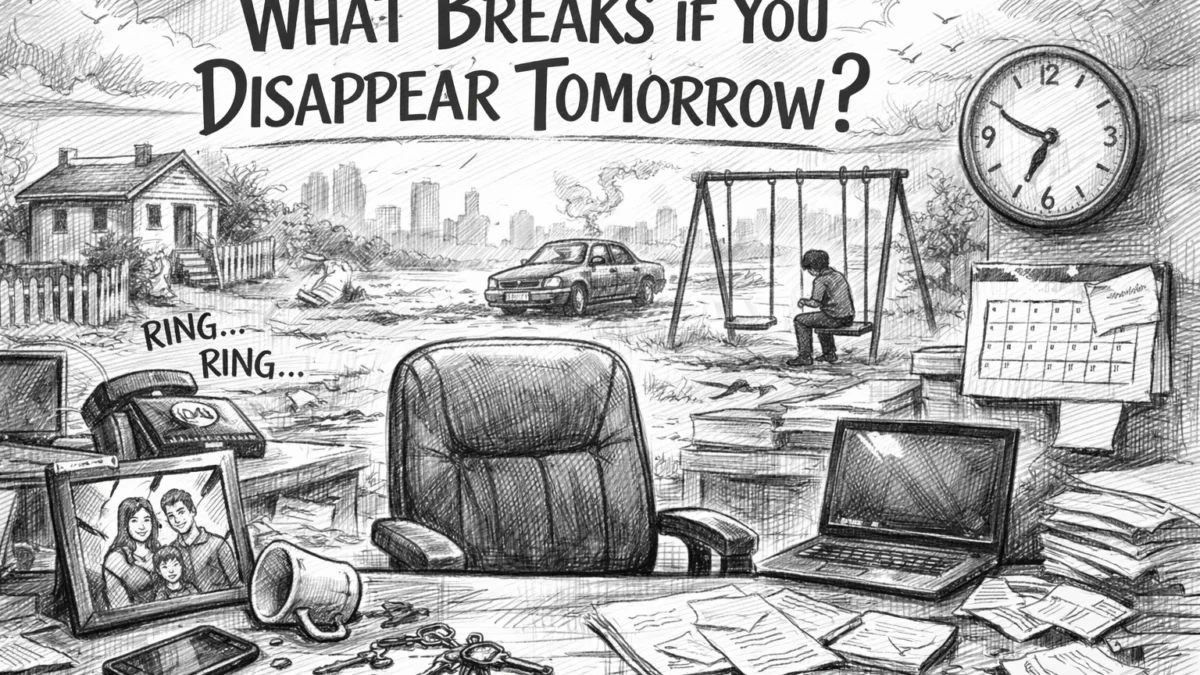
Imagine you leave tomorrow. No phone. No email. No "checking in" from a beach in Cabo. You disappear for thirty days.
What happens on day ten?
Does the sales pipeline dry up because you’re the only one who can close the big deals?
Do the employees start fighting because you’re the only one who can settle a dispute?
Do the vendors stop shipping because you’re the only one with the "special" relationship?
If it breaks, it isn't a business.
It’s a personality-driven revenue stream. And personality-driven revenue streams are impossible to sell for a premium.
A buyer is not looking to buy your charisma. They are looking to buy an engine. If the engine requires you to sit in the driver's seat 24/7 just to keep it idling, the buyer is going to walk. Or, worse, they’re going to offer you a price that reflects the massive weight of the risk they’re taking on.

The Buyer’s Cold Calculation
When a professional buyer looks at your company, they aren't looking at your past trophies. They are looking at the future without you.
They ask one question: What is the probability that these profits continue when the current owner exits?
If the answer is "low," your valuation disappears.
You might think your business is worth 5x or 6x earnings. But if you are the primary salesperson, the chief engineer, and the head of HR, your business is worth closer to 2x.
Maybe less.
You are the bottleneck. Every decision has to pass through your desk. Every problem has to be solved by your brain. You’ve created a culture of permission instead of a culture of ownership.
This is the central tension of exit planning. You want to be important, but for your business to be valuable, you have to become irrelevant.
The Multiplier Murder
Let’s talk math.
Two companies. Both do $1 million in bottom-line profit.
Company A: The owner works 60 hours a week. They know every customer by name. They sign every check. They handle the complex technical issues.
Company B: The owner works 5 hours a week. They focus on high-level strategy. They have a management team that handles operations. They have documented systems for everything from lead gen to janitorial services.
Company A sells for $2.5 million.
Company B sells for $6 million.
Why? Because the buyer of Company B is buying a machine. The buyer of Company A is buying a headache.
A business that depends on the owner is a business with a "key man" risk that most banks won't even finance. If the bank won't finance it, your pool of buyers shrinks to almost zero.
When the pool of buyers shrinks, the price drops.
This is what your business is really worth, regardless of what your gut tells you.

The Myth of Being "Unreplicable"
Owners love to tell themselves that what they do cannot be replicated.
"Nobody cares about the customers like I do."
"Nobody understands the nuances of this industry like I do."
This is an ego trap.
If what you do is truly unreplicable, then your business is un-salable.
If it can’t be taught, it can’t be scaled. If it can’t be scaled, it can’t be valued as a true enterprise.
Most of what you do isn't magic. It’s a series of habits, instincts, and knowledge that you’ve failed to document. You have "implicit knowledge." You need "explicit systems."
An asset isn't something that requires your permission to function. An asset is a system that produces a result regardless of who is pulling the lever.
The Anatomy of the Bottleneck
Where are you stuck? Look at these three areas:
- Sales and Marketing: If you are the "Face" of the brand, you are the bottleneck. If the phone only rings because people want to talk to you, you are the bottleneck.
- Operations: If the "way we do things" lives in your head and not in a manual, you are the bottleneck.
- Finance: If you are the only one who understands the cash flow or manages the bank, you are the bottleneck.
If you want to increase your value, you have to start firing yourself from these roles one by one.
It’s painful. It requires humility. It requires letting people make mistakes that you could have prevented.
But it is the only way to build the owner-optional business.

From Hero to Architect
You need to stop being the "Hero" who saves the day. You need to start being the "Architect" who designs the day.
A hero reacts to fires. An architect builds a fireproof building.
The market pays for the building, not the firefighter.
Truth-teller moment: Most owners stay the bottleneck because they enjoy the ego stroke of being needed. They like being the one with all the answers. They like the adrenaline of the "save."
If that’s you, be honest about it. But don't complain when the market discounts your life's work by 50%.
You are paying a "Significance Tax." You are trading millions of dollars in future exit value for the feeling of being important today.
Is the ego stroke worth the seven-figure haircut?
The Steps to Disappearing
You don't fix this in a weekend. You fix it in a season.
- Identify the Breaks: Take that 30-day hypothetical. Write down exactly what would fail first. That is your priority list.
- Document the "Magic": Take the things you think "only you can do" and record yourself doing them. Use a screen recorder. Use a voice memo. Give it to a smart employee and tell them to write the manual.
- Test the Systems: Give your team the authority to make decisions within a certain budget or framework. Then: and this is the hard part: stop interfering.
- The Mini-Exit: Take a Friday off. Then a Thursday and Friday. Then a full week. Watch what breaks. Fix the system, not the person.
The goal is a business where you are a guest, not a ghost.
A guest is welcome, but the house functions perfectly without them. A ghost haunts the place, and everyone is constantly looking over their shoulder wondering when the "spirit" is going to intervene.

The Final Warning
The clock is ticking.
One day, you won't have a choice. You will disappear from your business. It might be by choice (a sale), or it might be by force (health, family, or market shifts).
If you haven't prepared the business to survive without you, you aren't leaving a legacy. You’re leaving a mess.
You’ve spent years building the engine. Now, spend some time making sure it can run without you holding the starter cable.
The market rewards the prepared. It punishes the indispensable.
Decide which one you want to be before the clock decides for you.
Your Move
Go through your calendar for the last two weeks. Circle every meeting or task that only you could have done.
If that list is more than 20% of your time, you are the bottleneck.
Pick one of those tasks. Document it. Delegate it.
Do it today.
Because tomorrow, you might not have the choice.
Check out our resources to start building a business that doesn't break when you walk out the door.