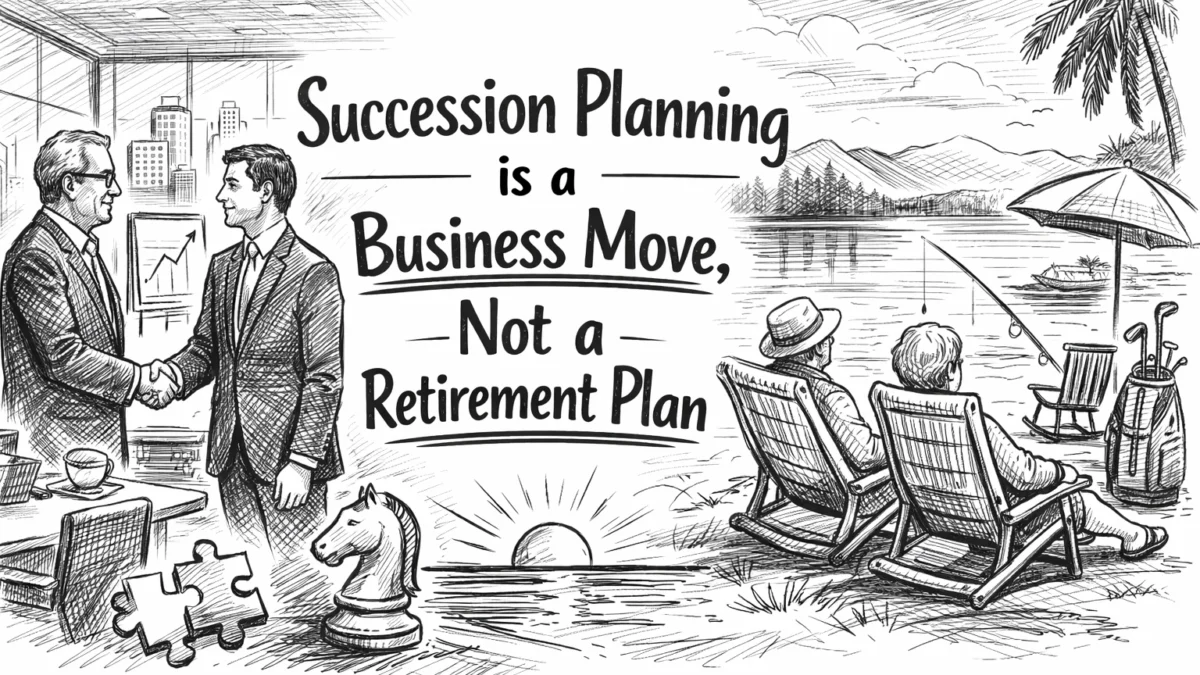
You have been lied to.
Most consultants treat succession planning like a funeral rehearsal. They talk about "gold watches," "legacy," and "passing the torch." They frame it as a task for the tired, the old, and the ready-to-quit.
They are wrong.
Succession planning isn’t a retirement strategy. It is a growth strategy.
If you wait until you want to retire to start planning your succession, you’ve already lost. You’ve left money on the table. You’ve increased your risk. And you’ve likely built a cage, not a company.
It’s time to stop looking at the exit as an end-of-life event for your career. It’s time to see it as the ultimate business move to maximize the value of what you’ve built.
The Retirement Trap
Most owners think succession planning is something they do to themselves. They think it’s about finding a replacement so they can go play golf.
That is "HR thinking." It’s narrow. It’s soft. And it’s dangerous.
When you treat succession as a retirement task, you focus on the person leaving. When you treat it as a business move, you focus on the entity staying.
A business that depends on you is a liability.
If the revenue, the relationships, and the "secret sauce" all live inside your head, your business has a ceiling. That ceiling is your personal bandwidth. You can’t scale a brain. You can only scale systems.
Succession planning is the process of extracting the value from your person and depositing it into the business.

What Breaks if You Disappear?
Let’s get blunt.
What happens to your profit if you don’t show up for thirty days?
Don't give the "polite" answer. Give the honest one.
- Do the sales stop closing?
- Do the key clients call their lawyers?
- Does the staff wander around like lost sheep?
If the answer is "everything breaks," you don't own a business. You own a high-stress job that you can't quit.
Succession planning is the cure for this dependency. It’s about building the owner-optional business.
When you identify successors: not just for the CEO role, but for every critical function: you are performing a stress test. You are finding the single points of failure and fixing them before the market finds them for you.
The Buyer’s Harsh Reality
You might not want to sell today. You might not want to sell for ten years. It doesn't matter.
You should run your business as if it’s for sale every single day.
Why? Because a buyer doesn't want to buy you. They don't want to pay for your charisma or your 80-hour work weeks. They want to buy a machine that produces predictable cash flow without your intervention.
If you are the "key man," you are a risk factor.
A buyer looks at a business dominated by a founder and sees a "Key Man Discount." They shave 20%, 30%, or 50% off the price because the moment you walk out the door, the value walks out with you.
What your business is really worth is directly tied to how well it functions without you.
Succession planning is the process of removing that discount. It is the most aggressive way to increase your multiple.
The Multiplier Effect
Let's look at the math.
Company A: Founder-led. $1M in profit. No clear successor. No systems.
Buyer's View: High risk. Low transferability.
Result: 3x multiple. Value: $3M.
Company B: Succession-ready. $1M in profit. Management team in place. Operations documented.
Buyer's View: Turnkey. Scalable. Low risk.
Result: 5x multiple. Value: $5M.
The work of succession planning just earned Company B an extra $2 million.
That didn't happen because the owner retired. It happened because the owner made a strategic business move to de-risk the asset.

It Isn’t About Who; It’s About How
Succession planning is often stalled because owners can't find the "perfect person."
"I don't have a son or daughter who wants it."
"My managers aren't ready."
Stop looking for a clone of yourself. You won't find one. And frankly, a clone of you would just recreate the same dependencies you already have.
Succession is about building a structure, not finding a savior.
- Identify Critical Roles: Not just yours. Who holds the keys to the kingdom?
- Document the "How": If it’s in a head, it’s a hazard. Get it on paper.
- Delegate the Decision, Not Just the Task: If they have to ask you for permission to spend $500, they aren't succeeding you. They are assisting you.
- Test the Waters: Take a week off. Then two. Then four. Watch what breaks. Fix it. Repeat.
Strategic Growth vs. Operational Stagnation
A business with a clear succession plan is a more aggressive competitor.
When you aren't bogged down in the day-to-day "fires," you can look at the horizon. You can spot opportunities. You can think about acquisitions.
Succession planning gives you back your most valuable asset: Time.
If you are "in the weeds," you are a technician. If you are "above the trees," you are a strategist. You cannot be a strategist if every decision has to cross your desk.
Succession planning is the engine of operational excellence. It forces you to professionalize your management team. It forces you to improve your reporting. It forces you to be better.
Most owners wait too long. They wait until they are burnt out, sick, or bored. By then, they have no leverage.
The Truth about Continuity
Succession planning preserves institutional knowledge.
When a key employee leaves without a successor in place, years of experience vanish. That's a leak in your balance sheet.
By identifying and developing internal talent, you aren't just "planning for the end." You are building a culture of advancement. You are showing your best people that there is a path forward.
Retention is a byproduct of succession planning.
If your top performers feel they are hitting a ceiling because you won't let go of the reins, they will leave. They will take your clients and your secrets with them.
Succession planning keeps the talent in the building. It turns your company into a talent magnet rather than a talent graveyard.

The Bottom Line
Succession planning is not a "nice to have" for the final chapter. It is a fundamental requirement for any serious business owner who wants to build something of lasting value.
It is about Operational Continuity.
It is about Value Protection.
It is about Strategic Growth.
If you treat it like a retirement plan, you will treat it with the urgency of someone looking at a distant horizon. You will procrastinate. You will make excuses.
If you treat it like a business move, you will treat it with the urgency of a closing deal. You will act.
A business that is ready to be handed over tomorrow is a business that is significantly more profitable today.
Stop waiting for the clock to decide your future. Take control of the machine you’ve built.
Your Move
Step 1: Define the "30-Day Ghost" date. Pick a month, six months from now, where you will not answer a single email or phone call.
Step 2: Audit your dependencies. List every task that only you can do. Every relationship only you can manage. Every decision only you can make.
Step 3: Start killing that list. Assign a name to every item. If there isn't a name, find one.
Step 4: Build the systems. Create the playbooks. Stop being the hero and start being the architect.
Succession is not the end. It is the proof that you actually built something that matters.
Build it before the clock decides.