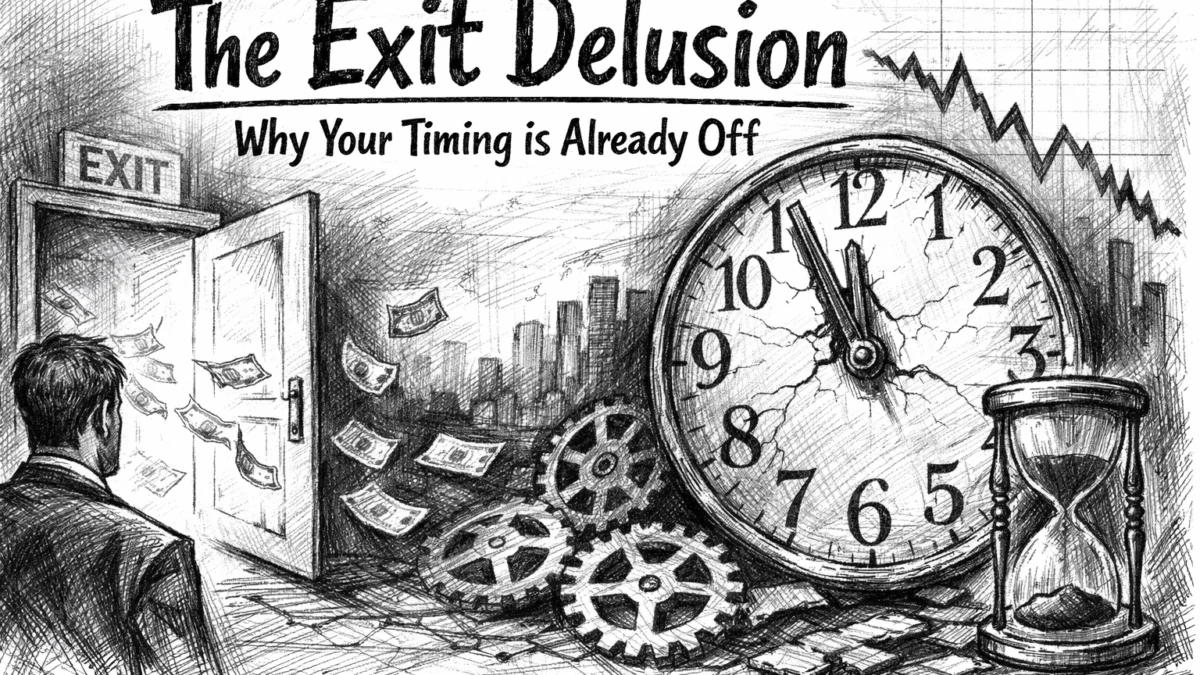
You think you have time. You don’t.
You believe you are in control of the calendar. You aren’t.
Every business owner harbors a quiet, dangerous fantasy: the "perfect exit." You imagine a future where the market is peaking, your profits are at an all-time high, and you are emotionally ready to walk away. You think you’ll see the peak coming. You think you’ll have the clarity to pull the trigger exactly when the numbers look best.
This is the Exit Delusion.
The reality is much colder. The market doesn't care about your retirement party. The economy doesn't consult your spreadsheet before it pivots. If you are waiting for the "perfect" time to plan your exit, you have already missed the window.
Timing isn't something you find. It’s something you build.
The Market is a Thief
Most owners treat their business like a savings account. They think the value is static or perpetually climbing. They assume that as long as they keep working, the value keeps growing.
This is a lie.
External factors, interest rates, industry disruption, geopolitical shifts, can strip 30% of your business value overnight. You didn't do anything wrong, but you waited. You waited for "one more good year."
The "one more year" strategy is a gamble where you bet your entire legacy against a world you cannot control.

When the market shifts, it doesn't give you a head start. It just closes the door. If you haven't already built an owner-optional business, you aren't selling a company. You’re trying to offload a job during a recession.
Guess who wins that negotiation? Not you.
The Myth of "I’ll Know When I’m Ready"
We are terrible at recognizing the present. We are even worse at predicting our own emotions.
You think you’ll recognize the "right" moment because you’ll feel a sense of peace. You won't. You will feel a mix of fear, ego, and exhaustion.
The "Exit Delusion" relies on four psychological traps:
- The Hindsight Bias: You look at other successful exits and think they were obvious. They weren't. Those owners took a risk when things were uncertain.
- The Sunk Cost Lock: You’ve put twenty years into this. You feel the business "owes" you a certain number. The market doesn't owe you anything. What your business is really worth has nothing to do with your sweat equity.
- The Comparison Illusion: You heard a guy at the golf course sold for 8x EBITDA. You don't know his debt, his terms, or his actual numbers. You’re chasing a ghost.
- Moving Target Conditions: You say you’ll sell at $5M in revenue. You hit $5M. Now you want $7M. The goalposts move because you’re afraid of the "what's next."
If you don't pick a finish line, the clock will pick one for you.
The Biological Clock vs. The Economic Clock
There are two clocks running at all times.
The Economic Clock dictates what buyers are willing to pay. The Biological Clock dictates how much energy you have left to fight the battles.
When these two clocks are out of sync, you lose.
If the market is hot but you’re burnt out, you sell for a discount because you lack leverage. If you’re full of energy but the market is cold, you’re trapped in a business you no longer want to run.
True exit planning is the art of aligning these two clocks before they decide for you.

Most owners wait until the Biological Clock hits midnight. They wait until a health scare, a divorce, or a bone-deep burnout forces their hand. That is not an exit. That’s a liquidation.
Exit planning is why most owners wait too long. They mistake "planning" for "leaving."
Preparation is Not an Event
An exit is not a transaction. It is the culmination of a strategy.
If you want to beat the Exit Delusion, you must stop viewing your exit as something that happens "someday." You must view it as the lens through which you make every current decision.
An exit-ready business is simply a better-run business.
- Does the business run without you?
- Are your financials clean and verifiable?
- Is your customer concentration diversified?
- Is your management team incentivized to stay?
If the answer to any of these is "no," your timing is already off. You aren't waiting for the market. You’re waiting for a miracle.
The Cost of Ambivalence
Ambivalence is the most expensive emotion in business.
When you are "thinking about selling" but not "preparing to sell," you enter a state of strategic drift. You stop investing in new equipment. You stop hiring top talent. You stop taking the risks that built the company in the first place.
Your employees smell it. Your customers feel it. Your competitors exploit it.
By trying to time the market perfectly, you are slowly devaluing the very asset you're trying to protect.

The buyers who are actually worth dealing with: the ones who pay a premium: can spot a drifting owner from a mile away. They don't pay for what you did five years ago. They pay for the future you’ve built.
If you are checked out, there is no future to buy.
What an Exit Isn't
To understand the truth, you have to strip away the fluff.
An exit is not a retirement plan.
An exit is not an admission of defeat.
An exit is not a betrayal of your employees.
An exit is a transfer of risk.
When you own 100% of a business, 100% of your wealth is tied to a single, illiquid, high-risk asset. Every day you stay past the point of "readiness" is a day you are doubling down on that risk.
Is the "perfect market" worth the possibility of losing everything you've built?
The Truth About "Perfect"
There is no perfect time.
There is only prepared and unprepared.
The owners who "win" at the exit game aren't the ones who timed the peak of the 2021 bubble. They are the ones who had their books in order, their teams in place, and their personal goals defined three years before they needed to sell.
They didn't wait for the market to give them permission. They created their own window.

If you are reading this and thinking, "I’ll start thinking about this next year," the delusion has you.
The clock is already ticking. The market is already moving. Your competitors are already planning.
You can decide your future now, or you can wait for the clock to decide it for you. The latter option rarely ends with a check you’ll like.
If you want to see the reality of your situation, read the book Before the Clock Decides. It isn't a manual on how to wait. It’s a blueprint on how to act.
Your Move
1. Audit the dependency. If you left for 90 days today, what would the valuation be when you got back? If the answer is "zero," you don't have a business to sell. You have a job you can't quit.
2. Set a floor, not a ceiling. Determine the number that secures your freedom. If the market hits that number, move. Don't let greed talk you into "one more year."
3. Stop watching the news. Start watching your internal systems. You can't control the Federal Reserve. You can control your profit margins and your management structure.
4. Get an objective eyes-on. You are too close to the project to see the flaws. Find a guide who doesn't care about your feelings, but cares about your outcome.
The Exit Delusion ends the moment you stop waiting for "someday" and start building for "any day."
The clock is moving.
Shop the resources to start your transition.