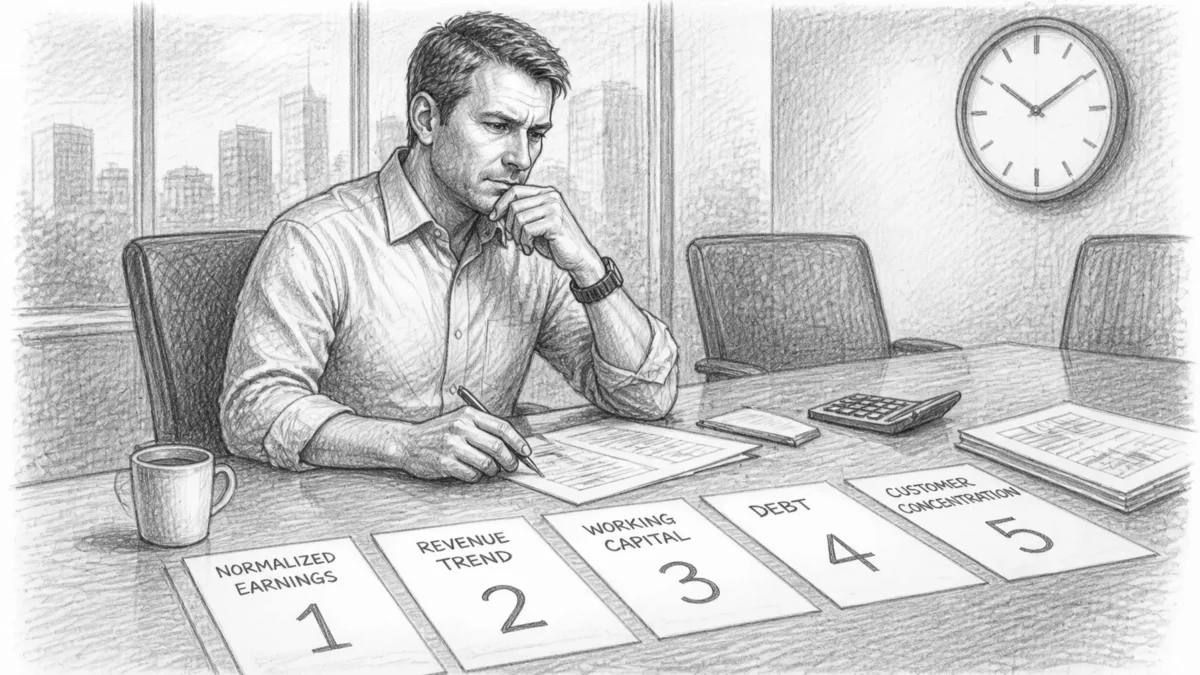
Most owners know their revenue.
They know last year’s sales. They know this month’s sales. They may even know their gross margin.
But when the conversation turns to selling, many owners cannot answer five basic questions:
- What are my normalized earnings?
- How consistent is my revenue?
- How much working capital does the business require?
- What debt and liabilities will reduce my proceeds?
- How dependent is the company on a few customers?
That gap creates a problem.
Owners think in terms of effort, history, and revenue. Buyers calculate risk, cash flow, and transferability.
Those are not the same thing.
If you want to understand how to value a company, start with the five numbers below.
They will not produce a final valuation by themselves.
They will show you how the market is likely to see your business.
The Number in Your Head Is Not the Market Value
Every owner carries a number.
Sometimes it comes from a competitor who sold. Sometimes it comes from an industry article. Sometimes it is based on a simple formula:
“We do $5 million in revenue, so the company must be worth at least $5 million.”
That formula is usually wrong.
Revenue measures activity.
Buyers pay for durable earnings and manageable risk.
A company with $5 million in revenue and $300,000 in normalized earnings may be worth less than a company with $2 million in revenue and $600,000 in reliable earnings.
Why?
Because the second company produces more cash from every dollar of sales.
That is what buyers can use to pay themselves, repay financing, invest in growth, and earn a return.

1. Normalized Earnings: SDE or EBITDA
This is the first number buyers will examine.
Not your revenue.
Not the value of your equipment.
Not how hard you work.
The first question is: how much economic benefit does this business reliably produce?
For a smaller, owner-operated company, that number may be Seller’s Discretionary Earnings, or SDE.
SDE generally includes:
- Net income
- Owner compensation
- Interest
- Taxes
- Depreciation and amortization
- Legitimate personal or discretionary expenses that will not continue under a new owner
For a larger company with a management team, buyers may focus on EBITDA: earnings before interest, taxes, depreciation, and amortization.
The key word is normalized.
Normalized earnings are not whatever number looks best on your tax return or internal spreadsheet.
They are the earnings a buyer can reasonably expect to continue after the transaction.
That means unusual expenses may be adjusted.
One-time legal fees may be removed.
Personal vehicle expenses may be reconsidered.
But weak earnings cannot be disguised as add-backs.
If an owner’s spouse is on payroll but performs real work, that expense may not disappear.
If the owner works sixty hours a week without a replacement, the business may need a management adjustment.
Buyers test the story.
The basic valuation equation
Enterprise value = normalized earnings × valuation multiple
For example:
- $500,000 in normalized EBITDA × 4 = $2 million in enterprise value
- $500,000 in normalized EBITDA × 6 = $3 million in enterprise value
That two-point difference in the multiple creates a $1 million gap.
The earnings stayed the same.
The market’s view of risk changed.
The multiple is not a reward for how long you have owned the company.
It reflects factors such as:
- Earnings consistency
- Owner dependence
- Recurring revenue
- Customer concentration
- Management depth
- Industry risk
- Documentation quality
Research from Rehmann on valuation preparation makes the central point clearly: preparation and positioning influence how buyers understand the business before they decide what it is worth.
2. Revenue Level and Revenue Trend
Revenue still matters.
It shows scale.
It helps buyers understand the company’s market position.
It gives context to the earnings number.
But revenue by itself is a weak measure of value.
The better number is revenue over time.
Look at the last three to five years and ask:
- Is revenue growing?
- Is it flat?
- Is it declining?
- Is the growth concentrated in one customer?
- Is the growth profitable?
- Is it recurring or dependent on constant new sales?
A business with $3 million in revenue that has grown steadily for five years tells a different story from a business that reached $3 million through one unusually large contract.
The totals match.
The risk does not.
Buyers pay more confidently for revenue they believe will still exist after closing.
That means quality matters.
Recurring contracts, repeat customers, subscription income, and strong renewal rates can support a better valuation conversation.
Project-based revenue may still be valuable, but it requires more proof.
If every year begins at zero, then the buyer is not only buying your current earnings.
They are buying the risk of rebuilding those earnings.
That usually affects the multiple.
A useful comparison:
- 80% recurring revenue with steady renewals creates visibility
- 80% one-time project revenue creates uncertainty
- Uncertainty leads to more questions
- More questions often lead to lower price, tighter terms, or both
Do not just know your revenue.
Know its direction, durability, and source.
3. Working Capital and Cash Requirements
This is the number many owners overlook until it becomes a negotiation problem.
Working capital is the cash tied up in the normal operation of the company.
It often includes:
- Accounts receivable
- Inventory
- Accounts payable
- Other short-term operating assets and liabilities
A business can report strong earnings and still consume cash.
If customers take ninety days to pay, but employees and suppliers must be paid every two weeks, the company needs cash to bridge that gap.
If inventory keeps growing faster than sales, money is sitting on shelves instead of in the bank.
If the business requires $400,000 in working capital to operate normally, that requirement affects what the buyer must fund after closing.
Many transactions include a “normal working capital” target.
If the business is delivered below that target, the purchase price may be reduced.
The exact treatment depends on the deal structure and purchase agreement, but the principle is straightforward:
A buyer expects to receive a business that can operate normally on day one.
If the business cannot do that without an extra cash injection, the buyer will notice.
Track these numbers before a sale:
- Average collection period
- Inventory turnover
- Accounts payable timing
- Seasonal cash needs
- Minimum cash required to operate
- Working capital as a percentage of revenue
If receivables rise while revenue stays flat, then cash conversion is getting worse.
If inventory rises faster than revenue, then more of your value is trapped in operations.
Profit on paper is not the same as cash in hand.
Buyers know the difference.
For more detail on the financial information buyers examine during a sale process, review this sell-side due diligence checklist from Valutico.
4. Debt and Liabilities
A business can sell for a strong headline price and still leave the owner with disappointing proceeds.
The reason is simple.
Enterprise value is not the same as the money you take home.
Start with the enterprise value.
Then account for:
- Bank loans
- Equipment financing
- Lines of credit
- Vehicle leases
- Seller obligations
- Unpaid taxes
- Legal claims
- Deferred maintenance
- Contract liabilities
- Other debts or commitments that transfer or affect the deal
A rough framework looks like this:
Estimated equity value = enterprise value − debt + excess cash ± working capital adjustment
Transaction expenses and taxes can reduce the final amount further.
Example:
- Enterprise value: $3 million
- Debt: $700,000
- Working capital adjustment: minus $100,000
- Transaction costs and taxes: additional deductions
The owner does not receive $3 million.
The headline number is not the personal outcome.
This is why business valuation for sale should include more than an attractive multiple.
You need to understand what the valuation means for your actual financial future.
If you do not know your total debt and liabilities, then you do not know what you are selling.
You only know the number someone may put in a presentation.
5. Customer Concentration
A buyer is not only buying customers.
A buyer is buying the likelihood that those customers will stay.
Customer concentration measures how much of your revenue depends on a small number of accounts.
Calculate it this way:
Customer concentration = revenue from a customer or customer group ÷ total revenue
Suppose one customer produces $1 million of your $4 million in annual revenue.
That customer represents 25% of total revenue.
The business may be profitable.
The customer may be loyal.
The relationship may be excellent.
But the buyer still sees exposure.
What happens if that customer changes suppliers?
What happens if its own business is sold?
What happens if your personal relationship is the reason the account stays?
A common rule of thumb is that a customer representing more than 20% of revenue creates significant risk.
It is not an automatic deal breaker.
It is a pricing issue and a diligence issue.
A buyer may respond with:
- A lower valuation multiple
- An earnout
- A holdback
- Customer retention conditions
- A request for longer transition support
- No offer at all
The same applies to your top five customers.
If they represent 60% of revenue, then your customer base may be less diversified than your sales report suggests.
Concentration is not just a sales number. It is a transferability number.
You can reduce the risk over time by:
- Expanding into new customer segments.
- Documenting account relationships.
- Building a sales process that others can run.
- Reducing personal dependence on key accounts.
- Creating contracts or renewal systems where appropriate.
You may not be able to eliminate concentration.
You can prove that the risk is understood and managed.
These Five Numbers Work Together
Do not review these numbers in isolation.
They interact.
A business with strong earnings but one dominant customer may receive a lower multiple.
A business with growing revenue but poor cash collection may require a working capital adjustment.
A business with excellent revenue and earnings but heavy debt may produce less cash for the owner.
A business with moderate earnings, clean books, diversified customers, and low owner dependence may attract stronger buyer interest.
That is the market’s calculation.
Not sentiment.
Not pride.
Not the number you need to fund retirement.
The market values what can be transferred, defended, and repeated.
One owner I have seen treated the company as an extension of himself.
Every major customer called him.
Every important decision ran through him.
He believed that personal involvement proved the business was valuable.
In reality, it made the business harder to sell.
Once he documented processes, developed managers, and moved relationships into the company rather than keeping them in his phone, the business changed.
He stopped being the bottleneck.
He became the builder of an asset.
That work takes time.
It cannot be completed honestly in the final month before a listing.
Your Move
Do not wait until you are ready to sell.
Build a one-page scorecard with these five numbers:
- Normalized SDE or EBITDA
- Revenue level and three-to-five-year trend
- Working capital requirement and cash cycle
- Total debt and liabilities
- Customer concentration percentage
Then ask the harder questions:
- What breaks if I disappear for ninety days?
- Which number would make a buyer hesitate?
- Which risk would reduce my multiple?
- What would improve if I had three years to fix it?
- What will I personally receive after debt, costs, taxes, and adjustments?
If the answers are unclear, you are not behind.
But you are not ready either.
Start with clarity.
Read Before the Clock Decides, or schedule a confidential conversation with Mike Steward about understanding your company’s value before time forces the decision.
Your future options are shaped by the numbers you understand early( not the numbers you discover under pressure.)