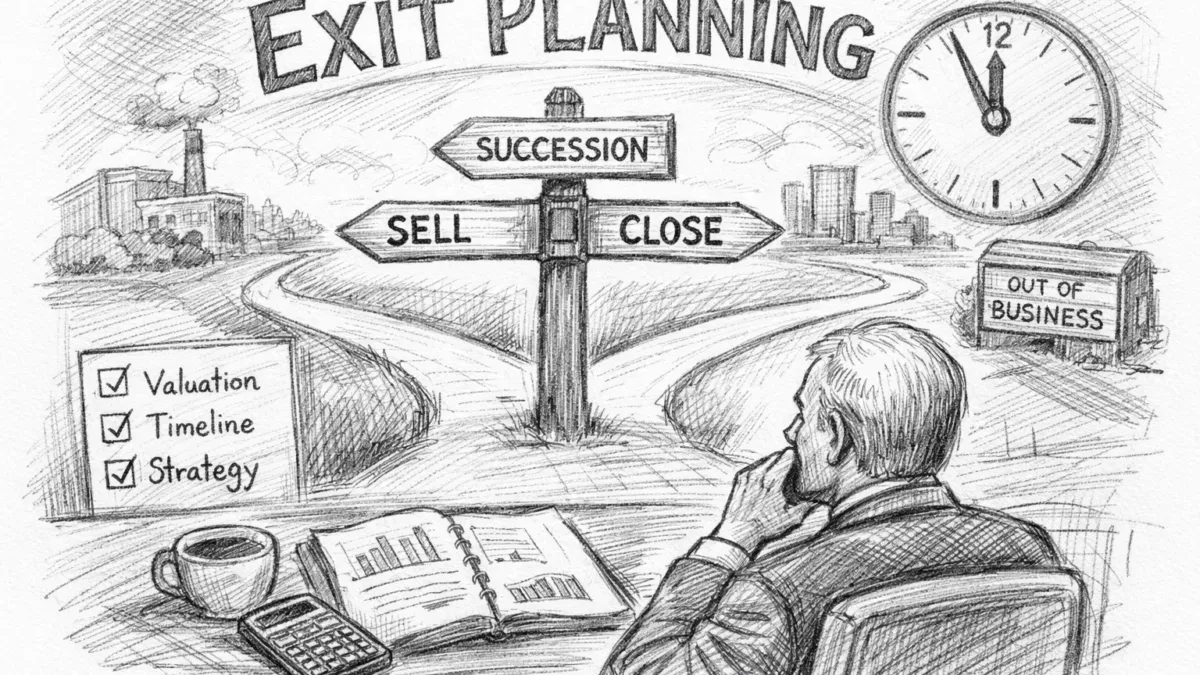
You say you have an exit strategy.
Usually, you mean this:
“Someday, I’ll sell.”
That is not an exit strategy.
That is a hope with a calendar attached to it.
You built the company. You carried the risk. You survived the slow years, the bad hires, the difficult customers, and the cash-flow crunches.
But none of that guarantees a clean exit.
The market does not reward effort. Buyers reward transferable value, predictable earnings, and reduced risk.
Those are not the same thing.
The Plan You Think You Have
Most owners believe they have a plan because they have answered one broad question:
- “What do you want to do eventually?”
The answer might be:
- Sell to a third party.
- Transfer the company to a child.
- Let a key employee take over.
- Keep operating until retirement.
- Close the doors when the time comes.
These are possible outcomes.
They are not strategies.
A real small business exit strategy answers harder questions:
- When do you want to leave?
- How much money do you need from the business?
- Who could take over?
- What would a buyer see as a risk?
- What must change before you can leave on your terms?
- What happens if your preferred option fails?
If those questions are unanswered, you do not have a plan.
You have a preferred fantasy.
The Tomorrow Test
Here is the test most owners avoid.
What would happen if you had to leave the business tomorrow?
Not in five years.
Not after one more strong season.
Tomorrow.
Could your team operate without you?
Could someone else explain the company’s financial position?
Could customers be reassured?
Could employees make decisions without waiting for your approval?
Could the business continue producing profit?
If the answer is no, then your company is not an asset you own.
It is a job you cannot leave.
That distinction matters because buyers see owner dependence as risk. If customers rely on your personal relationships, if key processes exist only in your head, or if every important decision runs through your desk, the business becomes harder to transfer.
If the business weakens when you step away, then your exit options shrink when you need them most.

What an Exit Strategy Actually Includes
An exit strategy is not a document you create once and place in a drawer.
It is a set of decisions tied to action.
At a minimum, it should include five parts.
1. Your Exit Options
You need to understand the realistic paths:
- Sale to an outside buyer.
- Sale to a competitor.
- Management buyout.
- Family succession.
- Employee ownership.
- Orderly closure.
Each path has different demands.
A family transfer may preserve a legacy but create tax, financing, and relationship problems.
A third-party sale may create more cash but require stronger financial records and less owner dependency.
Closing may be the right answer for a business with limited transferable value, but waiting until the last minute can turn an orderly wind-down into a distressed shutdown.
You do not need to choose today.
You do need to know what each option requires.
2. A Timeline
“Someday” is not a timeline.
A timeline might look like this:
- Year 1: establish value and identify risk.
- Year 2: strengthen leadership and document systems.
- Year 3: improve earnings quality and prepare for a transition.
- Year 4: select an exit path and begin execution.
The exact schedule will vary.
The principle does not.
If your exit requires changes that take three years, starting three months before you leave is not a strategy.
It is a crisis.
3. A Value Target
You cannot plan your exit without knowing what the business may be worth.
You also need to know what you personally need.
Those are separate numbers.
Your business may be worth $2 million.
Your post-exit life may require $3 million.
That gap does not disappear because you feel optimistic.
Business value depends on more than revenue. Buyers look at earnings, customer concentration, recurring revenue, systems, leadership, and the company’s ability to perform after the owner leaves.
As explained in What Your Business Is Really Worth: and Why Most Owners Get It Wrong, value is math plus confidence.
If buyers lack confidence, the price falls.
4. A Transferable Company
A buyer does not want to purchase your personal workload.
They want to purchase an operating company.
That means you must build:
- Documented processes.
- Reliable financial reporting.
- A capable leadership team.
- Customer relationships distributed across the business.
- Clear decision authority.
- Consistent performance without constant owner intervention.
This work improves the business whether you sell or not.
It also gives you something valuable before the sale: freedom.
5. A Backup Plan
Hope depends on one outcome.
A strategy prepares for several.
What if your child does not want the business?
What if your key employee cannot finance the purchase?
What if the market turns?
What if you become unavailable before your preferred timeline?
What if the buyer wants a structure different from the one you imagined?
A serious plan includes “if/then” decisions:
- If the family successor is not ready by a certain date, then begin exploring outside buyers.
- If the business cannot support your target exit value, then delay the transition and improve the value drivers.
- If you cannot reduce owner dependence, then expect a lower price or a longer handoff.
That is planning.
The Cost of Pretending
Owners delay because planning feels like admitting the business will one day exist without them.
That is emotionally difficult.
It is also unavoidable.
Every business eventually exits through sale, succession, or closure. The question is not whether the transition will happen.
The question is whether you will shape it.
Waiting creates costs:
- Less negotiating power.
- Fewer qualified buyers.
- More pressure on your family.
- Greater exposure to health and market events.
- Less time to improve value.
- A higher chance of accepting the first available offer.
Read Exit Planning Starts Earlier Than You Think for a deeper look at why prepared waiting is different from passive waiting.

From Bottleneck to Builder
I once worked with an owner who believed his company was ready to sell because revenue had climbed steadily for years.
Then he tested a simple question:
“What happens if I am gone for 60 days?”
The answer was uncomfortable.
Sales slowed.
Employees waited for approvals.
Two major customers called him directly.
No one knew where several critical procedures were documented because they were not documented anywhere.
The company was profitable.
It was also fragile.
He did not put the business on the market. He did something more important first.
He built leadership depth, transferred customer relationships, documented operating procedures, and clarified who could make which decisions.
He moved from bottleneck to builder.
The business became stronger.
His options expanded.
That is what an exit strategy should do.
Your 90-Day Starting Point
You do not need to solve your entire exit this quarter.
You need to stop pretending that intention equals preparation.
Over the next 90 days:
- Write down your preferred exit date.
- Estimate the personal wealth you need from the business.
- Get an honest view of current business value.
- List the five things that break when you are absent.
- Assign one person to own each improvement.
- Schedule a quarterly review of your exit readiness.
Start with facts.
Not feelings.
Your business deserves more than a vague promise that you will “figure it out later.”
A hope waits for the future to cooperate. An exit strategy prepares for the future to change.
Your Move
Write this sentence today:
“If I had to leave my business tomorrow, the first three things that would break are…”
Those three items are not just weaknesses.
They are your starting roadmap.
If you want to understand how business value and transferability shape your options, explore Vision Fox Business Advisors. The sooner you know where you stand, the more choices you keep.
Your Business Is Not Ready to Sell If You Are Still the Business
You may call it leadership.
A buyer may call it owner dependence.
You may call yourself indispensable.
A buyer may hear, “This company could collapse when the owner leaves.”
That is the gap between how owners see their businesses and how buyers see them.
Owners see the years of effort.
Buyers see risk.
Owners see relationships.
Buyers ask whether those relationships belong to the company or to one person.
Owners see a loyal team.
Buyers ask who can actually run the operation after closing.
If the business cannot function without you, then you are not selling a business. You are selling a business plus a problem.
The Owner-Dependency Trap
Owner dependency develops gradually.
You make one decision because it is faster.
You handle one customer because the relationship matters.
You approve one expense because no one else knows the full picture.
You solve one operational issue because training someone takes too long.
Repeat that behavior for ten years.
Now everything important flows through you.
You become:
- The chief salesperson.
- The final approver.
- The keeper of customer history.
- The person who knows every workaround.
- The only person who understands the financial story.
- The emergency response system.
That may help the business survive.
It does not help the business transfer.
A company that depends on the owner has concentrated risk. Concentrated risk reduces buyer confidence. Lower confidence affects price, deal terms, and the buyer’s willingness to proceed.
The Difference Between Owner-Led and Owner-Trapped
An owner-led business has a strong leader at the top.
An owner-trapped business has no reliable second layer.
Those are not the same.
An owner-led company can continue when the owner takes a vacation.
An owner-trapped company starts calling the owner from the airport.
An owner-led company uses the founder’s experience strategically.
An owner-trapped company uses the founder as a substitute for systems.
The goal is not to remove yourself from the company overnight.
The goal is to make your presence valuable instead of mandatory.
That is the path toward an owner-optional business. The company still benefits from your judgment, but it no longer depends on your constant intervention.
Read Build a Business That Runs Without You for a practical look at this transition.
The Four Signs You Are Still the Business
1. Every Important Decision Comes to You
If employees cannot act without your approval, the company has a decision bottleneck.
Ask:
- What decisions can managers make without you?
- What spending limits do they have?
- Who handles customer complaints?
- Who approves hiring?
- Who makes pricing decisions?
If the answer to every question is “me,” you have work to do.
2. Customers Know You Better Than the Company
Personal relationships matter.
But if customers believe they are buying from you rather than from the company, the relationship may leave with you.
Introduce key customers to your leadership team.
Share responsibility.
Move important conversations into company systems rather than private text messages and personal phone calls.
The customer should trust the company, not only the founder.
3. Critical Knowledge Lives in Your Head
You know how to handle the difficult supplier.
You know which employee can solve a certain problem.
You know why the pricing model works the way it does.
You know which customer pays late but remains profitable.
That knowledge has value only when the company can use it without requiring your memory.
Write it down.
Train someone else.
Test whether they can execute it.
A process is not documented because a file exists in a folder. It is documented when another capable person can follow it and get the expected result.
4. Performance Drops When You Step Away
Take a real absence.
Not a long weekend.
Try two weeks.
Then measure what changed:
- Revenue.
- Customer response time.
- Employee decisions.
- Production or delivery.
- Cash collection.
- Problems escalated to you.
The results will show you where the business remains dependent.

What Buyers Actually Want
Buyers do not expect a company to have no owner involvement.
They expect to understand what happens after the owner leaves.
They want evidence that:
- Revenue will continue.
- Customers will stay.
- Employees know their roles.
- Managers can make decisions.
- Financial reports are accurate.
- Operations are repeatable.
- The owner’s departure will not create immediate damage.
This is why transferability matters.
A buyer may pay more for a smaller business with dependable systems than for a larger company held together by one person.
Revenue shows size. Transferability shows durability.
The Math of Dependence
Suppose your company produces $500,000 in annual earnings.
That sounds strong.
Now suppose 60 percent of sales come from relationships you personally manage. The leadership team has limited authority. Two major processes are undocumented. Employees expect you to resolve every major issue.
The earnings are real.
The risk is also real.
If a buyer believes earnings could fall by 20 percent after you leave, the buyer is not valuing the current company as if nothing will change.
The buyer is pricing the future risk.
A 20 percent decline on $500,000 is $100,000 of annual earnings at risk. Apply a valuation multiple to that lost confidence, and the cost becomes much larger than $100,000.
That is how owner dependence becomes a personal financial problem.
Moving From Bottleneck to Builder
Start with one area where you are still the only answer.
Then follow this sequence:
- Explain the decision or process.
- Document the steps.
- Assign responsibility to another person.
- Let that person perform the work.
- Review the result.
- Improve the system.
- Stop taking the work back.
The last step is where owners fail.
They delegate, see an imperfect result, and reclaim control.
That teaches the team a damaging lesson: “You may own the task, but the owner still owns the decision.”
Give people authority that matches responsibility.
Otherwise, you have created delegation theater.
Your Move
Choose one responsibility you currently handle that someone else should own.
Write down:
- The desired result.
- The decisions involved.
- The boundaries.
- The metrics.
- The person responsible.
- The date you will stop being the default answer.
A strong small business exit strategy does not begin with a buyer.
It begins with a company that can stand on its own.
If You Had to Leave Tomorrow, What Would Break First?
Most owners answer this question emotionally.
They say:
“Everything would fall apart.”
That may be true.
It may also be an exaggeration built from habit.
The only way to know is to test the business.
A business owner’s absence is a diagnostic tool.
It shows you what is truly systemized, what is merely familiar, and what depends on your personal memory.
The Tomorrow Test Is Not a Disaster Exercise
This is not about expecting the worst.
It is about removing your assumptions.
You are not asking whether your employees are loyal.
You are asking whether the business has enough structure to function.
You are not asking whether your team works hard.
You are asking whether authority, information, and responsibility are distributed.
You are not asking whether customers like you.
You are asking whether they trust the company.
Those questions produce useful answers.
Run the Test in Five Areas
1. Customers
If you disappeared tomorrow:
- Who would contact your top customers?
- Who would answer pricing questions?
- Who would handle a complaint?
- Who knows the history of each account?
- Who can make a retention decision?
Make a list of your ten most important customers.
Next to each name, identify the person inside the business who owns that relationship besides you.
If the list is blank, you have a concentration problem.
2. Cash
Could someone else understand the company’s cash position?
They should know:
- Which bills are due.
- Which customers owe money.
- Which payments are scheduled.
- What payroll requires.
- Which expenses cannot wait.
- What the next 30 days look like.
A business can be profitable and still fail because no one is watching cash.
If you are the only person who understands the cash cycle, your absence creates immediate risk.
3. Operations
Could the company deliver its product or service without your instructions?
Look at the core workflow.
What happens from:
- New order or customer request.
- Scheduling.
- Production or fulfillment.
- Quality control.
- Delivery.
- Invoicing.
- Follow-up.
If the process depends on “ask the owner,” it is not a process.
It is a dependency.
4. People
Who leads if you are not there?
Not who has the longest tenure.
Not who you personally like most.
Who can make decisions, resolve conflict, protect standards, and keep work moving?
A title does not create leadership.
Repeated responsibility does.
Give potential leaders real authority before you need them to carry the company.
5. Decisions
What decisions stop when you are unavailable?
Track them for one week.
Every time someone says:
- “I need to ask the owner.”
- “The owner usually handles that.”
- “I’m not sure what we are allowed to do.”
- “We have to wait until the owner decides.”
Write it down.
That list is your owner-dependency report.
The Difference Between a Weakness and a Threat
Not every dependency deserves the same response.
Some are minor.
Some can damage value.
Prioritize the dependencies that affect:
- Revenue.
- Customer retention.
- Cash flow.
- Legal compliance.
- Employee stability.
- Core delivery.
- Financial reporting.
A missing procedure for ordering office supplies is irritating.
A missing procedure for billing, payroll, or customer delivery is dangerous.
If a dependency affects earnings, it affects value.
A Short Story About the 60-Day Test
One owner believed his company was ready for him to step away because his managers had been with him for years.
He took a planned absence.
Within three weeks, three problems appeared:
- A manager delayed a major customer decision.
- An employee used an outdated process.
- A key supplier bypassed the team and called the owner directly.
None of these problems were catastrophic.
Together, they exposed the truth.
The company had loyal people but weak decision systems.
The owner did not respond by criticizing the team. He built a decision map, updated the operating procedures, and moved key relationships into the company.
Six months later, he could leave for two weeks without becoming the emergency department.
That was progress.
Not because the company became perfect.
Because the company became less dependent.
Build the Absence Plan
Create a simple document with these headings:
- Who handles customers?
- Who approves spending?
- Who manages employees?
- Who reviews cash?
- Who handles emergencies?
- Who has authority to contact vendors?
- Who reports performance?
- Who can make decisions above normal limits?
Then test it.
Give the team a scenario:
“The owner is unavailable for 30 days. A major customer threatens to leave. Cash is tight. A key employee resigns. What happens next?”
Listen carefully.
Do not rescue them during the exercise.
Your goal is not to prove they can answer every question immediately. Your goal is to see where your business needs clearer systems and authority.
Why This Builds a Better Exit Strategy
The tomorrow test does more than prepare you for illness or sudden departure.
It improves your options.
A buyer wants to know whether the company can continue after the transaction.
A successor needs to know whether the company can be managed without constant founder intervention.
Your family needs to know whether the business can survive a sudden change.
You need to know whether you own an asset or merely occupy a demanding role.
The answers are connected.
Your Move
Run a one-day version of the tomorrow test this week.
Do not answer routine questions.
Do not approve ordinary decisions.
Let your team operate within clear boundaries.
At the end of the day, record what stopped, what slowed, and what moved forward.
Those results are more useful than another vague promise to “work on the business.”
Your exit strategy starts where your dependence ends.
Business Value Does Not Rise Because You Worked Harder
You may have worked eighty-hour weeks.
You may have built the company from nothing.
You may have sacrificed family time, borrowed money, and personally guaranteed obligations.
That effort matters.
But buyers do not price effort.
They price the business they believe they are buying.
Your sweat equity is not the same as transferable value.
That is a hard truth.
It is also useful.
The Number in Your Head Is Not a Valuation
Most owners carry an estimate.
It may come from:
- A competitor’s sale.
- An industry multiple.
- A friend’s opinion.
- Revenue multiplied by a number.
- A retirement target.
- The amount of money they need.
None of those automatically equals market value.
Value is not what you hope to receive.
It is not what you invested.
It is not what the business would be worth if everything went perfectly.
Value reflects the buyer’s belief in future performance and the risks that could interrupt it.
As discussed in What Your Business Is Really Worth: and Why Most Owners Get It Wrong, buyers focus on earnings, transferability, and confidence.
Those three factors shape the conversation.
Revenue Is Not the Finish Line
Revenue can create the appearance of strength.
It can also hide weakness.
Consider two companies:
- Company A produces $3 million in revenue and $200,000 in earnings.
- Company B produces $1.6 million in revenue and $400,000 in earnings.
Company A is larger by revenue.
Company B produces more earnings.
Buyers care about the cash the business can generate and the confidence that cash will continue.
Revenue matters.
It is not enough.
A growing top line with poor margins, customer concentration, weak systems, or owner dependence may create less value than a smaller company with reliable profit and clean operations.
Five Value Questions Buyers Ask
1. Can I Trust the Financials?
If the books are confusing, inconsistent, or loaded with personal expenses, buyers must spend more time proving what is real.
More uncertainty usually means more negotiation.
Clean records do not guarantee a premium.
Poor records make a discount easier to justify.
2. Will Customers Stay?
A customer list is not valuable simply because it is large.
Buyers want to know:
- How long customers stay.
- How often they return.
- Whether revenue is recurring.
- Whether one customer dominates sales.
- Whether relationships depend on the owner.
A business with diversified, loyal customers gives buyers more confidence than one dependent on a few accounts.
3. Can the Team Run the Company?
The buyer is not just purchasing current earnings.
The buyer is purchasing the right to earn future profits.
If employees cannot operate without the owner, future earnings look less certain.
That lowers confidence.
4. Are Operations Repeatable?
Can the company deliver consistent results without improvisation?
Documented systems reduce the chance that performance disappears during transition.
A process hidden in the owner’s memory is not an asset.
It is a risk.
5. What Happens After the Owner Leaves?
The buyer will ask this directly or indirectly.
If the answer is unclear, the owner may be asked to stay longer, accept a lower price, or finance more of the deal.
If the buyer needs you to protect the value after closing, you have not fully transferred the value before closing.
The Multiple Is Not Magic
Owners often ask, “What multiple will I get?”
That question is incomplete.
A business with $400,000 in earnings might produce very different outcomes depending on:
- Industry.
- Growth.
- Customer concentration.
- Recurring revenue.
- Management depth.
- Financial quality.
- Owner dependency.
- Competitive position.
- Deal structure.
The same earnings can lead to different prices because the same earnings can carry different levels of risk.
Think of it simply:
Value = earnings × confidence.
Improve earnings while reducing confidence, and value may not rise.
Maintain earnings while increasing confidence, and value may improve.
Improve both, and your options become stronger.
Start With a Value Gap Review
You do not need to guess your weaknesses.
Review these areas:
- Financial reporting.
- Profit margins.
- Customer concentration.
- Supplier concentration.
- Owner responsibilities.
- Leadership depth.
- Process documentation.
- Legal and contractual obligations.
- Recurring or repeat revenue.
- Employee retention.
For each category, rate the business:
- Strong.
- Adequate.
- Weak.
- Unknown.
“Unknown” is not neutral.
Unknown means you do not yet know what a buyer may discover.
That uncertainty deserves attention.
A Better Use of the Next Three Years
If you have three to five years before your intended exit, use that time deliberately.
Year one can focus on visibility:
- Establish current value.
- Clean up records.
- Identify dependencies.
- Define personal financial needs.
Year two can focus on transferability:
- Develop leaders.
- Document systems.
- Move relationships into the company.
- Improve decision authority.
Year three can focus on readiness:
- Test owner absence.
- Review potential buyers or successors.
- Resolve loose ends.
- Align legal, tax, and financial advice.
This is not a rigid formula.
It is a way to stop wasting runway.
Your Move
Stop asking, “What is my business worth?”
Ask three better questions:
- What would a buyer trust immediately?
- What would a buyer question?
- What would a buyer discount?
Then act on the third answer.
To explore the broader role of timing, read The Most Expensive Mistake Business Owners Make: Waiting Too Long.
Your business value is not a reward for your past.
It is a judgment about the future.
The Succession Plan in Your Head Is Not a Succession Plan
You say your daughter may take over.
Your operations manager could probably buy it.
Your partner knows how everything works.
Your employees would figure it out.
That is not succession planning.
That is speculation.
A successor is not a plan until the person, path, price, timing, and responsibilities are clear.
Family businesses are especially vulnerable to vague assumptions because owners confuse love with readiness.
They are not the same.
The Family Will Not “Just Know”
Your family may understand what the business means to you.
They may not understand:
- How the company makes money.
- What it owes.
- What it is worth.
- What role they would hold.
- How ownership would transfer.
- Whether they can afford it.
- How siblings or other stakeholders would be treated.
Silence does not preserve harmony.
Silence delays conflict until the stakes are higher.
A family succession plan must address business facts and family emotions. Ignoring either side creates trouble.
Read Selling a Family Business vs. Succession Planning: Which Is Better for Your Legacy? for a closer look at the difference between preserving a family connection and forcing a family transfer.
The Five Questions Every Successor Must Answer
1. Do You Actually Want This?
Not “Would you help?”
Not “Could you imagine running it?”
Do you want the responsibility?
Owning a company means making decisions when the answer is unclear. It means managing people, cash, customers, risk, and family expectations.
Interest is not commitment.
2. Can You Operate It?
A successor needs more than loyalty.
They need competence.
That does not mean they must know everything today. It means they must show the capacity to learn, lead, and make decisions without using the founder as permanent backup.
Give them responsibility now.
Watch what happens.
3. Can the Business Support the Transfer?
A succession may involve financing, seller payments, ownership gifts, or a combination.
The company must produce enough cash to support the transition without damaging operations.
If the successor cannot finance the purchase and the business cannot support seller financing, the plan may not work as imagined.
Hope does not solve a funding gap.
4. Will Other People Accept the Transition?
Employees, customers, suppliers, and lenders all care about continuity.
A successor may be fully capable but still lack credibility with the people who keep the company running.
Build that credibility before the handoff.
5. What Happens If It Fails?
This question is often avoided because it sounds negative.
It is not negative.
It is responsible.
If the successor leaves, falls short, or changes direction, what is the next option?
- Outside sale?
- Management transition?
- New leadership hire?
- Wind-down?
A plan without a backup is a preference.
The Dangerous Assumption of “Equal” Treatment
Family succession often becomes complicated when owners try to divide the business equally among children who have different roles.
Equal ownership may not mean equal contribution.
Equal financial outcomes may require different assets.
One child may receive operating control. Another may receive cash, real estate, or other investments.
These decisions require professional legal, tax, and financial advice.
The important point is simple:
Fairness and sameness are not identical.
Pretending they are can damage both the business and the family.
Train Before You Transfer
The worst succession handoff happens when the owner announces a successor near the end and expects everyone to adjust immediately.
The better approach is gradual.
Let the successor:
- Lead a department.
- Manage a budget.
- Handle key customer relationships.
- Participate in financial reviews.
- Make decisions with real consequences.
- Report results to someone besides the founder.
- Take increasing responsibility for company performance.
This creates evidence.
Evidence is stronger than optimism.
If the successor cannot operate with growing responsibility before the owner leaves, there is no reason to assume the person will suddenly perform after the transition.
The Emotional Reality
Owners often say they want a family succession because they want to protect the legacy.
That desire is understandable.
But a business is not a family heirloom that can be passed down without preparation.
It is a living operation.
It must serve customers, pay employees, generate cash, and compete.
Legacy is not protected by handing over a title.
Legacy is protected by building a company strong enough to survive the handoff.
Use If/Then Logic
Write the plan in plain language:
- If the successor meets agreed performance goals for two consecutive years, then increase their operating authority.
- If the successor does not want ownership, then begin exploring a sale or management transition.
- If financing is not available by the target date, then adjust the timeline or exit route.
- If the business cannot support the transfer, then improve value before transferring ownership.
- If family conflict threatens operations, then use an outside advisor to keep the process disciplined.
This is not cold.
It is clear.
Clarity gives people a chance to respond before the situation becomes urgent.
Your Move
Have the first direct conversation.
Ask the potential successor:
“Do you want to own this business, and what would you need to become ready?”
Do not defend.
Do not persuade.
Listen.
Then write down what must be true before the transition can work.
That list is the beginning of a real succession strategy.
Waiting for the Right Time Is How Owners Lose Options
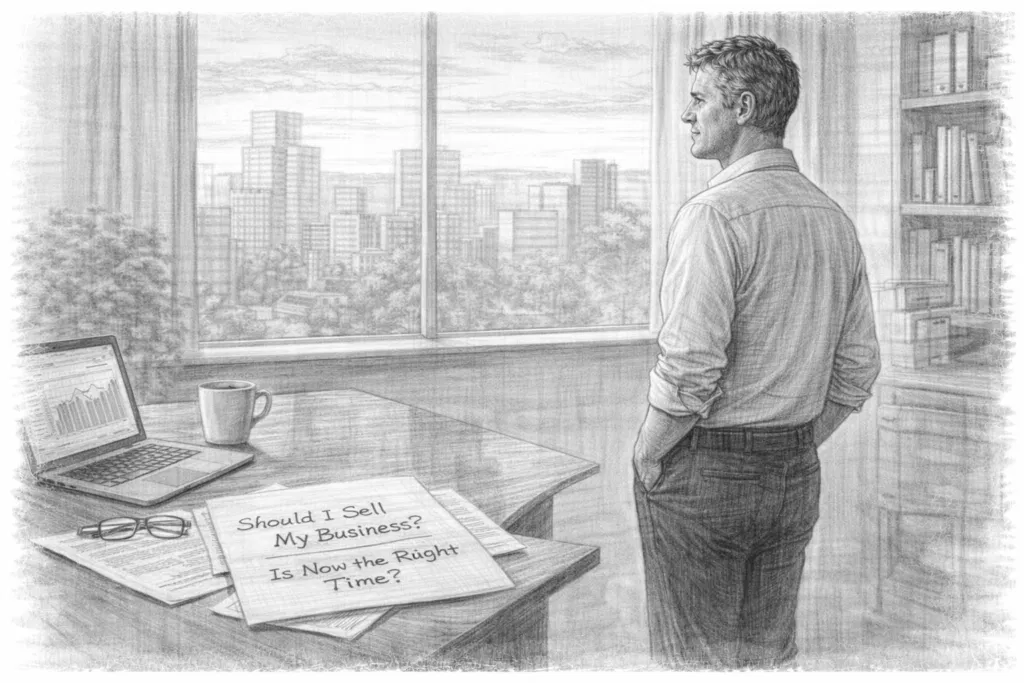
You are waiting for the right time to plan your exit.
You want stronger earnings.
A better market.
Less stress.
More clarity.
One more good year.
That sounds reasonable.
It is also how many owners reach the point where planning becomes emergency response.
There is no perfect time to prepare. There is only a better time than later.
Why Waiting Feels Safe
Waiting avoids discomfort.
You do not have to confront:
- What the business is worth.
- Whether you can afford to leave.
- Who could replace you.
- Whether your family wants the company.
- What buyers may criticize.
- What life looks like after ownership.
As long as you do not ask, you can continue believing the answer will improve automatically.
But the business does not become more transferable because you avoided the question.
Passive Waiting vs. Prepared Waiting
Waiting itself is not always the problem.
An owner may reasonably decide not to sell for several years.
The problem is waiting without preparation.
Prepared waiting means:
- Reviewing business value annually.
- Tracking key risks.
- Building leadership depth.
- Improving financial reporting.
- Reducing customer concentration.
- Documenting important systems.
- Defining conditions that would change the plan.
Passive waiting means:
- “We will figure it out.”
- “My son will probably take over.”
- “A buyer will show up.”
- “The business is growing, so value must be rising.”
- “I will start when I am ready.”
Only one kind of waiting preserves options.
Time Is a Business Asset
Time allows improvement to compound.
Suppose you want to reduce your personal involvement.
That may require hiring leaders, training them, transferring relationships, and letting them make mistakes.
That cannot be compressed easily.
Suppose you want cleaner financial records.
You may need several reporting periods to establish a trustworthy pattern.
Suppose you need to diversify customers.
That may require changing sales strategy over multiple years.
Suppose your successor needs credibility.
They must earn it through repeated performance.
If the change affects trust, leadership, or customer behavior, then time is part of the work.
What Waiting Can Cost
Waiting can create a chain reaction:
- You delay planning.
- A key employee leaves.
- You take on more responsibility.
- Burnout increases.
- Performance weakens.
- Your exit becomes urgent.
- Buyers see declining results.
- Your negotiating position weakens.
The owner often says, “The market treated us unfairly.”
Sometimes the market did exactly what markets do.
It priced the business based on current risk.
A company with declining earnings, unclear leadership, and an exhausted owner does not receive credit for what it used to be.
The Health Question
No one wants to plan around illness.
That does not make illness impossible.
A health event can force decisions before you have chosen a successor, prepared your finances, or communicated with your team.
The same is true of:
- Family emergencies.
- Partner disputes.
- Legal problems.
- Key customer loss.
- Economic downturns.
- Industry disruption.
Exit planning is not a prediction that one of these events will happen.
It is preparation for the fact that control is never complete.
The Market Will Not Wait for Your Confidence
Owners often believe they must feel ready before they start.
That reverses the order.
Preparation creates confidence.
You do not gain confidence by avoiding the numbers. You gain it by understanding the numbers.
You do not gain confidence by refusing to discuss succession. You gain it by testing whether a successor is capable.
You do not gain confidence by assuming a buyer will pay your target price. You gain it by identifying what supports that price.
Read When Is the Right Time to Sell Your Business? for a broader discussion of timing and readiness.
A Three-Year Readiness Framework
If your exit may happen within three to five years, divide the work.
First 90 Days: See Clearly
- Establish current business value.
- Identify owner dependencies.
- Review financial records.
- List possible exit routes.
- Define your personal financial target.
Next 12 Months: Reduce Risk
- Document core processes.
- Build second-layer leadership.
- Transfer customer relationships.
- Improve reporting.
- Address customer or supplier concentration.
Years Two and Three: Create Options
- Test your absence.
- Develop a successor or buyer profile.
- Strengthen earnings.
- Resolve legal and contractual issues.
- Build a professional advisory team.
The exact sequence will change.
The discipline should not.
The Cost of Starting Too Late
Starting late does not always make a sale impossible.
It often makes the sale more expensive, more stressful, and less flexible.
You may have to:
- Accept a lower price.
- Stay involved longer.
- Finance more of the purchase.
- Sell to a less-than-ideal buyer.
- Delay retirement.
- Close instead of transfer.
That is the hidden cost of waiting.
Your Move
Choose one date within the next 30 days.
On that date, review:
- Current value.
- Owner dependency.
- Exit options.
- Personal financial needs.
- Progress on the most important value gap.
Put the review on your calendar every year.
You do not need to sell.
You need to stop being surprised by your own future.
A Buyer Does Not Want Your Hope. A Buyer Wants Proof.
You may believe your business is attractive because you know what it could become.
A buyer does not know what it could become.
A buyer knows what can be verified.
That difference controls negotiations.
Potential is a story. Proof is an asset.
What Owners Say
Owners often explain value this way:
- “We have a lot of upside.”
- “The market is growing.”
- “Our customers love us.”
- “We could expand into three more locations.”
- “The team is capable.”
- “The new product will change everything.”
Maybe.
But a buyer will ask:
- Where is the evidence?
- Who will execute the growth?
- What did the company do last year?
- How repeatable is the revenue?
- What happens if the owner leaves?
- What investment is required?
- How long will it take?
A buyer’s job is not to honor your optimism.
A buyer’s job is to protect capital.
Proof Comes in Patterns
One strong month does not prove a trend.
One great employee does not prove leadership depth.
One loyal customer does not prove customer stability.
One clean financial statement does not prove financial quality.
Buyers look for patterns:
- Consistent earnings.
- Repeatable sales.
- Stable margins.
- Reliable reporting.
- Low customer concentration.
- Management performance.
- Documented operations.
Patterns reduce uncertainty.
Reduced uncertainty supports confidence.
Confidence supports value.
Build the Evidence File
Start keeping evidence before you need it.
Your evidence file should include:
Financial Performance
- Monthly income statements.
- Balance sheets.
- Cash-flow reports.
- Tax returns.
- Clear explanations for unusual expenses.
- Records that reconcile across reporting periods.
Revenue Quality
- Customer retention.
- Repeat purchase rates.
- Contract terms.
- Recurring revenue.
- Sales pipeline history.
- Customer concentration.
Operational Strength
- Process manuals.
- Training materials.
- Key performance metrics.
- Technology systems.
- Vendor agreements.
- Quality controls.
People and Leadership
- Organizational chart.
- Job descriptions.
- Management responsibilities.
- Compensation structure.
- Employee tenure.
- Leadership development plans.
Risk Management
- Legal agreements.
- Insurance coverage.
- Intellectual property records.
- Lease terms.
- Compliance documentation.
- Known disputes or liabilities.
This is not paperwork for its own sake.
It is how the company becomes easier to understand.
“Add-Backs” Do Not Erase Weakness
Many owners expect buyers to add back personal expenses, unusual costs, or discretionary spending.
Some adjustments may be reasonable.
But aggressive adjustments can weaken trust.
If every expense is described as temporary, personal, or unnecessary, the buyer may question the entire financial picture.
The goal is not to make one year look artificially attractive.
The goal is to show sustainable earnings.
A buyer is not paying for an adjusted fantasy. A buyer is paying for believable future cash flow.
Make Growth Less Dependent on You
Growth is valuable only when the company can deliver it.
If every new customer comes through you, the buyer sees a sales risk.
If the business has no repeatable marketing process, no sales leadership, and no documented customer acquisition method, projected growth remains speculation.
Build a sales system that others can use.
Track:
- Lead sources.
- Conversion rates.
- Sales cycle length.
- Customer acquisition costs.
- Retention.
- Gross margin by customer or service line.
Numbers do not eliminate uncertainty.
They expose it.
That is progress.
Use the Buyer’s Questions Before the Buyer Arrives
Ask someone outside your daily operations to challenge the company.
Questions might include:
- Why do customers stay?
- Why do employees stay?
- What happens when the owner leaves?
- What makes the company different?
- Which customer could be lost?
- Which process is most fragile?
- Which expense is difficult to explain?
- Where does growth come from?
- What would a competitor do better?
Do not choose someone who will protect your feelings.
Choose someone who will find the gaps.
A Short Transformation
One owner believed his strongest asset was his reputation.
That was partly true.
It was also dangerous because the reputation belonged mostly to him.
He began moving the brand into the company:
- Sales staff joined customer meetings.
- The company: not the owner: became the primary point of contact.
- Service standards were documented.
- Customer feedback was tracked.
- Marketing focused on the team and process, not only the founder.
Over time, customers stopped saying, “I need to speak with you.”
They started saying, “Your company always takes care of us.”
That sentence changed the business.
It shifted value from a person to an organization.
Your Move
Create a one-page buyer proof sheet.
Answer:
- How does the company make money?
- Why do customers stay?
- Who runs the business when you are away?
- What evidence supports future earnings?
- What risks could reduce performance?
- What are you doing about those risks?
If you cannot answer clearly, do not hide the weakness.
Work on it.
A strong exit strategy is built from proof accumulated before the sale process begins.
Your Preferred Buyer May Not Exist
You may have a buyer in mind.
A child.
A partner.
A longtime employee.
A competitor.
A friendly customer.
You may have imagined the conversation, the handoff, and the relief.
But a preferred buyer is not the same as a qualified buyer.
The person you want to take over may not be able: or willing: to do it.
That does not mean you should abandon the idea.
It means you should test it early.
The Three Tests of a Real Buyer
A potential successor or buyer must pass three tests.
1. Capability
Can the person operate the company?
That includes:
- Making decisions.
- Managing people.
- Understanding financial performance.
- Protecting customer relationships.
- Handling pressure.
- Leading after you leave.
Technical skill alone is not enough.
A great salesperson may not be able to manage a company.
A loyal employee may not be ready to carry financial responsibility.
A family member may care deeply but lack the experience required.
2. Capacity
Can the person handle the demands?
Ownership requires time, judgment, and emotional stamina.
The buyer may need to manage:
- Debt.
- Payroll.
- Hiring.
- Customer loss.
- Vendor problems.
- Employee conflict.
- Strategic uncertainty.
Ask whether the person has demonstrated capacity under pressure, not just interest during good times.
3. Capital
Can the person finance the transition?
Many internal buyers cannot write a large check.
That may lead to:
- Seller financing.
- Bank financing.
- Earn-outs.
- Staged ownership.
- Gifts or transfers.
- Outside investment.
Each structure creates risk.
You need to understand how the deal affects your cash, taxes, security, and future income.
Professional advisors should help with the details.
The owner’s job is to stop pretending that financing will solve itself.
“They Can Take Over” Is Not a Financial Plan
Owners often assume the business can simply pay the seller over time.
Maybe it can.
But seller financing means you remain exposed.
If the business underperforms after the transfer, your payments may stop.
If the new owner cannot lead, you may be pulled back in.
If the transaction creates excessive debt, the company may lose the strength needed to survive.
The transfer must work for both sides.
A succession that leaves the former owner financially unsafe is not a successful exit.
Create a Candidate Scorecard
For each potential successor, rate:
- Leadership.
- Financial judgment.
- Customer credibility.
- Operational knowledge.
- Decision-making.
- Commitment.
- Ability to finance.
- Support from the team.
- Development needs.
Use a simple scale:
- Ready.
- Developing.
- Unproven.
- Not a fit.
Do not score based on affection.
Score based on evidence.
Then create a development plan.
For example:
- Manage one department for six months.
- Own a budget.
- Lead a customer review.
- Present monthly financial results.
- Resolve a major operational problem.
- Take a two-week period without founder intervention.
This is how you replace assumptions with proof.
Keep a Second Exit Route
A good small business exit strategy does not depend entirely on one person.
If your child decides against ownership, you need another option.
If your management team cannot finance the purchase, you need another option.
If the market changes, you need another option.
That does not mean you must pursue multiple exits at once.
It means you should understand what happens if the preferred path fails.
Possible alternatives include:
- A third-party sale.
- A strategic buyer.
- A management transition.
- A merger.
- Employee ownership.
- An orderly wind-down.
Planning for alternatives does not weaken your preferred route.
It protects you from being trapped by it.
The Buyer Is Also Evaluating You
A transition can fail because the owner refuses to let go.
You may say you want the successor to lead.
Then you override every decision.
You may say you want independence.
Then you call employees directly.
You may say the buyer has authority.
Then you continue managing through informal relationships.
A successful exit requires a real transfer of control.
If you cannot separate ownership from daily authority, the new owner cannot truly lead.
That is an emotional problem disguised as an operating problem.
Your Move
Choose the person you currently imagine as your successor.
Have a direct conversation about:
- Desire.
- Readiness.
- Money.
- Timing.
- Responsibility.
- Failure scenarios.
Then identify one measurable responsibility they must own this year.
Do not wait until the handoff to discover whether your preferred buyer exists.
A Real Exit Strategy Can Survive a Bad Year

A hope works when conditions remain favorable.
A strategy works when conditions change.
That is the test.
What happens if earnings drop?
What happens if a major customer leaves?
What happens if your partner wants out?
What happens if the economy turns?
What happens if you are suddenly unavailable?
If your plan only works in the best-case scenario, it is not a plan.
It is a forecast.
Start With the End You Actually Want
An exit strategy should begin with your personal destination.
Not the transaction.
Ask:
- What do I want my life to look like after leaving?
- How much income will I need?
- Do I want to remain involved?
- Do I want cash now or income over time?
- What responsibilities do I still want?
- What does legacy mean to me?
- What am I unwilling to accept?
These answers shape the business decisions that come next.
If you need a large amount of cash immediately, some transfer options may not work.
If you want to preserve the company’s culture, a strategic buyer may not be the best fit.
If you want to stay involved, selling may still be possible: but the role must be defined.
A plan must serve your life.
Define the Non-Negotiables
Write down what cannot be compromised.
Examples:
- Employees must have a reasonable transition.
- Customers must experience continuity.
- The company must remain local.
- The owner must receive a certain minimum value.
- The owner will not carry unlimited seller financing.
- The owner will not remain full-time after closing.
- Family relationships must not be used to justify a bad business decision.
Non-negotiables help you evaluate options honestly.
They also reveal conflicts early.
You cannot maximize cash, preserve complete control, guarantee every employee’s future, avoid taxes, and never remain involved.
Every exit includes trade-offs.
A strategy makes those trade-offs visible.
Build the If/Then Map
Use direct logic.
- If the company reaches the target value by 2029, then begin formal sale preparation.
- If value remains below target, then extend the timeline and address the largest gaps.
- If the successor is not ready, then do not transfer control simply because the calendar says so.
- If a serious health issue occurs, then activate the emergency management plan.
- If a major customer leaves, then pause the exit and rebuild revenue quality.
- If a buyer wants you to stay longer, then define the role, pay, authority, and end date before agreeing.
This is not overplanning.
It is how you keep one event from controlling every decision.
Protect the Emergency Exit
Every owner should have a plan for sudden absence.
It should identify:
- Who has authority.
- Who controls banking access.
- Who communicates with employees.
- Who manages customers.
- Who handles payroll.
- Who contacts advisors.
- Where key documents are stored.
- What obligations require immediate attention.
This plan is not the same as your long-term exit plan.
It is the bridge that protects the company until the long-term decision can be made.
Without it, your family and employees may be forced to make business decisions while grieving, confused, or under pressure.
Prepare for a Bad Year Before It Arrives
A bad year may reduce value.
It does not have to destroy your options.
Build resilience by:
- Maintaining cash discipline.
- Diversifying major customers.
- Reducing personal guarantees.
- Reviewing debt.
- Developing leaders.
- Keeping financial records current.
- Avoiding one-person relationships.
- Testing your absence.
The strongest businesses are not those that avoid every problem.
They are the ones that can absorb problems without losing their structure.
Do Not Confuse Patience With Drift
You may decide not to exit for several years.
That is a valid decision.
But revisit the plan at least annually.
Your personal goals can change.
Your health can change.
The market can change.
The business can change.
A plan that was right five years ago may now be wrong.
This is why Exit Planning Starts Earlier Than You Think emphasizes clarity before urgency. You are not committing to sell. You are preserving the ability to choose.
Your Move
Create a one-page contingency plan.
Write down:
- Who takes operational control if you are unavailable?
- Who can access the financial information?
- Who communicates with employees and customers?
- Which decisions cannot wait?
- Which advisors must be contacted?
- What happens if the absence becomes permanent?
Then review the plan with the people named in it.
A strategy you keep secret is not a strategy your company can use.
Build an Exit Strategy You Can Actually Execute
Most exit plans fail long before the sale, succession, or closure.
They fail because the owner never turns the plan into operating behavior.
The document says “reduce owner dependency.”
The owner continues approving everything.
The plan says “develop management.”
The owner keeps every important customer relationship.
The strategy says “improve value.”
The owner never measures the value gaps.
A plan that does not change what you do each week is not an exit strategy. It is decoration.
Make the Strategy Operational
Your exit strategy should connect four things:
- Your desired outcome.
- The current condition of the business.
- The gaps between the two.
- The actions and owners responsible for closing those gaps.
For example:
- Desired outcome: sell in four years.
- Current condition: owner manages sales, operations, and key customer relationships.
- Gap: company cannot operate independently.
- Action: appoint a sales leader, transfer ten customer relationships, document the sales process, and test results quarterly.
That is specific.
Specific plans can be measured.
Measured plans can be improved.
Use a Simple Exit Scorecard
Review these categories every quarter:
Value
- Current estimated value.
- Earnings trend.
- Margin trend.
- Recurring or repeat revenue.
- Customer concentration.
Transferability
- Number of decisions requiring owner approval.
- Key processes documented.
- Leadership coverage.
- Customer relationships owned by the company.
- Results during owner absence.
Personal Readiness
- Personal financial needs.
- Desired exit date.
- Post-exit plans.
- Willingness to remain involved.
- Emotional readiness to transfer control.
Risk
- Debt.
- Legal issues.
- Key employee dependence.
- Supplier concentration.
- Customer concentration.
- Unresolved tax or accounting matters.
A scorecard does not need to be complicated.
It needs to be honest.
Assign Owners to the Work
Do not make yourself responsible for every improvement.
That recreates the problem.
Assign specific work to specific people:
- Controller: improve monthly reporting.
- Operations leader: document core procedures.
- Sales manager: transfer customer relationships.
- Human resources leader: build a management succession plan.
- Advisor: review value gaps and exit options.
You remain accountable for the overall direction.
You do not remain the only person capable of execution.
Set Quarterly Targets
“Improve leadership” is too vague.
Use targets such as:
- Two managers will make operational decisions without owner approval.
- Ten key customer relationships will have a second company contact.
- Four core processes will be documented and tested.
- Monthly financial reports will be completed within ten business days.
- Owner approval will be removed from three routine decisions.
- The company will operate for 14 days without daily owner involvement.
Targets create traction.
Traction creates evidence.
Expect Resistance
Your team may resist because responsibility increases.
You may resist because control decreases.
That does not mean the change is wrong.
It means the change is real.
The first version of a process will not be perfect.
The first manager will make mistakes.
The first customer handoff may feel awkward.
Let the system improve through use.
If you take the work back every time someone performs imperfectly, the business remains dependent forever.
Review the Plan With Advisors
An exit touches more than operations.
You may need input from:
- Your CPA.
- Your attorney.
- Your financial advisor.
- An experienced business advisor.
- A qualified valuation professional.
The U.S. Chamber of Commerce and the Library of Congress Small Business Hub both recognize that leaving a business involves financial, legal, operational, and personal decisions.
Do not expect one professional to solve every part.
Build the right team for the questions in front of you.
Vision Fox Business Advisors can also help owners understand business value and prepare for potential future sale options through business brokerage and advisory services.
Know When the Plan Needs to Change
A strategy is not a contract with the future.
Change it when:
- Your health changes.
- Your family situation changes.
- A successor becomes unavailable.
- Business performance shifts.
- The market changes.
- Your personal goals change.
- The company becomes more valuable: or less valuable: than expected.
Changing the plan is not failure.
Refusing to change it because you are attached to the original version is failure.
The Final Test
Ask four questions:
- Who is responsible for the next action?
- What result will prove progress?
- When will we review it?
- What happens if it does not work?
If you cannot answer those questions, the plan is still too vague.
Bring it down to the next decision.
Then the next one.
Your Move
Schedule a 90-minute exit strategy meeting with yourself and your key leaders.
Bring:
- Your target exit date.
- Your current value estimate.
- Your personal financial target.
- Your top five business risks.
- Your top five owner dependencies.
- Your preferred exit route.
- Your backup route.
Leave the meeting with three actions, three owners, and three deadlines.
That is enough to begin.
You do not need perfect certainty. You need a plan that creates better choices before time makes the choice for you.