
Most owners think succession begins when they name the person who will take over.
That is too late.
Succession is not a meeting, a promotion, or a signed document.
It is not a ceremonial handoff where you pass over the keys and hope the business keeps moving.
Succession is a system that makes the business transferable before the transfer becomes urgent.
That system must work for the owner, the team, the customers, and the next leader.
If it does not, you do not have succession planning.
You have a last-minute gamble.
The Handoff Myth
The comfortable story sounds like this:
- “My son or daughter will take over.”
- “My general manager already knows how things work.”
- “The team can handle it.”
- “I’ll train someone when I’m ready to step away.”
Maybe.
But who makes the final decisions?
Who knows why your largest customer stays loyal?
Who can solve the problem no one else has seen before?
Who understands the unwritten rules with your vendors, employees, and lenders?
Who knows which numbers matter and which ones only look impressive?
If the answer is still you, then the business is not ready for succession.
It is still dependent on the owner.
A successor cannot inherit what the business has never built.
Succession Is Not About Replacing You
This is where many owners get defensive.
They hear “succession” and assume someone is suggesting they become irrelevant.
That is not the point.
Succession planning is not an accusation that you are doing too much.
It is an honest assessment of what happens if you are no longer available to do it.
You may leave voluntarily.
You may become sick.
You may burn out.
You may die unexpectedly.
The reason does not matter to the business.
The dependency does.
A business that cannot function without its owner carries risk in every direction:
- Customers may lose confidence.
- Employees may wait for instructions.
- Revenue may slow.
- Decisions may stall.
- A buyer may discount the price.
- Family members may fight over control.
- The owner’s life savings may lose value.
If one person holds the knowledge, relationships, and authority, that person is not just the leader. That person is the bottleneck.
And bottlenecks reduce options.

What Buyers See
You may see loyalty.
A buyer sees concentration risk.
You may see a strong personal relationship with a major customer.
A buyer sees a customer who might leave when you do.
You may see your ability to fix any problem in the business.
A buyer sees an operation that depends on one person’s memory and judgment.
You may believe your years of experience make the company more valuable.
That is only partly true.
Experience creates value when it has been converted into:
- Repeatable processes.
- Trained leaders.
- Reliable records.
- Clear authority.
- Transferable customer relationships.
- Consistent financial performance.
Otherwise, your experience may be valuable to you but difficult for someone else to buy.
That distinction matters.
A company producing $1 million in annual profit is not worth the same if:
- The owner works 20 hours a week on strategy and oversight.
- The owner works 70 hours a week solving every major problem.
Same profit.
Different risk.
Different value.
Different future.
For more on this issue, read Build a Business That Runs Without You.
The Four Parts of a Succession System
A real succession system has four parts.
Leave out one, and the plan weakens.
1. Document How the Business Actually Works
This does not mean creating a 300-page manual that nobody reads.
It means capturing the processes that keep the business alive.
Start with the work that would cause the most damage if it stopped for 30 days.
Document:
- How orders are handled.
- How estimates are prepared.
- How major customers are managed.
- How cash is monitored.
- How employees are hired and trained.
- How vendors are selected.
- How complaints are resolved.
- How emergencies are handled.
- How pricing and discounts are approved.
Do not document what you wish the business did.
Document what it actually does.
That may reveal gaps.
Good.
You cannot improve what you refuse to see.
2. Transfer Relationships Before You Transfer Ownership
A successor cannot take over relationships through an introduction made at the closing table.
Customers need time to build trust.
Employees need time to respect new authority.
Vendors need time to understand who makes decisions.
If every important relationship runs through you, begin moving those relationships into the company.
Use a simple test:
- Can the customer contact someone else?
- Has that person solved a problem for them?
- Does the customer know the relationship is bigger than the owner?
- Can the successor explain the customer’s needs without asking you?
If the answer is no, the relationship has not been transferred.
It has only been mentioned.
3. Develop Decision-Makers, Not Assistants
Many owners say they have a successor when they really have a dependable assistant.
Those are not the same thing.
An assistant waits for direction.
A leader makes a decision with incomplete information and accepts responsibility for the result.
That skill must be developed before the transition.
Give potential successors real authority in controlled stages:
- Let them make routine decisions.
- Let them manage a department or customer segment.
- Let them participate in financial reviews.
- Let them handle a difficult employee or customer issue.
- Let them lead a planning meeting.
- Let them make decisions that affect profit, not just activity.
Then watch what happens.
Do they ask better questions?
Do they protect cash?
Do they hold people accountable?
Do they make decisions quickly enough?
Do they learn from mistakes without hiding them?
A title does not create a successor. Repeated responsibility does.
4. Build Redundancy
Redundancy is not waste.
It is protection.
If only one person knows how to perform a critical task, the business has a single point of failure.
That includes you.
Create a backup for every essential role.
Not a theoretical backup.
A trained backup.
If the bookkeeper is the only person who knows how payroll is processed, then payroll has a risk.
If the sales manager is the only person who knows the pipeline, then revenue has a risk.
If you are the only person who can approve major purchases, negotiate key deals, or resolve customer disputes, then the company has a risk.
The math is simple:
- One person responsible = one point of failure.
- Two trained people responsible = greater resilience.
- Three people who understand the process = stronger continuity.
You do not need three people for every task.
You do need more than one person for the tasks that keep the company alive.

The Owner’s Real Job
Your job is not to remain indispensable forever.
Your job is to build a company that can perform without constant rescue.
That may feel uncomfortable.
It may also be the most valuable work you do in the final phase of ownership.
I have seen owners move from bottleneck to builder by making one change at a time.
They stopped answering every question immediately.
They required managers to bring solutions, not just problems.
They introduced key employees to important customers.
They reviewed weekly numbers with the leadership team instead of keeping financial knowledge to themselves.
At first, decisions took longer.
Then the team improved.
The owner gained room to think.
The business became less fragile.
The company did not lose its identity.
It gained capacity.
That is what a succession system is supposed to do.
If You Wait, the System Gets More Expensive
Waiting feels harmless because nothing breaks today.
That is the trap.
If you delay succession planning for one year, you do not simply lose one year of preparation.
You lose one year of:
- Leadership development.
- Relationship transfer.
- Process improvement.
- Risk reduction.
- Value creation.
- Testing and correction.
If a successor needs three years of real operating experience, and you begin three months before your planned exit, the math does not work.
If a customer needs 12 months to trust the next leader, and you introduce them at the time of sale, the relationship is already behind.
If your business needs two years to reduce owner dependence, but you wait until health or fatigue forces a decision, you are no longer planning.
You are reacting.
The shorter the timeline, the fewer choices you have.
That affects whether you sell, transfer ownership, keep control, or close.
It also affects your leverage.
Business value depends on more than earnings. It also depends on the durability of those earnings after the owner leaves. Understanding what your business is really worth requires looking directly at the risks attached to the company.
Start With a 60-Day Absence Test
You do not need a perfect succession plan to begin.
You need an honest test.
Ask:
What breaks if I disappear for 60 days?
Write down the first five answers.
Then sort them into three categories:
Critical
The business could lose customers, cash, or employees if this fails.
Important
The business would slow down, but someone could recover it.
Personal Preference
You handle it because you prefer your way, not because the business truly requires you.
Begin with the critical list.
For each item, identify:
- The current owner of the responsibility.
- The backup person.
- The missing documentation.
- The next training step.
- The date you will test the backup.
Do not make this theoretical.
Take a vacation.
Step out of a meeting.
Let someone else lead the customer call.
Allow the team to solve a problem without immediately taking control.
The test will expose weaknesses.
That is the point.
Succession Protects More Than the Business
A strong succession system protects your employees.
It gives them a future they can understand.
It protects customers.
They know the company will remain dependable.
It protects your family.
They are less likely to be forced into emergency decisions during a crisis.
It protects your legacy.
The business can continue as something more than a monument to the person who built it.
And it protects you.
Because you are no longer trapped by the company’s dependence on your presence.
Succession does not guarantee the outcome you want.
Nothing does.
But preparation gives you more possible outcomes.
That is the real advantage.
Your Move
Do not start by asking, “Who will take over?”
Start with better questions:
- What breaks if I am gone for 60 days?
- Which decisions still come to me by default?
- Which customer relationships belong only to me?
- What critical knowledge exists only in someone’s head?
- Who is developing the judgment required to lead this company?
Then choose one dependency and remove it.
Document one process.
Transfer one relationship.
Give one leader real authority.
Review one number with the team.
Repeat next week.
That is how succession is built.
Not in one dramatic handoff.
Through a system of small decisions made early enough to matter.
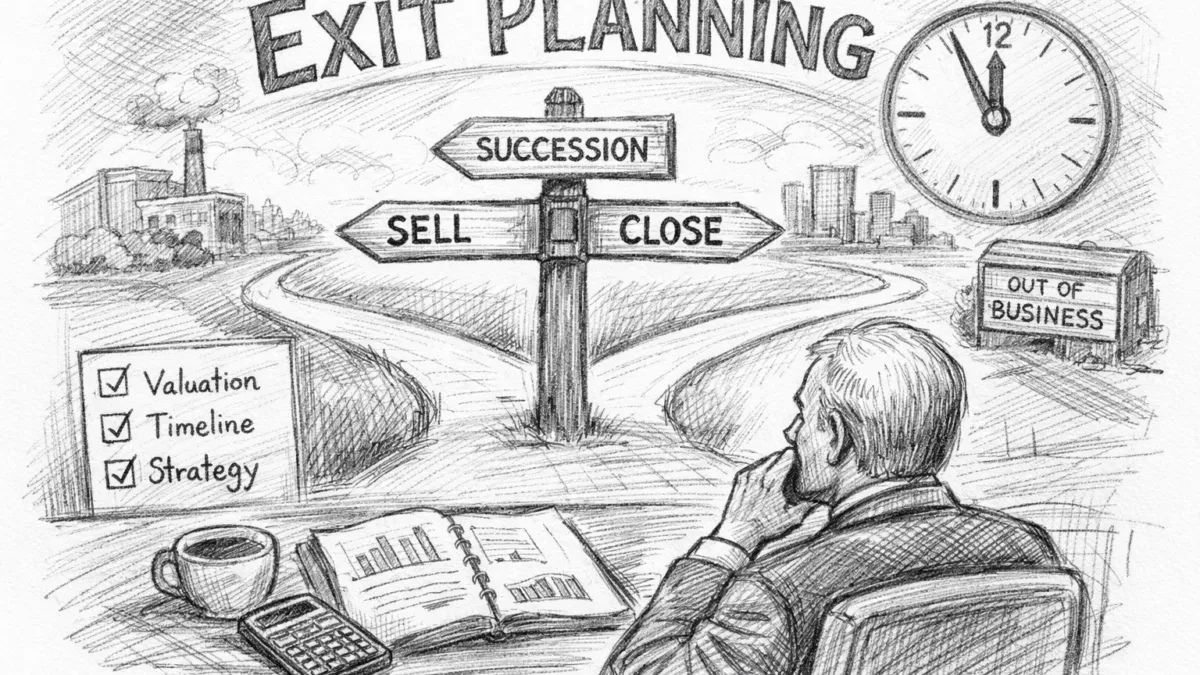
Exit planning starts earlier than most owners think. The best time to build your succession system is before you need it.
The second-best time is now.