You’ve heard it a thousand times.
“My business is my baby.”
It’s a nice sentiment. It’s a common refrain in coffee shops and networking mixers.
It’s also a lie that will cost you millions of dollars when it comes time to exit.
If you treat your business like a child, you will negotiate like a parent. You will be defensive. You will be irrational. You will be blind to the flaws that every buyer sees from a mile away.
I’m Mike Steward. I spend my days in the trenches as a broker and partner at Before the Clock Decides. I’ve seen great deals die on the vine because an owner couldn’t separate their identity from their income statement.
If you want to win at the negotiation table, you need to stop being a parent and start being an asset manager.
The Lethal Cost of Sentimental Value
Buyers do not pay for your memories.
They don’t care about the late nights you spent in the garage in 2008. They don’t care that you missed your daughter’s piano recital to land that first big contract.
To a buyer, your business is a collection of cash flows, risks, and systems. Nothing more.
When you bring "sentimental value" to the table, you create a valuation gap that no bridge can cross. You think the business is worth $10M because of your "blood, sweat, and tears." The market thinks it’s worth $6M because that’s what the EBITDA and multiples dictate.
Hard Truth: Your "sweat equity" has a market value of zero.
Your business value isn't what you think it is.
If you can't accept that, you aren't ready to sell. You are just looking for someone to validate your life’s work with a check they’ll never write.
Emotional Attachment is a "Tell"
In poker, a "tell" is a subtle change in behavior that reveals your hand.
In negotiation, emotional attachment is a billboard.
When a buyer critiques your inventory management or questions your customer concentration, how do you react?
If you take it personally: if you get flush in the face or start defending your "baby": you’ve just told the buyer exactly how to play you.
They know they can use your ego against you. They can pressure you on terms because they know you care too much about the legacy to let the deal walk away. Or worse, they realize you are a "difficult seller" and they bake a "pain-in-the-ass" discount into their offer.
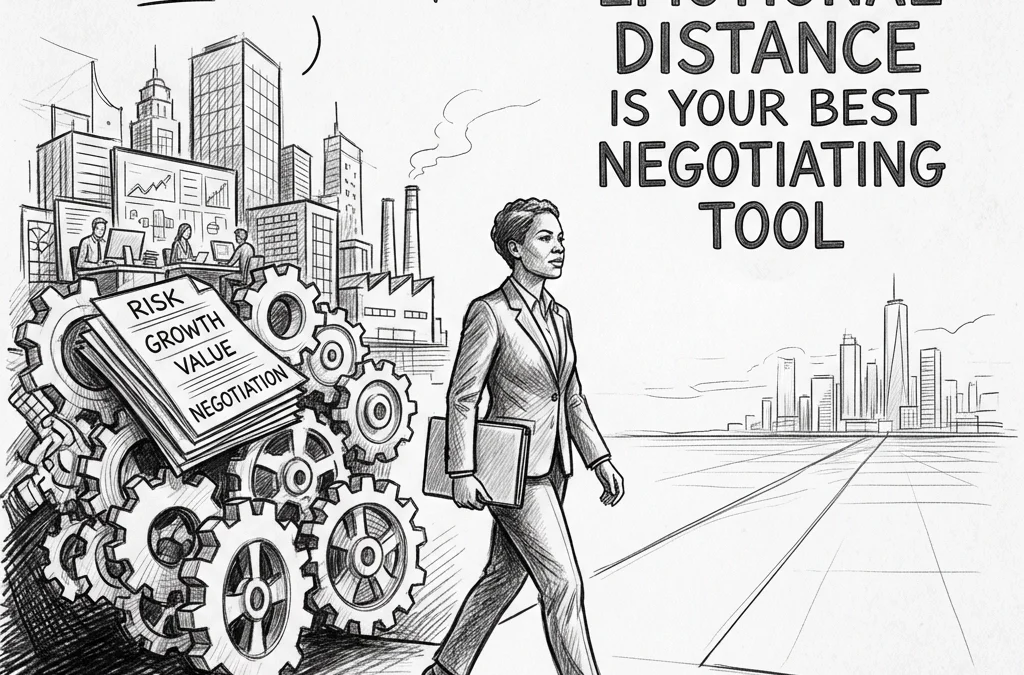
Emotional distance isn't about being cold. It’s about being professional.
Professionalism is the ability to hear a harsh truth about your business without feeling like it’s a harsh truth about you.

The Identity Trap: Who Are You Without the Logo?
Most owners struggle with emotional distance because they have no identity outside of the office.
If the business dies, a part of them dies. If the business is sold, they don't know who they'll see in the mirror the next morning.
This is why owners sabotage their own exits. They claim they want to retire, but they subconsciously tank the due diligence process because they are terrified of the "nothingness" that follows.
What breaks if you disappear?
If the answer is "everything," you don't own a business. You own a high-stress job that you can't quit.
You need to build a business that runs without you long before you put it on the market. If the business can't survive your absence, it’s not an asset: it’s a liability.
Tactical Empathy vs. Emotional Reactivity
I’m not saying you should be a robot.
The best negotiators use "tactical empathy." This means understanding the buyer’s emotions without letting your own get in the way.
The buyer is scared too. They are about to write a life-changing check. They are looking for reasons not to buy.
When you maintain emotional distance, you can see their fear for what it is: a request for data.
- Buyer: "Your customer churn is too high."
- Emotional Owner: "You don't understand how hard we work to keep people!" (Defensive/Parental)
- Distanced Owner: "The data shows a 4% churn. Let’s look at why that happens and the systems we have to mitigate it." (Asset Manager)
One of these responses keeps the deal moving. The other starts an argument.
The Power of "The Buffer"
This is why you hire a broker.
A broker is your emotional firewall. My job is to take the insults, the lowball offers, and the aggressive posturing from the buyer’s side and filter them into actionable information for you.
I don’t care if the buyer thinks your office decor is ugly. I don’t care if they think your star manager is overpaid.
I care about the deal structure.
If you are sitting across the table from a buyer alone, you are at a massive disadvantage. You are too close to the paint to see the whole picture.
Before you sell your business, read this. You need a strategy that accounts for your own psychological blind spots.

How to Detach Before the Clock Decides
You can’t flip a switch and suddenly stop caring about the thing you’ve spent twenty years building. It takes practice.
Here is how you start the process of emotional "de-coupling":
- Stop using "I" and "Me." Start using "The Company" and "The Entity." Language matters. If you talk about the business as an external object, you will start to see it as one.
- Audit your calendar. If 90% of your social life and 100% of your purpose comes from the business, you are over-leveraged on identity. Find a hobby. Join a board. Reconnect with your family.
- Run the numbers every month. Look at your P&L with the cold eyes of a stranger. If you were buying this company today, would you be happy with these margins?
- Set a "Walk Away" number. Decide what the business is worth to you based on math, not feelings. If the market won't pay it, you keep the business. If they will, you leave. No drama.

The Market is a Mirror
The market doesn't care about your intentions. It only cares about results.
When you try to sell a business you are emotionally attached to, you are essentially asking the buyer to pay for your autobiography.
They won't do it.
They want a manual, not a memoir. They want to know how the machine works, how much fuel it takes, and how much it outputs.
If you can provide that without the emotional baggage, you become the most dangerous person at the table: The person who doesn't need the deal.
The person who can walk away without feeling like they’ve lost their soul is the person who gets the highest price.
Reality Check: Is Now the Time?
Timing the market is hard. Timing your own ego is harder.
Most owners wait until they are burnt out, sick, or desperate to sell. By then, the emotional distance isn't a choice: it’s a collapse. And buyers smell blood.
When is the right time to sell your business?
The answer is: When it’s performing well and you still have the energy to navigate the exit.
Don't wait until the clock decides for you.

Your Move
Emotional detachment is a skill. Like any skill, it requires reps.
Step 1: Stop calling it your baby. It’s an asset. It’s a tool for wealth creation. Treat it with the respect it deserves, but don't give it your heart.
Step 2: Get an objective valuation. Not a "guess-timate" from your golf buddies. A real, hard-data look at what the market would actually pay today.
Step 3: Look at your exit options before you need them. Whether it’s selling a family business vs. succession planning, you need a map.
The clock is ticking. Are you the owner of an asset, or the parent of a ghost?
Decide now. Before the choice is made for you.