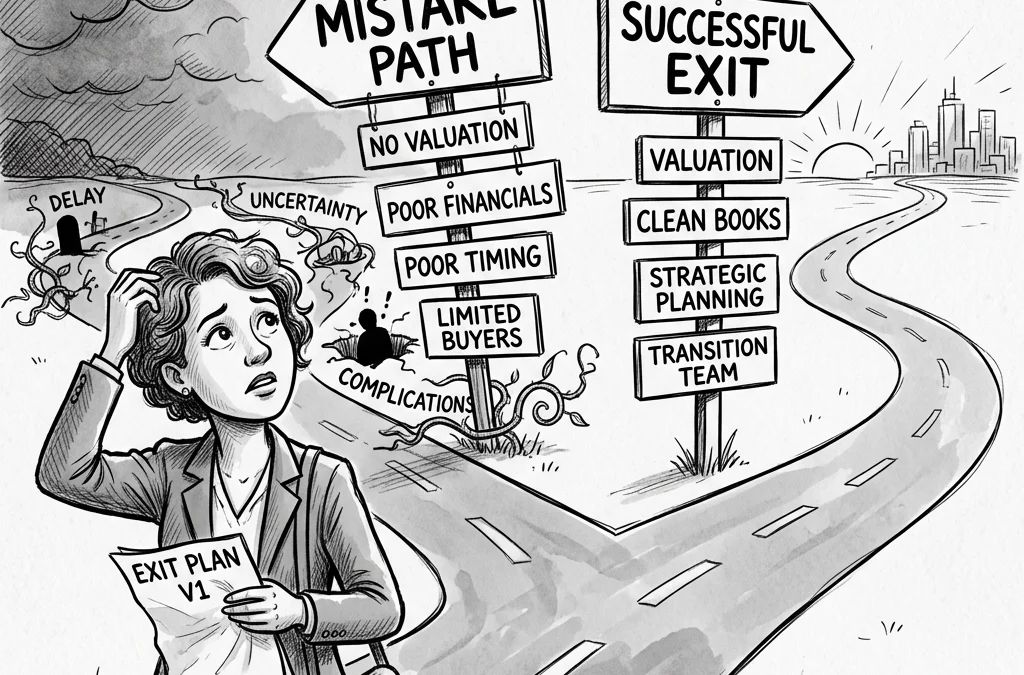
Most business owners don’t actually exit their companies.
They just stop working.
They wait until they’re burnt out, bored, or broken, and then they wonder why nobody wants to buy the mess they’ve spent twenty years building.
The hard truth? The market doesn't care about your hard work.
It doesn't care about the late nights, the missed birthdays, or the "sweat equity" you’ve poured into your foundation. A buyer only cares about one thing: Will this business work without you?
If the answer is "no," you don’t have an asset. You have a job. And nobody wants to buy your job.
If you want to walk away with a check and your legacy intact, you need to stop making these seven critical mistakes.
1. You Think You Have Time (You Don't)
The biggest lie you tell yourself is that you’ll deal with the exit "next year."
Then next year becomes five years from now. Then a health scare happens, or the market shifts, and suddenly you’re forced to sell.
When you are forced to sell, you lose.
A real exit strategy takes 2 to 5 years to execute properly. This isn't about paperwork; it's about conditioning the business to survive your absence.
If you wait until you are ready to leave to start preparing, you are already too late. You are selling under duress.

The Fix: Start today. Even if you don’t want to leave for a decade. Building a business that is "ready to sell" is the same thing as building a business that is "great to run."
Check out our free resources to see where you actually stand on the timeline.
2. You’re Letting Your Ego Value the Business
Most owners think their business is worth what they need for retirement.
The market doesn't owe you a retirement.
Your business is worth a multiple of its cash flow, adjusted for risk. If your industry average is a 3x multiple and you think you’re a 6x because you’re "special," you’re dreaming.
Overestimating your value kills deals before they start. You’ll scare off serious buyers and end up sitting on the market until your listing becomes "stale."
The Hard Truth: If you haven’t had a professional valuation in the last 12 months, you are guessing. And guessing is expensive.
The Fix: Get an objective valuation benchmark. Separate what you feel from what the data says. If the number is lower than you want, you now have a roadmap of what to improve.
3. Your Financials are a "Creative" Mess
If your accountant spends more time hiding profit from the IRS than showing it to a buyer, you’re in trouble.
Buyers don't "take your word for it."
If you tell a buyer, "Yeah, the profit looks low, but I run my car, my vacations, and my dog’s grooming through the business," they aren’t going to give you a higher price. They are going to see a business with poor discipline and high risk.

The Fix: Clean it up. Now.
- Separate personal and business expenses completely.
- Have three years of clean, reviewed financial statements.
- Standardize your reporting so a stranger can understand your trends in five minutes.
4. You Are the Hero (And the Bottleneck)
What happens if you disappear for three months?
If the business stops growing, the customers stop calling, or the employees stop working, your business is worth significantly less.
Buyers hate "Hero" owners.
They aren't buying you; they are buying a machine. If you are the engine, the machine is useless once you take the engine out.
Ask yourself these diagnostic questions:
- Do you hold all the key customer relationships?
- Are you the only one who can solve technical problems?
- Does every major decision require your "okay"?
If you answered yes to any of these, you are the biggest risk factor in your own company.

The Fix: Fire yourself from the daily operations. Build a management team. Document every process. Your goal is to become the least important person in the building.
If you need help shifting from "Hero" to "Owner," you might want to work with Mike to build a real transition plan.
5. You Have a "Golden Goose" Customer
If one customer represents more than 20% of your revenue, you don't own a business. You have a contract that a buyer will find terrifying.
What happens if that customer leaves the day after the sale?
Customer concentration is a deal-killer. It creates a "single point of failure." The same applies to suppliers. If your entire product line depends on one guy in a warehouse who might retire next year, you are at risk.
The Fix: Diversify. Stop chasing the "big whale" and start building a broad base of recurring revenue. A business with 100 small clients is infinitely more valuable than a business with one massive client.
6. You’ve Ignored the Legal Landmines
Handshake deals are great for starting a business. They are toxic for selling one.
When a buyer enters due diligence, they are looking for reasons to walk away or lower the price. They will find:
- Expired leases.
- Unsigned employment agreements.
- Unclear intellectual property rights.
- Pending litigation you "forgot" to mention.
The Fix: Conduct a legal audit before you ever go to market. Ensure every contract is in writing and current. If you have "key employees," make sure they have non-compete or stay-agreements that are actually enforceable.
Clean up the mess before someone else uses it as a reason to devalue your life's work.
7. You Have No Plan for "Day After"
This is the mistake that leads to "Seller’s Remorse."
You spend thirty years being "The Boss." You sell the company, the check hits the bank, and on Monday morning… you have nowhere to go.
Without a destination, you will sabotage your own sale.
You’ll get cold feet. You’ll pick fights with the buyer. You’ll find "flaws" in the deal that aren't there because, deep down, you’re scared of who you are without the business.

The Fix: Decide what "Life After" looks like before you sign the Letter of Intent. Are you traveling? Starting a foundation? Consulting?
Read through our book reviews for perspectives on legacy and transition. Understanding that you are more than your business is the first step toward a successful exit.
The Math of Mistakes
Let's look at the direct consequences of these behaviors:
- Good Financials + Strong Team = 4x–6x Multiple.
- Messy Financials + Owner Dependent = 1.5x–2.5x Multiple (if it sells at all).
On a business doing $1M in profit, that is a $3.5 Million mistake.
Is your ego worth $3.5 million?
Is your refusal to document processes worth $3.5 million?
The clock is ticking. You can decide how you leave, or you can let time decide for you.
Your Move:
- Audit your dependence. Take a two-week vacation without checking your email. See what breaks.
- Review your books. If you wouldn't show them to a bank today, don't show them to a buyer tomorrow.
- Get the guide. Pick up a copy of Before the Clock Decides to understand the psychological and strategic framework of a real exit.
Don't wait for the clock to run out. Start building your exit today.