
You built the company.
You made the sales.
You solved the customer problems.
You trained the team.
You carried the risk when nobody else would.
That is how many businesses start.
It is also how many businesses become trapped.
If the company cannot function without you, you are not only running a business. You are running a job.
That job may be profitable.
It may even look impressive from the outside.
But buyers do not pay a premium for a job they have to inherit.
They pay for an asset that can keep producing without the person who built it.
That is the key person trap.
The Business You Think You Built vs. the Business a Buyer Sees
You may believe your greatest asset is your personal involvement.
You know every customer.
You approve every major decision.
You understand the operation better than anyone.
You can fix problems in minutes.
Those facts may be true.
They may also reduce your value.
A buyer hears:
- Customers may leave when you leave.
- Employees may wait for direction.
- Critical knowledge may disappear with you.
- Revenue may fall during the transition.
- The buyer may have to become the new owner-operator.
The very traits you are proudest of can become the risks a buyer prices against you.
This is not personal.
It is transferable value.
A company is valuable when its earnings, relationships, systems, and decisions can move from one owner to another without breaking.
Your reputation matters.
Your leadership matters.
But if all of those assets live inside one person, the buyer is not acquiring the company.
The buyer is acquiring access to the person.
That is a much weaker deal.
What Owner Dependence Really Means
Owner dependence is not simply working hard.
It is not spending long hours.
It is not being involved in strategy.
Owner dependence means the business loses meaningful value when you step away.
That can happen through several channels:
-
Revenue dependence
Important customers buy because of you personally. -
Relationship dependence
Vendors, referral partners, or employees rely on your direct access. -
Decision dependence
Nothing important moves without your approval. -
Knowledge dependence
The most important information exists in your memory, inbox, or phone. -
Operational dependence
You are the person who handles the work nobody else knows how to do.
Ask the blunt question:
What breaks if you disappear for 60 days?
Do not answer with what you hope would happen.
Answer with what would actually happen.
- Who handles the largest accounts?
- Who approves spending?
- Who resolves employee disputes?
- Who understands the pricing model?
- Who knows which promises were made to customers?
- Who can make a major decision without calling you?
Your answers show where the business still has one owner-shaped support beam.
The Math of Key-Person Risk
Business owners often ask, “How do I value a company?”
They expect one clean formula.
The basic starting point may be simple:
Earnings × market multiple = enterprise value
But the multiple depends on risk.
And owner dependence is risk.
Consider a straightforward example.
Your company produces $1 million in annual EBITDA.
A comparable business might command a 5x multiple.
That creates a baseline value of:
$1 million × 5 = $5 million
Now the buyer examines your role.
You personally manage the top customers.
You approve nearly every major decision.
You are the only person who understands several core processes.
The buyer may need to hire an executive or replace some of your operational contribution. Suppose that costs $150,000 per year.
Adjusted earnings become:
$1 million − $150,000 = $850,000
Then the buyer applies a lower multiple because the business is harder to transfer.
Instead of 5x, the buyer offers 4x.
The adjusted value becomes:
$850,000 × 4 = $3.4 million
The difference is not theoretical.
- Baseline value: $5 million
- Adjusted value: $3.4 million
- Value at risk: $1.6 million
- Reduction: 32%
This is an illustration, not a formal appraisal.
There is no universal owner-dependence discount. The result depends on the company, the industry, the buyer, the quality of the financials, and the severity of the risk.
But the logic is real.
Lower confidence creates lower value.
A buyer may respond to risk by:
- Reducing the purchase price
- Lowering the valuation multiple
- Requiring a long transition period
- Holding back part of the purchase price
- Using an earnout tied to future performance
- Requiring key employees to sign retention agreements
- Walking away entirely
The headline price is only one part of the outcome.
Structure matters too.
A $5 million offer that depends heavily on future performance is not the same as $5 million in cash at closing.
Why Succession Planning Is Really About Removing Yourself
Succession planning is not a document sitting in a drawer.
It is not a conversation reserved for the final year before retirement.
It is not just deciding which child, employee, or buyer gets the company.
Succession planning is the systematic removal of the owner from the value equation.
That does not mean becoming irrelevant.
It means making the company less fragile.
The objective is not to erase your contribution.
The objective is to convert your contribution into systems, people, habits, and decisions the business can keep using after you leave.
That requires work.
1. Transfer the customer relationships
If every major client calls you first, start changing the pattern.
Bring another leader into meetings.
Move communication from your personal phone to company systems.
Let customers experience the strength of the team.
If customers only trust you, then the relationship is not fully owned by the company.
2. Document how the business works
Your memory is not a business system.
Write down:
- Sales steps
- Pricing rules
- Hiring procedures
- Vendor terms
- Customer service standards
- Production or delivery processes
- Financial controls
- Emergency responses
Documentation does not create value by itself.
But undocumented knowledge creates risk.
3. Build decision-makers, not assistants
An assistant waits for instructions.
A leader makes sound decisions without you.
Give capable people authority that matches their responsibility.
Set clear limits.
Review outcomes.
Stop reclaiming every decision simply because you can make it faster.
Short-term control often creates long-term weakness.
4. Measure the business without your name attached
Track the numbers that show whether the company can stand independently:
- Revenue by customer and salesperson
- Profit by product or service line
- Customer retention
- Employee turnover
- Sales pipeline ownership
- Decisions made without owner approval
- Days the owner can be absent without disruption
What gets measured can be transferred.
What stays vague stays dependent.
From Bottleneck to Builder
I have seen owners move through this change.
At first, everything comes back to them.
A customer has a question.
An employee needs approval.
A vendor wants a decision.
A problem appears.
The owner steps in.
The owner becomes the solution.
Then the owner becomes the bottleneck.
The turning point comes when the owner stops asking, “How do I fix this?” and starts asking, “Why does this require me?”
That question changes the work.
The owner trains a manager.
The manager takes over the account.
The process gets documented.
The team receives authority.
The owner reviews results instead of controlling every move.
Over time, the company becomes less dependent on the founder and more valuable to the next owner.
The owner has not done less.
The owner has finally done the work of building an asset.
The Owner-Optional Test
An owner-optional business is not a business where the owner does nothing.
That is a fantasy.
It is a business where the owner’s absence does not destroy performance.
Use this test:
- If you leave for one week, does anything slow down?
- If you leave for one month, does revenue suffer?
- If you leave for six months, does leadership hold?
- If you never return, does the company still have a future?
Each answer reveals a different level of dependence.
If one week creates chaos, you have an operating problem.
If one month creates uncertainty, you have a management problem.
If six months threatens revenue, you have a succession problem.
If your permanent absence ends the business, you may not have a transferable company at all.
You may have a valuable job.
Those are not the same thing.
How to Value a Company More Honestly
A useful valuation is not just a number.
It is a diagnosis.
When evaluating your company, look beyond revenue and EBITDA.
Ask:
- How much profit depends on your personal labor?
- How many customers are tied primarily to you?
- Who can replace your daily responsibilities?
- Are your systems documented and used?
- Can the leadership team make decisions without you?
- Would a buyer believe the current earnings continue after closing?
This is where a proper business valuation becomes useful.
It shows not only what the company may be worth today, but also what is weakening the number.
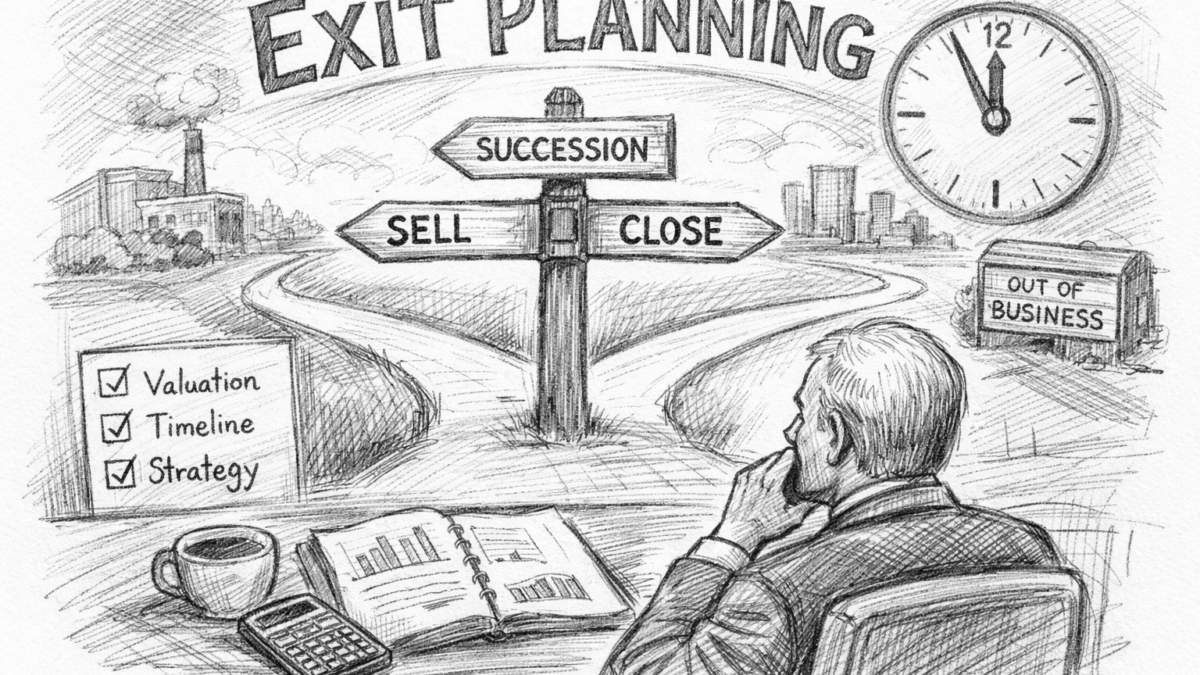
Mike Steward’s approach at Before the Clock Decides centers on this reality: every business eventually closes, sells, or passes to someone else.
The question is whether you build enough transferability to choose the outcome.
You can also review What Your Business Is Really Worth: and Why Most Owners Get It Wrong and Build a Business That Runs Without You.
For a deeper technical discussion of valuing a company with and without a key person, see Aswath Damodaran’s analysis of key-person risk.
Your Move
Write down every responsibility that stops, slows, or becomes uncertain when you are unavailable.
Then divide the list into three columns:
- Transfer : someone else can own it.
- Document : the process exists only in your head.
- Eliminate : it should not require owner involvement at all.
Start with the responsibility tied to the most revenue.
Then the one tied to the most risk.
Then the one that consumes the most of your time.
Your goal is not to make yourself less important. Your goal is to make the company valuable without needing you to remain the product.
That is what succession planning is for.
That is how you protect your options before the clock decides for you.