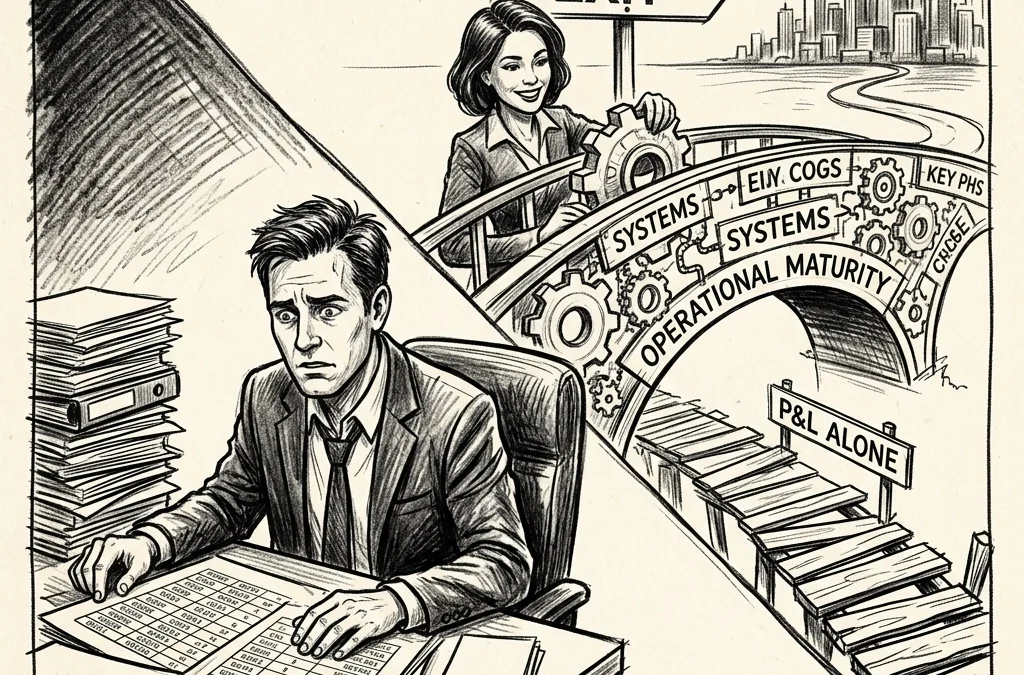
Your Profit and Loss statement is a scoreboard for a game that has already been played.
It tells a story about last year. It tells a story about last month. It might even show a healthy, growing bottom line that makes you feel like a genius.
But here is the hard truth: Buyers don't buy your past. They buy your future.
When a sophisticated buyer looks at your business, they aren't just looking at the number at the bottom of the page. They are looking at the machine that produced that number. They are looking for "Operational Maturity."
If that machine is actually just you in a cape, working eighty hours a week and making every single decision, your business isn't an asset. It’s a job. And nobody pays a premium multiple for a job.
The P&L Delusion
I’ve sat across the table from hundreds of founders. Most of them fall into the same trap. They think that as long as the EBITDA (Earnings Before Interest, Taxes, Depreciation, and Amortization) is high, the valuation will be high.
That is a dangerous lie.
Profitability is a prerequisite for a sale, but it is not the driver of a premium exit.
A high-profit business with low operational maturity is a "risky" bet. A buyer sees that profit and asks, "What happens if the owner leaves?" If the answer is "everything breaks," the buyer will either walk away or offer you a "fire sale" price with a five-year earn-out that chains you to your desk.
Operational maturity is the bridge between "making money" and "having a valuable company."

What Operational Maturity Actually Is (And What It Isn’t)
Let’s define this clearly by starting with what it isn't.
Operational maturity isn’t a 400-page manual gathering dust on a shelf.
It isn’t having a "VP" title for a relative who doesn't do anything.
It isn’t just using fancy software.
Operational maturity is the degree to which your business can execute its strategy consistently, predictably, and: most importantly: independently of you.
It’s the difference between a local restaurant where the food only tastes good when the owner is in the kitchen, and a global franchise where the fries taste exactly the same in London as they do in Chicago.
It’s about:
- Repeatable Processes: Can a new hire produce the same result as a veteran?
- Data-Driven Decisions: Are you making moves based on "gut feeling" or on real-time KPIs?
- Leadership Depth: Does your middle management have the authority to solve problems without texting you?
If you want to see where you stand, check out our resources to begin auditing your own internal systems.
The Diagnostic Question: What Breaks If You Disappear?
I want you to be honest with yourself for a second.
If you were to get into a car accident tomorrow and end up in a coma for thirty days, what would your business look like when you woke up?
- Level 1 (The Hero): The business stops. Clients leave. Employees don't know what to do. The bank account starts draining.
- Level 2 (The Manager): The business survives, but growth stops. Problems pile up on your desk. The team is "waiting for the boss" to make every major call.
- Level 3 (The Mature Operation): The business continues to run. Sales are made. Customers are served. Growth might even continue.
Buyers pay for Level 3.
They are looking for "transferability." They want to know that the cash flow they are buying won't evaporate the moment you hand over the keys. If you are the primary salesperson, the primary visionary, and the primary problem-solver, you are the bottleneck.

(Suggested Sketch: A black and white pencil drawing of a funnel where the "Owner" is the narrowest point, and "Growth" is stuck at the top.)
The Math of Maturity: Why 1+1 = 5
In the world of M&A (Mergers and Acquisitions), maturity isn't just a "nice to have." It has a direct mathematical impact on your bank account.
Let’s look at two hypothetical companies, Company A and Company B. Both have $2M in EBITDA.
Company A:
- Low Operational Maturity.
- Owner makes all the decisions.
- No documented systems.
- High employee turnover.
- Exit Multiple: 3.5x.
- Sale Price: $7M.
Company B:
- High Operational Maturity.
- Strong management team.
- Documented, automated workflows.
- Independent sales engine.
- Exit Multiple: 7x.
- Sale Price: $14M.
Both companies made the exact same amount of money last year. But Company B is worth double because it is a professionalized organization. It represents less risk to the buyer.
As I discuss in my book, Before the Clock Decides, you don't get the premium price for doing the work; you get the premium price for building the system that does the work.
The Four Pillars of the Mature Machine
If you want to move from Company A to Company B, you need to focus on four specific pillars.
1. The Strategy-to-Execution Loop
Mature companies don’t just have "goals." They have a rhythm. They translate high-level strategy into weekly tasks. Every employee knows exactly what "winning" looks like for them today.
2. The Management Layer
You cannot be the only one who cares about the bottom line. You need people who are incentivized to think like owners. This doesn't mean you need a C-suite of expensive Ivy League grads. It means you need a layer of people who are responsible for outcomes, not just activities.
3. Standardized "Productization"
Whether you sell widgets or consulting, your delivery must be standardized. If every project is a "custom build" that requires your personal touch, you are unscalable. You need a "factory" mindset.
4. The Data Dashboard
You should be able to see the health of your business in five minutes via a dashboard. If you have to ask three people to run reports to know your customer acquisition cost, you aren't mature yet.

The Harsh Reality: Maturity Takes Time
You can’t "install" operational maturity three months before you want to sell.
It’s like planting a tree. The best time to do it was ten years ago. The second best time is today. Most owners wait until they are burnt out to think about an exit. By then, they don't have the energy to build systems. They just want out.
And that is when they get slaughtered at the negotiating table.
A buyer can smell desperation. They can also smell a disorganized business. They will use your lack of systems as a lever to pry down your price. They will tell you, "We love the profit, but the risk of transition is too high. We're going to have to hold back 40% of the purchase price for three years."
Don't let that be your story.
The "Transferability" Premium
I often tell my clients: Work on your business as if you are going to keep it forever, but could sell it tomorrow.
When your operations are mature, you actually have more options. You might find that once the business doesn't require 60 hours of your week, you don't even want to sell it anymore. You’ve created a "passive" cash-flow machine.
But if you do decide to walk away, you’ll be doing so with a "premium" check.
Operational excellence is the ultimate insurance policy. It protects your lifestyle while you own the business, and it protects your legacy when you leave it.
If you’re wondering where to start, you can work with me to look under the hood of your current operations and see where the leaks are.
Your Move
Stop looking at your P&L as the final word on your company’s value. It’s just the starting point.
Here is your immediate checklist:
- Audit Your Calendar: For one week, write down every time an employee asks you for a decision. Each of those is a failure of your system.
- Pick One Process: Identify the one thing you do most often (Sales, Onboarding, Fulfillment). Document it. Make it so someone else can do it 80% as well as you.
- Read the Reviews: See what people are saying about the transition process in book reviews. Realize that the "exit" starts years before the "sale."
Operational maturity isn't a "boring" corporate buzzword. It is the literal difference between a $5M exit and a $10M exit.
The clock is ticking. Don't let it decide for you.
Your Move.