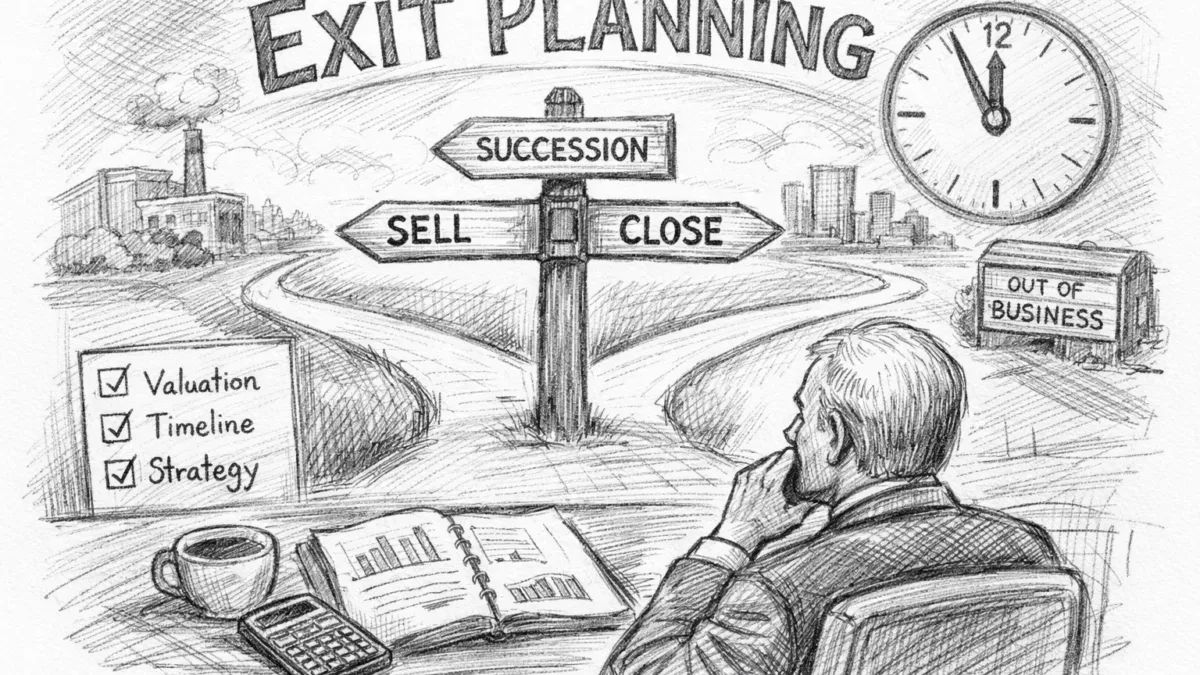
You have a number in your head.
Maybe it is $5 million.
Maybe it is “enough to retire.”
Maybe it is whatever someone told you your business might sell for.
Those are not the same thing.
Your retirement number and your business value are two separate numbers. If you confuse them, you may spend years believing you are prepared when you are not.
The difference can determine whether you leave on your terms, or keep working because the math gives you no choice.
Your Retirement Number Is Not Your Business Valuation
Your retirement number is not what your company is worth.
It is not your annual revenue.
It is not your EBITDA multiplied by a hopeful multiple.
It is not the number you would like a buyer to pay.
Your retirement number is the amount of personal, investable wealth you need to support your life after you stop receiving:
- A salary
- Bonuses
- Company-paid benefits
- Distributions
- Access to business cash
- The ability to create income through daily work
It is a personal number.
It depends on what you will spend, how long your money must last, what income sources you have, and how much risk you are willing to accept.
A basic planning shortcut is:
Annual retirement spending × 25 = approximate investment target
If you expect to spend $150,000 per year, that formula produces a target of roughly $3.75 million.
At a more conservative 3.5% withdrawal rate, the target rises to approximately $4.29 million.
That is not a promise.
It is not a substitute for advice from a qualified financial planner.
It is a starting point that forces you to stop guessing.
The Creative Planning retirement guide for business owners makes the same larger point: business owners often have most of their wealth trapped inside an illiquid company or related real estate. That wealth may look impressive on paper, but it cannot automatically pay your grocery bill after you exit.
Business Value Is Only the Starting Point
Business value is an estimate of what a buyer may pay for the company under specific conditions.
It is not cash in your account.
It is not necessarily what you can invest on the day of closing.
It may represent enterprise value, equity value, asset value, or another valuation standard.
Those distinctions matter.
A business may appear to be worth $4 million. Then the real transaction math begins.
Subtract:
- Debt that must be paid off
- Working capital requirements
- Broker and advisory fees
- Legal and accounting costs
- Taxes
- Escrow
- Seller financing
- Earnouts
- Deal conditions that delay payment
What remains is your net, after-tax, investable proceeds.
That is the number retirement planning cares about.
Not the headline.
Not the teaser.
Not the number you mention at dinner.
Your business can be worth $4 million and still fail to fund a $4 million retirement target.
The business value and the retirement number may look close. The money you actually keep may not be.
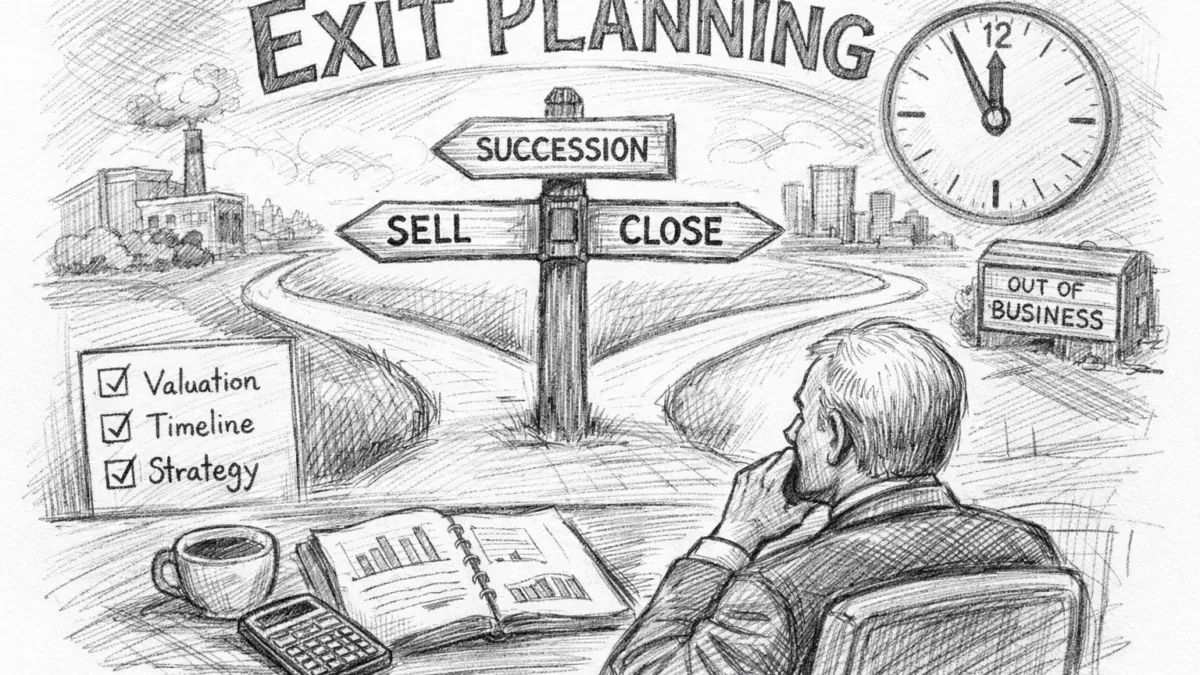
The Gap Is the Real Problem
Here is the simple calculation:
Retirement number – outside investments – net business proceeds = funding gap
Suppose your retirement target is $4 million.
You have $600,000 invested outside the business.
Your company’s likely sale produces $2.5 million after debt, taxes, fees, and deal adjustments.
Your gap is $900,000.
That gap does not disappear because you feel confident.
It does not disappear because revenue is growing.
It does not disappear because a friend sold a similar company for more.
You have four basic choices:
- Increase the value of the business.
- Build more wealth outside the business.
- Reduce your expected retirement spending.
- Delay or redesign the exit.
You may use one choice.
You may use all four.
But you need to know the gap before time forces the decision.
The Most Dangerous Assumption: “The Business Will Fund My Retirement”
This belief sounds reasonable.
You built the company. You grew it. You reinvested profits instead of putting money into a diversified portfolio. You accepted risk. You worked weekends.
So you assume the business will eventually pay you back.
Maybe it will.
But a business is not a retirement account.
It is an operating asset with customers, employees, debt, competition, market risk, and buyer requirements.
Its value can rise.
Its value can fall.
Its value can disappear.
The RBC business transition guide points out that many owners have informal transition plans but few have a formal plan that is regularly updated. That creates a serious problem. If your retirement depends on a sale, then the sale is not a side issue. It is the central funding event of your life.
Treat it that way.
Buyers Do Not Pay for Your Sacrifice
You may believe buyers will reward you for how hard you worked.
They will not.
You may believe buyers will pay for years of history.
They may not.
You may believe a strong revenue number proves the company is valuable.
It does not.
Buyers pay for future cash flow and confidence that the cash flow will continue after you leave.
That confidence usually comes from:
- Clean, credible financial statements
- Consistent earnings
- Recurring or repeatable revenue
- A diversified customer base
- Documented systems
- Strong employees and managers
- Limited owner dependence
- A business that can transfer without breaking
As I explain in What Your Business Is Really Worth, and Why Most Owners Get It Wrong, revenue alone does not drive value. Earnings, transferability, and buyer confidence matter more.
If the business cannot operate without you, then the buyer is not purchasing a valuable asset.
The buyer is purchasing your job.
And buyers do not pay a premium for jobs they have to rebuild.
Ask the Question Most Owners Avoid
What breaks if you disappear for 30 days?
Do customers stop calling the company and start calling you?
Do employees wait for every decision?
Do you approve all pricing?
Do you control the bank relationship?
Do you personally manage the largest accounts?
Do you carry the only real knowledge of how the business works?
If the answer is yes, your personal retirement plan has a business-risk problem.
The company may be profitable.
It may be respected.
It may have operated for decades.
But if you are the operating system, your exit becomes a threat to value.
Read The Owner-Optional Business: Why It Matters More Than You Think for a deeper look at why reducing owner dependence can improve both your freedom and your valuation.
A Practical Retirement Planning Sequence
Do not begin with, “What can I sell my business for?”
Begin here.
1. Calculate your personal retirement number
Estimate your actual annual spending.
Include:
- Housing
- Healthcare
- Taxes
- Travel
- Family support
- Insurance
- Recreation
- Unexpected costs
Do not use a vague monthly estimate pulled from memory.
Review real spending.
Then decide how much income you want after leaving the business.
2. List assets outside the business
Include:
- Retirement accounts
- Brokerage accounts
- Real estate
- Cash
- Other investments
- Business-related property
Separate liquid, investable assets from assets that may be difficult or slow to sell.
Your company’s building may have value.
That does not mean it can immediately fund your retirement.
3. Get a realistic business valuation
Do not rely on industry folklore.
Do not rely on a casual comment from a friend.
Do not rely on a multiple you found online.
A valuation should help you understand what drives the number and what weakens it.
The goal is not to make you feel good.
The goal is to show you where you stand.
4. Convert value into net proceeds
Work with your CPA, attorney, financial advisor, and valuation or exit advisor to estimate:
- Debt payoff
- Taxes
- Transaction costs
- Working capital adjustments
- Deal structure
- Cash at closing
- Seller financing
- Earnout risk
A $4 million offer is not a $4 million retirement fund if only $2.6 million becomes available to invest.
5. Measure the gap
If your projected net proceeds cover your retirement target, you have options.
If they do not, you have work to do.
That work may include growing earnings, improving margins, reducing owner dependence, diversifying customers, building outside investments, or changing the timing of your exit.

Start Earlier Than Feels Necessary
If you plan to exit in five years, you do not have five years to waste.
You may need several years of clean financial performance to support a stronger valuation.
You may need time to build a management team.
You may need time to transfer customer relationships.
You may need time to correct weak margins, messy books, concentration risk, or undocumented processes.
You may also need time emotionally.
Leaving the business is not only a financial decision. It is an identity decision.
For years, the company may have given you structure, status, purpose, and control.
If you wait until the sale is imminent to consider what comes next, you may make poor decisions simply to avoid the discomfort of leaving.
Preparation gives you choices.
Urgency removes them.

Your Move
Write down three numbers:
- The annual income you will need after leaving the business.
- The investable assets you already have outside the business.
- The realistic net proceeds your business could produce today.
Then subtract.
If the result is negative, do not panic.
But do not ignore it.
A gap discovered ten years before your exit is a planning problem.
A gap discovered six months before your exit is a crisis.
Start with a baseline valuation. Then build a plan around the number buyers will trust, not the number you hope to receive.
You can work with Mike to begin that conversation, or explore the ideas behind the book Before the Clock Decides.
The goal is not to predict the future perfectly. The goal is to understand your options before time makes the decision for you.
This article is for educational purposes only and is not financial, tax, legal, or investment advice. Work with qualified professionals before making retirement or business-exit decisions.