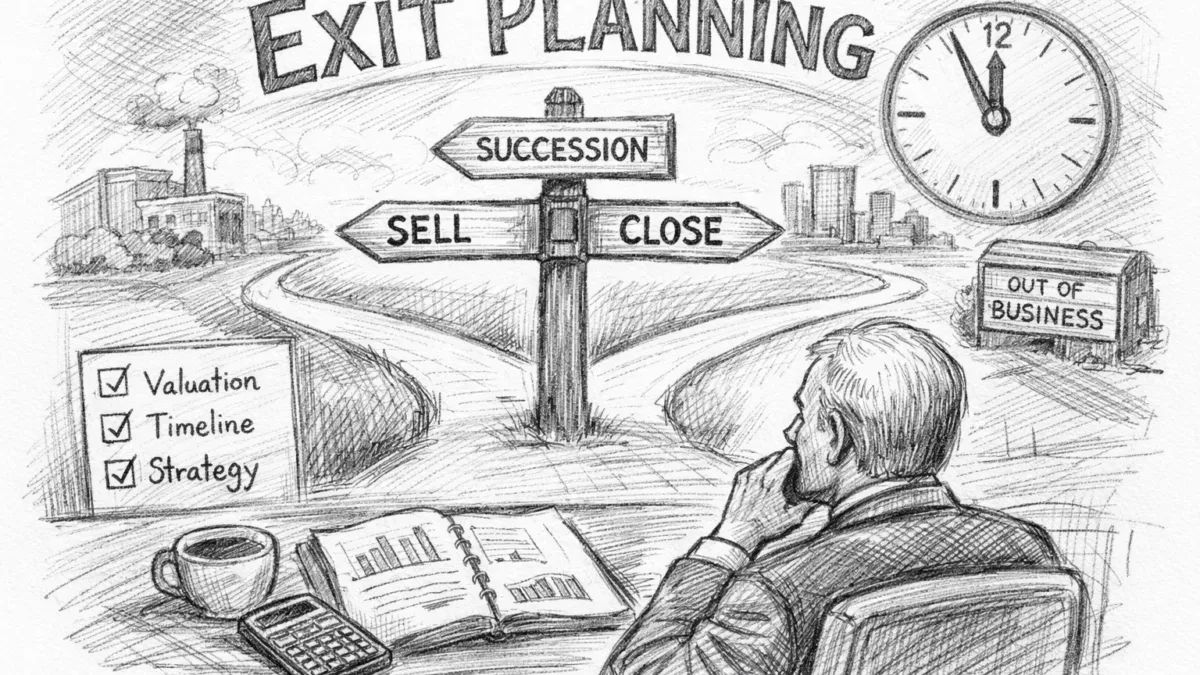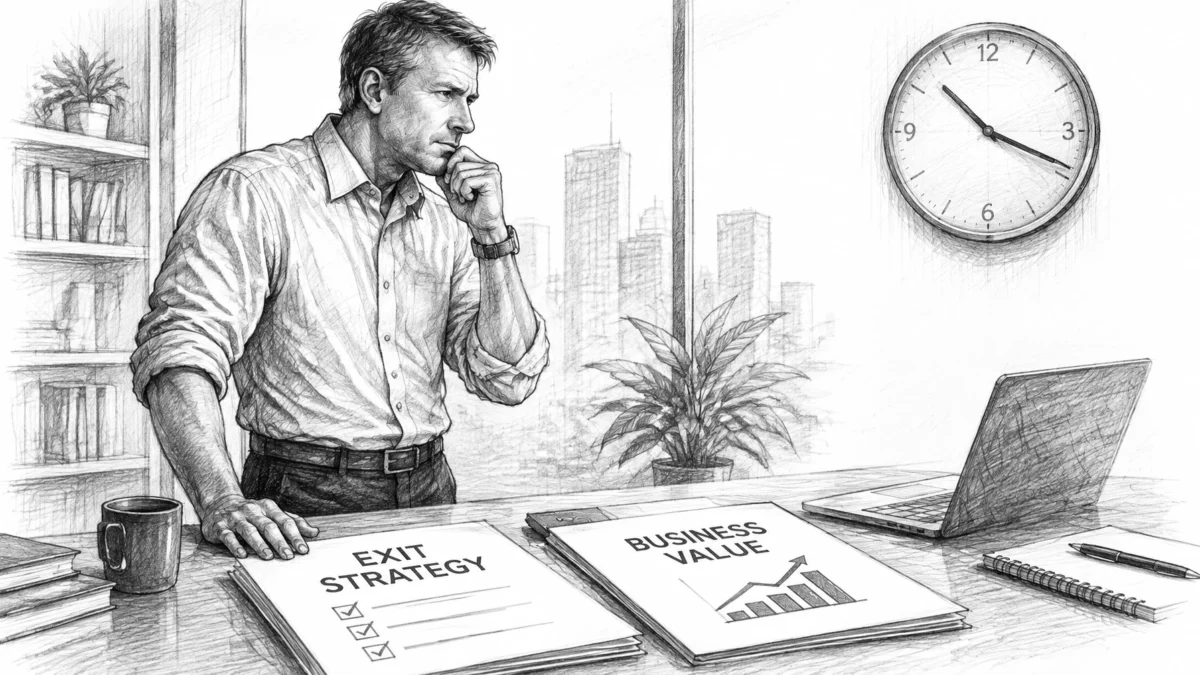
The best day to build an exit strategy was the day you started the business.
The second-best day is today.
That line sounds simple because it is simple. It is also easy to ignore.
Most owners do.
They tell themselves they have time. They tell themselves they will think about selling after one more strong year. They tell themselves the business is not ready, the market is not right, or they are not emotionally prepared to leave.
Then something changes.
The owner gets tired. A key employee quits. Revenue stalls. A health problem appears. A partner wants out. A family member loses interest. A customer concentration problem becomes obvious.
Suddenly, the exit is no longer a distant idea.
It is a deadline.
The owners who sell too late usually do not regret building the business. They regret waiting to understand what they had built.
Exit planning is not the same as preparing to sell tomorrow
An exit strategy is not a listing agreement.
It is not an announcement to your employees.
It is not a promise that you will retire next year.
An exit strategy is a working plan for the future of the company and the owner.
That plan answers questions such as:
- What is the business worth today?
- What would make it more valuable?
- How dependent is the company on the owner?
- Who could run it without the owner?
- What does the owner need financially after leaving?
- What happens if the owner cannot continue unexpectedly?
- Which exit paths are realistic?
You can build that plan while continuing to grow the business.
In fact, you should.
The systems, people, financial discipline, and customer relationships that make a business valuable to a buyer also make it easier to operate today.
Research from SVA’s exit planning guide recommends beginning the process years before an expected exit because waiting can limit the owner’s choices, timing, and value.
That is the part owners do not want to hear.
But it is the part that matters.
What owners who sold too late wish they had done differently
Owners rarely say, “I wish I had sold sooner.”
They more often say:
- “I wish I had known what the business was worth.”
- “I wish I had developed someone to replace me.”
- “I wish I had cleaned up the financials earlier.”
- “I wish I had built a plan before I needed one.”
- “I wish I had understood how little time I really had.”
Those regrets are not about paperwork.
They are about lost options.
1. They waited for certainty
Many owners believe they need to know exactly when they will leave before they start planning.
That is backwards.
You do not need a final exit date to begin building an exit strategy. You need a direction.
If you think you may sell in five years, then five years gives you room to improve the business.
If you wait until you are certain, you may have only twelve months left.
The difference is enormous.
Five years gives you time to build. Twelve months gives you time to explain.
Those are not the same thing.

2. They confused income with value
A business can produce a good living and still be difficult to sell.
Your income proves that the business supports you.
It does not prove that a buyer can operate it, grow it, or trust its earnings after you leave.
Buyers look beyond your current paycheck.
They look for:
- Reliable financial records.
- Consistent profit.
- Repeatable revenue.
- Strong customer relationships.
- Capable management.
- Documented processes.
- Low dependence on the owner.
- A credible path for future growth.
If the business makes money only because you personally solve every problem, sell every major account, approve every decision, and carry every important relationship, then the business may be profitable but fragile.
A profitable job is not automatically a transferable company.
That distinction often becomes painful during a sale.
3. They never got an honest valuation
Many owners have a number in their head.
That number usually comes from one of three places:
- What they need for retirement.
- What a friend sold for.
- What they believe the business deserves.
None of those is a valuation.
The market does not price your sacrifice. It prices the future cash flow, risk, systems, people, and opportunity a buyer can reasonably expect.
The gap between what you need and what the business is worth is called a problem.
It does not disappear because you avoid measuring it.
A valuation is not a verdict. It is a diagnostic tool.
It shows:
- Where the business is strong.
- Where buyers will see risk.
- Which improvements could increase value.
- Whether your current exit plan can fund your next chapter.
Mike Steward’s work through Before the Clock Decides and Vision Fox Business Advisors starts with that clarity.
Not every owner should sell today.
Some owners should wait and build value first.
But you cannot make that decision intelligently if you do not know where you stand.
4. They stayed at the center of everything
Here is the uncomfortable test:
What breaks if you disappear for 90 days?
Be honest.
- Do customers call you directly?
- Do employees wait for your approval?
- Do you hold the key passwords and relationships?
- Do you make every pricing decision?
- Do you solve every operational problem?
- Does the team know what to do without you?
If the answer is yes, then the business is still built around the owner.
That may work while you are willing and able to carry the load.
It creates risk when you are not.
Owners who sell too late often discover that building a management team takes longer than expected. People need training, authority, repetition, and time to make decisions without the owner stepping back in.
You cannot create independence in a weekend.
If you want a buyer to pay for a functioning company, then the company must function without you.

Late planning creates a math problem
Suppose your business is worth $2 million today.
You believe it could be worth $3 million after three years of stronger margins, better systems, less owner dependence, and more predictable revenue.
That potential $1 million increase is not guaranteed.
But neither is the $2 million current value.
If you wait until burnout forces a sale, then the business may be worth less because:
- Revenue has flattened.
- Key employees have left.
- Customers sense uncertainty.
- You have stopped investing.
- Your financial records are harder to explain.
- You have lost negotiating strength.
The simple equation is this:
More time × focused improvements = more options.
The opposite is also true:
Less time × more urgency = fewer options.
That is why a late exit strategy costs more than advisory fees or administrative stress.
It can cost value.
The late-start plan
Maybe you are already late.
That does not mean you are finished.
It means you need to stop pretending that time is unlimited.
Start with four moves.
1. Set a planning window
Choose a realistic range:
- Less than 12 months.
- One to three years.
- Three to five years.
- More than five years.
Do not choose the answer that sounds best.
Choose the answer that reflects your health, energy, financial needs, and willingness to continue operating.
2. Find out what the business is worth
Get a candid assessment.
Do not ask only, “What could I sell it for?”
Ask:
- What is it worth now?
- What would reduce that value?
- What could increase it?
- What would a buyer question first?
- What is the gap between today’s value and my financial needs?
Vision Fox’s valuation resources are designed to help owners separate hopeful estimates from a market-grounded view.
3. Remove the biggest risks
You will not fix everything at once.
You do not need to.
Start with the issues that most affect buyer confidence:
- Unclear financial reporting.
- Owner-dependent sales.
- Weak management coverage.
- Customer concentration.
- Undocumented processes.
- Unprofitable work.
- Verbal agreements that should be written down.
Fix the largest leak first.
4. Build a personal plan for leaving
A business exit is not only a business decision.
It is a life decision.
What will you do with your time?
Where will your income come from?
What role will you have after the transition?
What parts of the company’s legacy matter to you?
Owners who plan only the transaction often struggle after the transaction.
You are not just leaving a building, a payroll, or a set of customers.
You are leaving a role that may have shaped your identity for decades.
Prepare for that honestly.

The point is not to leave early
The point is to avoid being forced into a bad choice.
An exit strategy gives you room to decide whether to:
- Sell the company.
- Transfer it to family.
- Transition it to employees.
- Bring in a partner.
- Keep operating.
- Restructure.
- Close it carefully if no better path exists.
Planning does not force an exit.
Planning protects your ability to choose one.
That is the difference between being the bottleneck and becoming the builder.
One owner waits until exhaustion makes the decision.
Another starts five years early, builds a stronger team, understands the value, and keeps working because the business is healthy, not because there is no alternative.
Both may eventually leave.
Only one leaves with control.
Your Move
Do not start with a complicated document.
Start with one honest conversation.
Write down:
- When you might want to leave.
- What the business would need to be worth.
- What breaks if you disappear for 90 days.
- The three risks a buyer would notice first.
- The one improvement that would create the most value.
Then take that list to a qualified advisor.
Schedule a confidential conversation with Mike Steward or learn more about Vision Fox’s exit-readiness guidance.
The best day to plan was yesterday.
The second-best day is today.