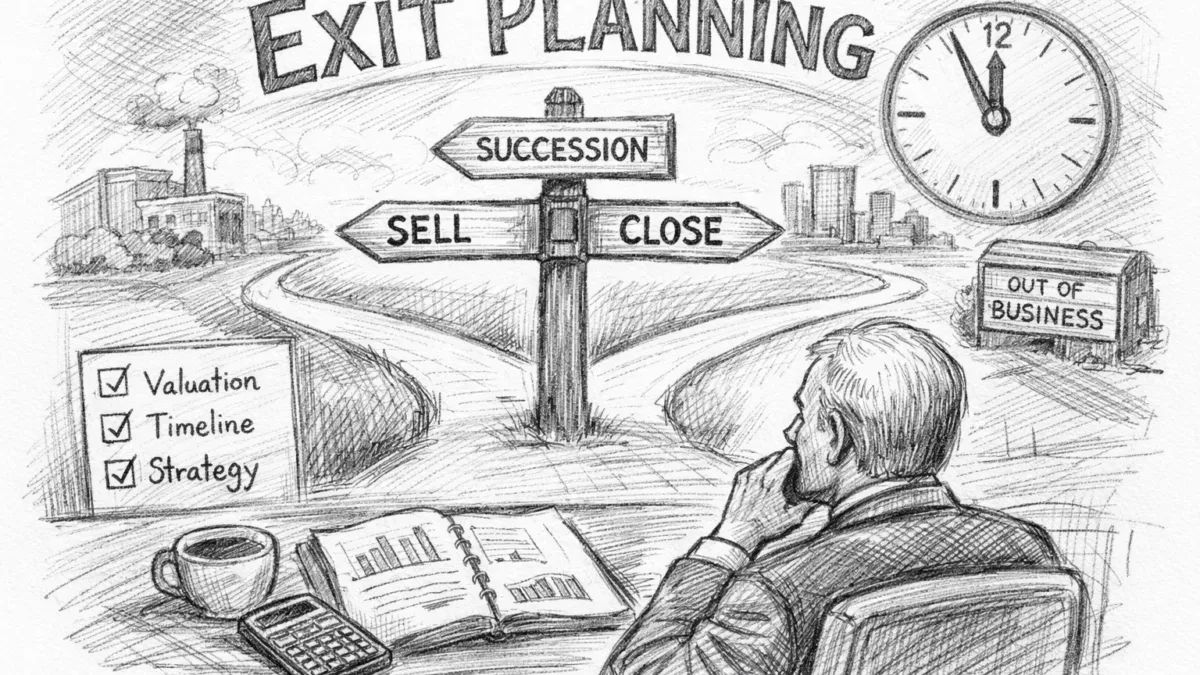
Two owners build a business together.
They share the risk. They split the work. They make decisions across the same table for years.
Then the goals change.
One partner wants out. The other wants to keep going.
There is no buy-sell agreement. No valuation formula. No funding plan. No process for breaking the tie.
Now the business has a problem that hard work cannot solve.
The partner exit conversation must happen before either partner needs it.
Not when one owner is already burned out.
Not after a health scare.
Not when a buyer appears unexpectedly.
Not when one partner has mentally left and the other is still planning the next five years.
That is the central problem with business exit planning for partners. Owners plan for growth together. They rarely plan for separation together.
“We don’t have an agreement” does not mean “we have no rules”
It means you may not have the rules you actually want.
Your LLC operating agreement, partnership agreement, shareholder agreement, loan documents, and state law may still control what happens next. Those documents may address ownership transfers, voting rights, deadlock, dissolution, or restrictions on selling an interest.
But they may not give either partner a clean, practical answer.
Default rules are not the same as a plan.
A plan answers three basic questions:
- When can one owner leave?
- How will the ownership interest be valued?
- Where will the money come from?
As McLane Middleton explains, wise owners address those questions before the departure becomes a crisis.
Without that preparation, the loudest issue usually becomes price.
That is a mistake.
Price is only one part of the problem.
You also have to settle timing, control, debt, guarantees, customer relationships, employee communication, taxes, and the future role of each partner.
The real conflict is not “sell versus keep”
That is the surface argument.
The deeper conflict is this:
- One partner wants liquidity.
- The other wants control.
- One partner wants certainty.
- The other wants more time.
- One partner values the next chapter.
- The other still identifies with the company’s future.
Neither partner is automatically wrong.
But their goals can become financially incompatible.
A continuing owner may say, “The business is worth more if we wait three years.”
The departing owner may say, “I cannot wait three years.”
Both statements can be true.
That is why business exit planning must begin with each owner’s personal objective, not a rushed argument over a number.
Ask the questions owners usually avoid:
- How soon does each partner need cash?
- Does either partner want to remain involved after the transaction?
- Can the continuing owner realistically finance a buyout?
- What happens if revenue drops during the transition?
- Who owns the customer relationships?
- What breaks if one partner disappears tomorrow?
That last question matters most.
There are four realistic paths
When one partner wants out and the other wants to continue, the choices are limited.
You can negotiate the path now, or you can let circumstances choose it later.

1. One partner buys out the other
This is usually the cleanest option when the remaining owner has the ability and desire to continue.
The continuing owner purchases the departing owner’s interest. Payment may come from:
- Cash already in the business
- Bank financing
- An SBA-backed loan, if the transaction qualifies
- Seller financing
- A combination of upfront payment and installments
The danger is pretending that ownership value equals available cash.
It does not.
If the business is worth $2 million, that does not mean the remaining owner can write a $1 million check. Debt, taxes, working capital, personal guarantees, and future operating needs all matter.
A buyout that leaves the business unable to operate is not a successful exit.
It is a delayed failure.
2. The company redeems the departing owner’s interest
In a redemption, the company itself buys back the departing partner’s ownership.
This can work when the business has enough cash flow to make payments without damaging operations.
It can also create legal and tax complications. The entity structure matters. The ownership documents matter. The payment terms matter.
Do not treat redemption as a shortcut around professional advice.
It is a transaction with consequences, not an accounting entry.
3. Both partners sell to a third party
Sometimes the continuing owner wants to stay but cannot afford the buyout.
Sometimes the departing owner needs more value than an internal transaction can provide.
Sometimes the relationship has deteriorated so badly that continued co-ownership is no longer realistic.
In those cases, a joint sale may produce the strongest financial result.
The partners sell the whole company together, divide the proceeds according to their agreement, and move on.
This path may maximize value because a buyer is purchasing the entire business rather than a minority interest. But it requires both owners to cooperate through preparation, buyer discussions, due diligence, and closing.
If one partner refuses to support the process, the business becomes harder to sell.
4. A structured transition
The departing owner reduces responsibility over 12, 24, or 36 months.
The continuing owner, management team, or outside successor takes on more control.
Ownership may transfer in stages. Payments may also occur in stages.
This can work when the departing partner wants to leave operations gradually rather than receive all proceeds immediately.
It can also protect the business from a sudden loss of relationships, knowledge, or leadership.
But a gradual transition is not an excuse to avoid decisions.
The agreement still needs a price, payment schedule, authority structure, performance expectations, and final exit date.
Do not negotiate value from memory
Partners often remember the business differently.
One remembers the record year.
The other remembers the debt, customer concentration, equipment needs, and owner dependence.
Neither memory is a valuation.

A fair process starts with a current, independent view of value.
That may involve a qualified valuation professional, a market-based assessment, or both. The method should reflect the actual business:
- Revenue quality
- Profitability
- Recurring income
- Customer concentration
- Debt
- Working capital needs
- Equipment and other assets
- Management depth
- Dependence on either owner
- Transferability of customer and vendor relationships
A stale formula can create a stale result.
A simple revenue multiple may look fair until the business carries heavy debt. A profit multiple may look attractive until most of the profit exists only because the owners work without market-rate compensation.
And a 50 percent ownership interest does not automatically equal 50 percent of the total company value.
Value must be tested against the business a buyer would actually purchase.
For more on this issue, read What Is My Business Worth? The Question Most Owners Avoid.
The agreement must cover more than death
Many owners think a buy-sell agreement is mainly for death or disability.
That is incomplete.
A useful agreement should address ordinary life changes and difficult business realities, including:
- Voluntary retirement
- A partner wanting to leave
- Disability
- Death
- Divorce
- Bankruptcy
- Termination of employment
- Misconduct
- Deadlock
- A partner starting a competing business
- A partner refusing to participate in a sale
It should also explain:
- How value is determined
- When value is updated
- Whether discounts apply
- How payment is funded
- What happens to personal guarantees
- Who controls the business during the transition
- How disputes are resolved
- What customers and employees are told
A document that says “the owners will agree on a price later” is not a plan.
It is a future argument waiting for a trigger.
The conversation should happen before the conflict
A partner exit conversation does not need to begin with, “I want to sell my share.”
That approach can feel like an ambush.
Start with a broader question:
“If one of us wanted to leave in the next five years, what would we want the process to look like?”
That question creates room for thought.
It allows both owners to discuss retirement, health, family, workload, financial needs, and long-term goals before anyone is forced into a decision.
The conversation should cover three scenarios:
- One partner wants to buy the other out.
- Both partners want to sell.
- Neither partner can agree on the first two options.
The third scenario matters because deadlock is not rare. If two owners cannot agree, the business can lose customers, employees, financing, and value while they fight.
A mediator, business advisor, attorney, or valuation professional can help keep the discussion focused on facts instead of old grievances.
A practical 30-day starting plan
If you and your partner have no clear exit process, take these steps.
Days 1–7: collect the documents
Review the operating agreement, partnership agreement, shareholder documents, loan agreements, guarantees, insurance policies, and ownership records.
Do not assume there is no relevant language because you do not remember signing a buy-sell agreement.
Days 8–14: define personal goals
Each owner should answer separately:
- When would I ideally leave?
- How much cash would I need?
- Would I accept installment payments?
- Do I want to remain involved?
- Would I support a full sale?
- What risks am I unwilling to accept?
Days 15–21: understand value
Get an independent view of the company’s current value and the factors that increase or reduce it.
Do not negotiate from a number pulled from an online calculator or a nearby business sale.
Days 22–30: build three written options
Put three paths on paper:
- Partner buyout
- Joint sale
- Structured transition
For each one, outline timing, price approach, payment terms, roles, risks, and next decisions.
Then take the options to qualified legal and tax professionals for review.
The partner problem is a planning problem
One owner wanting out is not automatically a business failure.
It is a normal ownership event.
The failure is having no agreed way to handle it.
A business with two owners has two futures to plan for. Those futures may stay aligned for years. They may not.
The owners who prepare early do not eliminate difficult conversations.
They make those conversations less destructive.
They give both partners options.
They protect the company from becoming collateral damage.
They turn one owner from a bottleneck into a builder of a business that can continue without them. That is the same principle behind building a business that runs without you.
The best time to discuss a partner exit is when both partners still trust each other and neither one is desperate.
Your Move
Schedule one meeting with your business partner.
Do not start by arguing about price.
Ask this instead:
“If one of us wanted out, what would a fair process look like for both of us?”
Write down the answer.
Then identify the gaps.
That is business exit planning.
Not a promise to sell.
Not a prediction about the future.
A practical agreement that keeps the clock from making the decision for you.
This article is for general educational purposes only. Ownership transitions involve legal, tax, valuation, and financial issues that vary by entity type and jurisdiction. Consult independent qualified professionals before acting.