You may believe your successor knows the plan.
You have mentioned it over dinner.
You have said, “Someday, this will be yours.”
You have brought them into important meetings.
You have told your leadership team that you are “thinking about the next phase.”
That feels like communication.
It is not succession planning.
It is a collection of hints.
And hints create a dangerous gap between what the owner believes has been explained and what the next generation actually understands.
The numbers expose the gap
A PwC Global NextGen Survey found that 61% of next-generation family business members said their family business had a succession plan in place.
That sounds encouraging.
But PwC’s earlier survey found that only 30% of current-generation leaders said there was a robust succession plan.
A separate Brightstar Capital Partners family business report found that 61% of family businesses did not have a written, formal succession plan.
These surveys are not identical. They do not measure the same companies or ask the exact same questions.
But the pattern is hard to ignore.
Successors often believe a plan exists because they have heard intentions. Owners often believe they have a plan because they have formed intentions. Neither is the same as a documented, shared, workable plan.
That difference matters.
If the successor thinks the handoff is defined but the owner has only a vague idea, the business is not prepared.
It is merely assuming.

A succession plan is not a feeling
A succession plan is not:
- “My daughter will probably take over.”
- “The management team knows what I want.”
- “We will figure it out when the time comes.”
- “Everyone understands how the business works.”
- “I have told them they can have it someday.”
Those are intentions.
Intentions matter.
They are also insufficient.
A real succession plan answers practical questions in plain language:
- Who is expected to lead?
- Who will own the business?
- When does the transition begin?
- What must the successor prove first?
- What decisions can the successor make today?
- What happens if the successor is not ready or no longer wants the role?
- How will the owner fund the transition and support personal financial needs?
- What happens if the owner dies, becomes disabled, or is forced out suddenly?
If those questions have no clear answers, you do not have a succession plan.
You have a hope.
Why owners overestimate what they have communicated
Most owners are not trying to mislead anyone.
They are busy.
They built the company by solving immediate problems. Payroll. Customers. Hiring. Cash flow. Equipment. Compliance. Growth.
Succession planning feels less urgent because the business is still operating.
That is the trap.
Owners also tend to communicate in shorthand because the business is part of their identity. They assume the next generation understands the history, the risks, and the standards.
The successor does not have access to the owner’s internal file cabinet.
They hear statements.
They infer meaning.
They fill in the blanks.
That creates at least four predictable problems:
1. “Someday” becomes a deadline
The successor may hear “someday” as a commitment.
The owner may mean “if you earn it, if the business is healthy, and if the timing works.”
Those are different messages.
2. Exposure gets mistaken for preparation
A successor may attend leadership meetings for years and still have no authority, ownership knowledge, or decision-making practice.
Watching is not leading.
3. Family status gets mistaken for qualification
Being the owner’s child does not automatically prepare someone to run the company.
A successor needs responsibilities, feedback, accountability, and the chance to make decisions before the transition.
4. Silence gets mistaken for agreement
If no one asks hard questions, the owner may assume alignment.
The successor may simply be afraid to ask.
The plan must be understood by both sides
A succession plan is not complete when the owner writes it down.
It is complete when the people affected by it understand it well enough to act on it.
That means the successor should be able to explain:
- The expected transition path.
- The target timeline.
- The difference between management and ownership.
- The performance standards required.
- The financial realities of the business.
- The owner’s personal financial expectations.
- The roles of other family members or leaders.
- The backup plan if the preferred successor cannot take over.
If the successor cannot explain those points, the plan has not been communicated.
It may exist in the owner’s head.
That is not where a business transition should live.

What the perception gap costs you
The cost is not limited to hurt feelings.
It can damage the business.
Trust
If the successor believes a future has been promised and the owner later changes the terms, the successor may feel betrayed.
If the owner believes the successor is ready and discovers they are not, the owner may feel abandoned.
Both sides become defensive.
Leadership stability
Employees notice uncertainty.
Key people begin asking:
- Who will make decisions?
- Will the culture change?
- Will ownership stay in the family?
- Should I wait this out or start looking elsewhere?
Uncertainty spreads faster than owners expect.
Business value
A business dependent on one owner is harder to transfer.
If customers, employees, vendors, and major decisions all flow through you, then your absence creates risk.
If risk rises, value can fall.
The math is direct:
More owner dependence = fewer transition options.
Fewer transition options = less leverage when the time comes.
Family relationships
A vague plan forces people to negotiate under pressure.
That is when old rivalries, unequal expectations, and financial misunderstandings surface.
A written plan does not eliminate conflict.
It exposes conflict early enough to manage it.
That is a much better outcome.
The owner must stop being the bottleneck
I have seen owners spend years saying they want the next generation to lead while continuing to make every meaningful decision.
They approve every major purchase.
They handle the most important customer relationships.
They control the financial information.
They correct every mistake before the successor can learn from it.
Then they conclude that the successor is not ready.
Sometimes that conclusion is accurate.
But sometimes the owner has built a system where nobody else can become ready.
The transition begins when the owner moves from bottleneck to builder.
That means transferring responsibility before transferring control.
Start with decisions that can be delegated safely.
Let the successor own the result.
Review performance without taking the work back.
If every mistake brings the owner back into the center, the successor learns dependence, not leadership.
Five moves that close the gap
1. Ask what the successor thinks the plan is
Do not explain first.
Ask first.
Try these questions:
- “What do you believe happens if I step away?”
- “What role do you expect to have?”
- “What do you think you need to accomplish before taking the lead?”
- “What have I failed to explain?”
- “What concerns you about the transition?”
The answers may surprise you.
That is useful information.
2. Write the plan in plain language
Do not hide the plan inside legal documents or vague corporate language.
Create a short working document that states:
- Desired outcome.
- People involved.
- Responsibilities.
- Milestones.
- Decision rights.
- Financial assumptions.
- Backup options.
The legal and tax documents matter.
They do not replace operational clarity.
3. Build a transition timeline
A succession plan without dates becomes permanent delay.
Use a simple sequence:
- Now: clarify roles and expectations.
- Next 12 months: transfer defined responsibilities.
- Next 24–36 months: test leadership performance.
- Before ownership transfer: confirm value, funding, governance, and authority.
- After transition: define the former owner’s role, or lack of one.
The timeline can change.
It still needs to exist.
4. Measure readiness through performance
Readiness is not age.
It is not family position.
It is not enthusiasm.
Evaluate the successor against real business requirements:
- Can they lead people?
- Can they make unpopular decisions?
- Can they manage cash?
- Can they protect customer relationships?
- Can they handle conflict?
- Can they improve the business without destroying what works?
If the answers are unclear, create opportunities to test them.
5. Understand the business value early
The successor needs to understand what is being transferred.
The owner needs to understand what the business can support.
That includes the company’s current value, its weaknesses, and the improvements that could strengthen future options.
Vision Fox Business Advisors helps owners understand business value and prepare for a potential future transition. This is not about forcing a sale. It is about replacing assumptions with facts.
You cannot design a fair succession plan around a number nobody has examined.
Legacy is not what you meant to leave behind
Legacy is not your intention.
Legacy is what remains after your involvement decreases.
Does the business make decisions without you?
Does the leadership team know what success requires?
Does the successor understand the responsibility?
Does the family know what is fair?
Can the company survive an unexpected event?
If the answer is no, the legacy is still dependent on the founder.
That is not continuity.
That is concentration risk with a family story attached to it.
The book Before the Clock Decides explores the decisions owners need to make before time, health, market conditions, or family circumstances remove their choices.
The central point is simple:
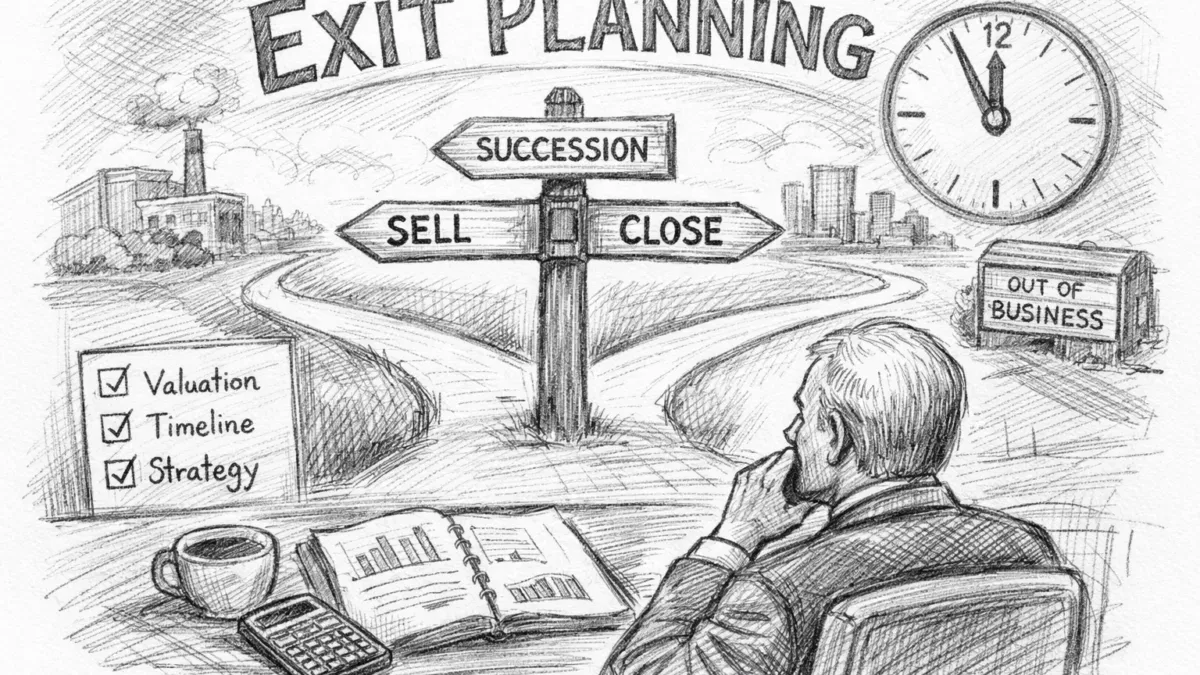
Every business eventually sells, closes, or passes to someone else. The only question is whether you shape that outcome before you are forced to accept it.
Your Move
This week, sit down with the person or team you believe will carry the business forward.
Ask one question:
“What do you believe our succession plan is?”
Then listen without correcting them.
Write down the answer.
Compare it with your own understanding.
If the two versions do not match, you have found the gap.
Do not defend it.
Close it.
Start with the next conversation, the next responsibility, and the next written decision.
A succession plan is not what you intended to communicate. It is what the next generation can clearly understand, prepare for, and eventually execute.