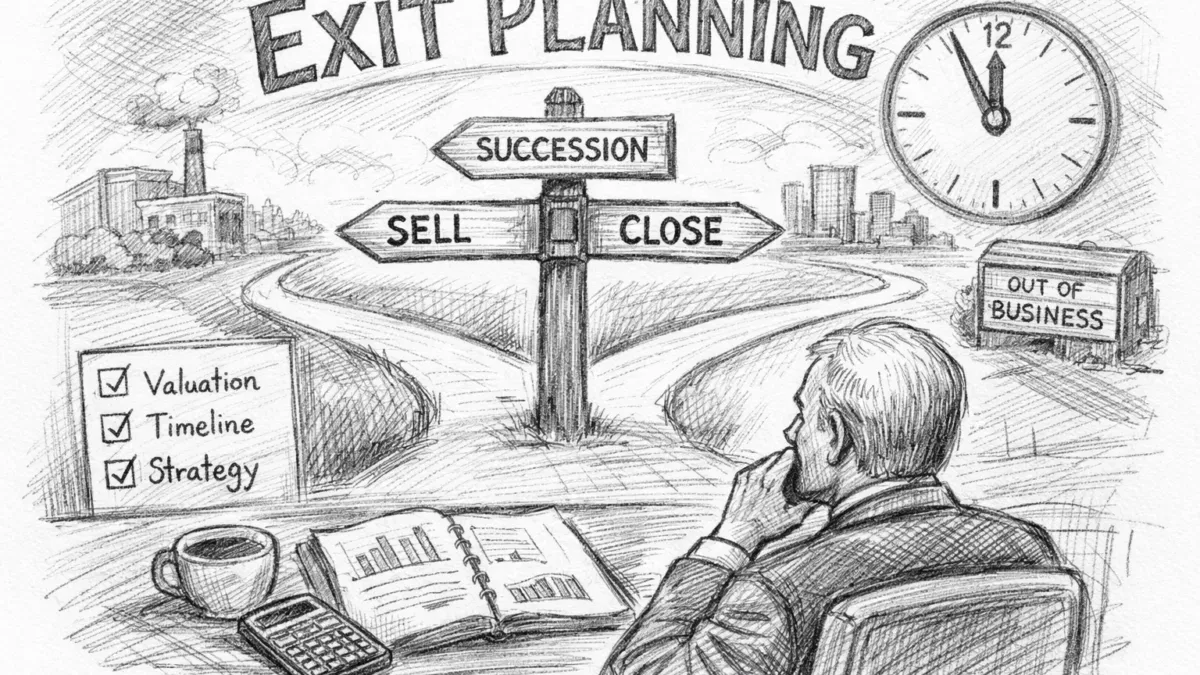
Most owners plan for a sale they choose.
They picture a clean handoff. A strong buyer. A fair price. A few quiet months afterward.
That is the preferred version.
It is not the only version.
A business can also leave your control because of Death, Disability, Divorce, Distress, or Disagreement.
These are the five forced exits nobody wants to discuss.
They are also the five events every serious owner should plan for.
This is not about expecting disaster.
It is about preserving control when life, health, finances, family, or partners create a decision you did not schedule.
An exit strategy is not only a plan for selling. It is a plan for what happens when selling is no longer fully your choice.
The uncomfortable truth about business exit planning
Most owners believe they will decide when the business ends.
They assume they will sell when they are ready, retire when the timing is right, or hand the company to the next generation after years of preparation.
Then something changes.
- The owner dies.
- A serious illness removes the owner from daily operations.
- A divorce forces ownership questions.
- Financial distress demands immediate action.
- Two partners stop agreeing on the future.
If you have no plan, the event becomes the plan.
That usually means fewer options, weaker negotiating power, greater family tension, and lower business value.
A planned exit gives you choices.
A forced exit gives other people choices on your behalf.
The Exit Planning Institute’s overview of the five D’s identifies these events as major threats to business continuity and owner wealth. The exact details differ from company to company, but the lesson is consistent:
Hope is not a contingency plan.
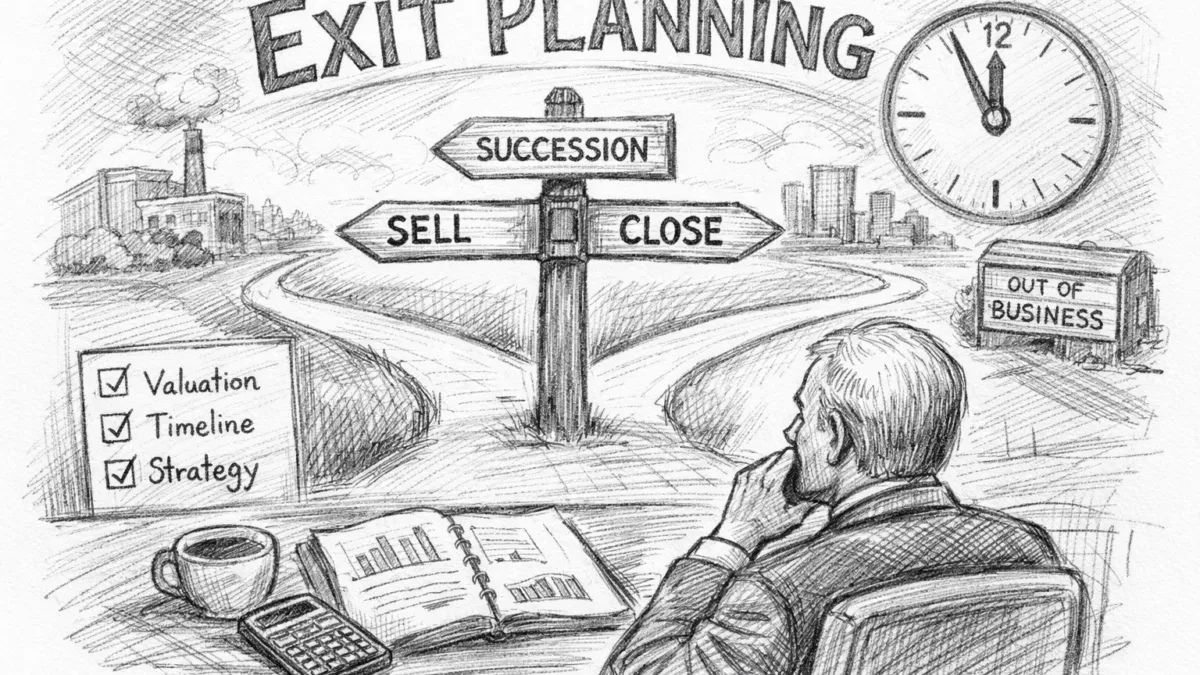
1. Death: When the owner disappears overnight
Death is not only a family tragedy.
It can also become an ownership crisis, a leadership crisis, and a liquidity crisis.
If the owner is the primary decision-maker, relationship holder, salesperson, and problem solver, the company may lose more than a person. It may lose its operating system.
What happens next?
- Who has authority to make decisions?
- Who can access the company’s money?
- Who communicates with employees and customers?
- Does the family want to own the business?
- Can the business afford to buy the ownership interest?
- Is there a capable successor?
- What happens if multiple heirs inherit the company?
If these questions have no clear answers, the business may be forced into a rushed sale or closure.
That is not legacy planning.
That is emergency management.
A death contingency plan should separate ownership from leadership. The people who inherit the company may not be the people capable of running it.
At a high level, owners should review:
- Ownership transfer instructions.
- Leadership succession.
- Estate documents.
- Key-person and life insurance coverage.
- Buy-sell provisions.
- Access to financial records and critical systems.
- Communication plans for employees, customers, lenders, and vendors.
The goal is not to predict the future.
The goal is to make sure the business can function during the first difficult days after the owner is gone.
2. Disability: When you are alive but no longer available
Disability is often treated as an insurance issue.
It is also a business continuity issue.
If the owner cannot work for six months, what breaks?
If the answer is “almost everything,” the company is not transferable. It is dependent.
That dependence may feel manageable while you are healthy.
It becomes expensive the moment you are not.
Disability can affect:
- Daily operations.
- Customer relationships.
- Financial decisions.
- Hiring and supervision.
- Banking authority.
- Sales activity.
- Strategic direction.
- The owner’s personal income.
A disability plan should answer a simple question:
Who can run the company if you cannot?
Not who might help.
Who has the authority, skill, and information to keep the business moving?
This is where systems matter. Written procedures matter. A capable leadership team matters. Clear decision rights matter.
If the owner is the only person who knows how to price work, approve expenses, manage key accounts, or solve operational problems, then the owner is not merely leading the business.
The owner is the business.
That is a dangerous position.
The best disability protection is not just an insurance policy. It is a company that can operate without its owner for a meaningful period of time.
3. Divorce: When personal conflict enters the ownership table
Divorce can affect a business even when the spouse has never worked in it.
A closely held company may represent a major marital asset. Ownership interests, distributions, compensation, real estate, and business value can all become part of a legal and financial dispute.
The company may not care why the marriage ended.
The company still has to deal with the consequences.
Divorce can create:
- Pressure to value or divide ownership.
- A forced buyout.
- New ownership rights.
- Confidentiality concerns.
- Disruption among employees and partners.
- Conflict over salary, distributions, and control.
- A need for liquidity at the worst possible time.
The business is not a substitute for a personal estate or marital plan.
It should not be left to informal assumptions.
What is clear in your head may not be clear in a legal document.
Owners should coordinate with qualified legal and tax professionals to review ownership agreements, marital agreements where appropriate, transfer restrictions, valuation language, and funding options.
This is not about assuming a marriage will fail.
It is about recognizing that business ownership has consequences outside the office.
If your company represents most of your personal wealth, personal planning and business exit planning cannot remain separate conversations forever.
4. Distress: When the market stops waiting
Distress does not always arrive as one dramatic collapse.
It often builds quietly.
A major customer leaves. Margins shrink. Debt increases. A lawsuit appears. A key employee quits. The owner delays necessary investment. Cash gets tight.
Then the company reaches a point where the owner is no longer choosing the timing.
The lender is calling.
The landlord is waiting.
The employees are uncertain.
The buyer, if one appears, knows you are under pressure.
Distress changes leverage.
If your company generates $500,000 in annual cash flow and you have time to improve systems, reduce owner dependence, and strengthen reporting, you may have multiple strategic options.
If the same company loses its largest customer and must sell within 60 days, the choices narrow sharply.
The value is not necessarily the same.
The negotiating position is not the same.
The emotional pressure is not the same.
If you wait until the business is in distress to think about an exit, you are not planning an exit. You are reacting to one.
A basic distress contingency plan should identify:
- The company’s minimum cash needs.
- Debt obligations and lender requirements.
- The customers or contracts most critical to survival.
- The roles that cannot remain owner-dependent.
- The early warning signs that require action.
- The professionals who should be contacted before the crisis peaks.
Financial reporting is not paperwork for its own sake.
It is an early-warning system.
You cannot protect value you refuse to measure.

5. Disagreement: When partners stop rowing in the same direction
Partnerships often work well until the owners want different futures.
One wants to grow.
One wants to sell.
One wants to reinvest.
One wants more distributions.
One wants to retire.
One wants control.
The other wants out.
Disagreement becomes dangerous when there is no agreed path for resolving it.
A deadlocked company can lose value even when the underlying business remains profitable.
Decisions slow down.
Employees notice.
Customers notice.
Partners make defensive moves instead of good business decisions.
The company becomes a battleground.
A strong ownership agreement should address more than percentages.
It should address what happens when owners disagree about:
- Major spending.
- Hiring and firing.
- Compensation.
- New debt.
- Selling the company.
- Bringing in a new partner.
- Retirement.
- Disability.
- Death.
- A partner’s desire to exit.
This is not about eliminating every disagreement.
That is impossible.
It is about creating a process for moving through disagreement without destroying the company.
A buy-sell agreement is not a complete exit plan, but an exit plan without clear ownership rules has a serious hole in it.
Your attorney, CPA, insurance advisor, and business advisor may all have a role in reviewing the structure. The important point is to review it before the owners are angry, rushed, or financially cornered.
What the five D’s have in common
Death, disability, divorce, distress, and disagreement look different.
They create the same core problem:
They reduce your control over timing.
When control over timing decreases, options usually decrease with it.
That affects value.
It affects family decisions.
It affects employees.
It affects your ability to protect the legacy you spent years building.
The answer is not to build a complicated binder that nobody reads.
Start with five practical moves:
-
Name the risk.
Ask which of the five D’s would hurt your company most today. -
Identify the dependency.
What breaks if you disappear for 30 days? -
Document authority.
Who can make decisions, access accounts, sign contracts, and lead employees? -
Understand value early.
A current valuation is not a promise of a sale price. It is a reference point for better decisions. Vision Fox Business Advisors offers business valuation guidance for owners who need a clearer view of what supports or weakens value. -
Build a timeline before you need one.
If you may exit in two to ten years, Before the Clock Decides is built around the larger question: will you choose the ending, or will time choose it for you?
One owner I have seen made the shift from bottleneck to builder by doing something simple.
He stopped treating every decision as proof of his importance.
He trained two leaders.
He documented key processes.
He clarified ownership expectations.
He reviewed the company’s value before he needed to sell.
Nothing changed overnight.
But the business became less fragile.
That was the point.
Your Move
Do not ask only, “When do I want to sell?”
Ask better questions:
- What happens if I die next month?
- What happens if I cannot work for a year?
- What happens if my marriage changes?
- What happens if revenue drops sharply?
- What happens if my partner and I stop agreeing?
- What breaks if I disappear?
Write down the first answer that comes to mind.
Then write down what should happen instead.
That gap is your next piece of work.
Business exit planning is not a prediction of disaster. It is the discipline of preserving choices before circumstances take them away.
You may still choose to sell.
You may choose succession.
You may choose to keep building.
But if you prepare for the five D’s, you are more likely to make that decision yourself.
And that is the real goal.
Before the clock decides.