
You may not be ready to sell your business.
That does not mean you should ignore your exit strategy.
In fact, waiting until you are ready to sell is one of the fastest ways to weaken your options.
An exit strategy is not a decision to sell tomorrow.
It is a plan to build a business that can support your decision when the time comes.
Sell it.
Pass it on.
Step back.
Keep owning it with less daily involvement.
The point is not to predict the future perfectly. The point is to prepare well enough that the future does not make the decision for you.
Exit planning is not a countdown to the sale
Many owners hear “business exit planning” and picture brokers, buyers, confidential listings, and a closing table.
That is not where you start.
Exit planning is not:
- A promise to sell.
- An announcement to employees.
- A retirement date carved in stone.
- A frantic attempt to fix the business six months before departure.
It is the work of creating optionality.
If your business is profitable, organized, transferable, and less dependent on you, then you have more choices.
If it depends on your personal relationships, memory, daily decisions, and constant presence, then you have fewer choices.
That is the hard truth.
You do not create freedom by waiting for freedom. You create it by building a business that can operate without holding you hostage.
Start with the mindset shift
The owner who says, “I’m not ready to sell,” may be saying one of several different things:
- “I still enjoy running the business.”
- “I need more income before I step away.”
- “I do not know what the business is worth.”
- “My team is not ready.”
- “I cannot imagine what I would do next.”
- “Selling feels like giving up something I built.”
Those are real concerns.
But none of them require you to avoid preparation.
You can keep running the business and still improve its future value.
You can remain fully committed and still reduce its dependence on you.
You can build for growth while also building for transfer.
Ask yourself:
If you had to step away for six months, what would break first?
- Sales?
- Customer relationships?
- Cash management?
- Production?
- Hiring?
- Decision-making?
Your answer is not an insult.
It is a diagnostic report.
Step 1: Establish a valuation baseline
You cannot build a useful exit strategy while guessing what your business is worth.
You do not need a formal appraisal every year.
You do need a realistic baseline.
A valuation baseline gives you a starting point. It helps you understand how buyers may view the business today and which weaknesses are limiting its value.
Look at:
- Revenue and revenue growth.
- Profitability and cash flow.
- Earnings consistency.
- Customer concentration.
- Recurring versus one-time revenue.
- Owner dependence.
- Management strength.
- Business systems.
- Debt and liabilities.
- Industry and market conditions.
A simple comparison makes the point.
If your business produces $500,000 in adjusted annual earnings and the market supports a 4x multiple, the rough enterprise value is $2 million.
If weak reporting, owner dependence, and customer concentration reduce the multiple to 3x, that same business may be viewed closer to $1.5 million.
The difference is $500,000.
That is not a theoretical problem. That is money created or destroyed by business quality.
A valuation is not a guarantee. Markets change. Buyers differ. Deal terms matter.
But without a baseline, you are managing in the dark.
The resources section of Before the Clock Decides is a useful place to continue thinking about business value, timing, and the decisions that shape an eventual exit.
Step 2: Find your value gap
Your business has a current value.
You also have a personal number.
That number may represent:
- Retirement security.
- Debt repayment.
- A new business venture.
- Family needs.
- A charitable goal.
- The freedom to stop working every day.
The gap between those two numbers is your value gap.
For example:
- Your financial plan requires $3 million after taxes and debt.
- Your business may currently produce $1.8 million in net proceeds.
- Your value gap is $1.2 million.
That gap does not disappear because you avoid looking at it.
It gets larger if you keep making decisions that weaken value.
If you know the gap, you can act.
You may need to:
- Increase reliable earnings.
- Improve margins.
- Reduce debt.
- Diversify customers.
- Build recurring revenue.
- Create a management team.
- Document critical processes.
- Clean up financial reporting.
The number gives your business planning a job to do.
Without it, “grow the company” is often just a slogan.
Step 3: Reduce owner dependence
This is where many owners get defensive.
They say, “My customers want to deal with me.”
Some do.
But buyers are not paying a premium for a business that collapses when the owner leaves.
They are paying for future cash flow that they can reasonably expect to receive.
If the revenue walks out with you, the value walks out with you.
That does not mean you must remove yourself from every customer relationship immediately. It means you must build depth around those relationships.
Start with a blunt list:
- What decisions require your approval?
- Which customers call only you?
- What knowledge exists only in your head?
- Which employee handles a critical task without backup?
- What would nobody know how to do if you were unavailable?
- Which vendor relationships depend on your personal involvement?
Then choose one dependency at a time.
Train someone else.
Document the process.
Let them make the decision.
Review the outcome.
Repeat.
The shift is simple but uncomfortable:
You are not becoming less important. You are becoming less necessary for every decision.
That is how an owner moves from bottleneck to builder.
Step 4: Create financial clarity
Many businesses have financial statements.
Fewer have financial clarity.
A tax return may help calculate taxes. It may not help you understand the business well enough to make strategic decisions or withstand buyer scrutiny.
You need financial information that answers basic questions quickly:
- Which products or services produce the best margins?
- Which customers create the most profit?
- What does it cost to acquire a customer?
- How much cash does the business need to operate?
- What expenses are one-time or personal?
- What earnings can a buyer reasonably expect to continue?
Clean monthly reporting matters.
Consistent bookkeeping matters.
Clear explanations for unusual expenses matter.
If earnings look different every month and nobody can explain why, buyers notice.
If the books are clean and the numbers are credible, you gain leverage.
A future buyer may still challenge your assumptions. That is normal.
But messy records give the buyer a reason to challenge everything.
Confusion creates discounts. Clarity creates confidence.
You can learn more about the broader ideas behind intentional business ownership through the Before the Clock Decides book.
Step 5: Build systems that survive your absence
A system is not a binder that sits on a shelf.
A system is a repeatable way of producing a reliable result.
Document the work that matters most:
- How leads are handled.
- How proposals are created.
- How jobs are scheduled.
- How customers are onboarded.
- How quality is checked.
- How invoices are sent.
- How problems are escalated.
- How employees are trained.
- How cash is reviewed.
Start with the process that causes the most disruption when you are unavailable.
Write down the current method.
Have someone else follow it.
Fix the gaps.
Then make it the standard.
Do not wait for perfect documentation.
Perfect is another form of delay.
A practical exit strategy is built through repeated improvements, not a single planning retreat.

Step 6: De-risk the business
Buyers do not only ask how much money the business makes.
They ask how durable that money is.
That means looking for risks such as:
- One customer representing too much revenue.
- One employee holding too much knowledge.
- One supplier controlling a critical input.
- Informal agreements that were never documented.
- Old lawsuits or unresolved liabilities.
- Weak cybersecurity.
- Expiring contracts.
- Unprotected intellectual property.
- Revenue that disappears when you stop selling personally.
The goal is not to eliminate every risk.
That is impossible.
The goal is to know where the business is exposed and reduce the risks that can damage value.
If one customer represents 40% of your revenue, then losing that customer could cut earnings nearly in half.
If that happens, the value impact may be even greater because buyers may also apply a lower multiple.
One problem can hit both sides of the equation:
Lower earnings × lower multiple = a much lower business value.
The cost of waiting
Waiting feels safe because nothing changes today.
That is the trap.
While you wait:
- A key employee may leave.
- A major customer may disappear.
- Your health may change.
- Your energy may decline.
- A partner may want out.
- The market may weaken.
- A family emergency may force a decision.
- Your best buyer may arrive before you are prepared.
You may still choose not to sell.
But the choice is different when you are prepared.
Prepared owners can say no.
Unprepared owners often say yes because circumstances have narrowed the path.
The cost of waiting is not just lost value. It is lost control.
A practical 12-month exit planning program
You do not need to rebuild the entire company this quarter.
Start here:
Months 1–3: Get clear
- Establish a realistic valuation baseline.
- Review your personal financial target.
- Identify the value gap.
- Clean up major financial inconsistencies.
- List every critical task that depends on you.
Months 4–6: Transfer responsibility
- Choose one key process to document.
- Train someone else to own it.
- Introduce regular management reporting.
- Identify your strongest potential second-in-command.
- Review customer and supplier concentration.
Months 7–9: Build durability
- Improve recurring or repeat revenue.
- Strengthen customer relationships beyond the owner.
- Resolve obvious legal, contractual, or operational gaps.
- Create backup coverage for critical roles.
- Track the measures that drive profit.
Months 10–12: Reassess
- Update your valuation estimate.
- Compare progress against your value gap.
- Identify the next three weaknesses to address.
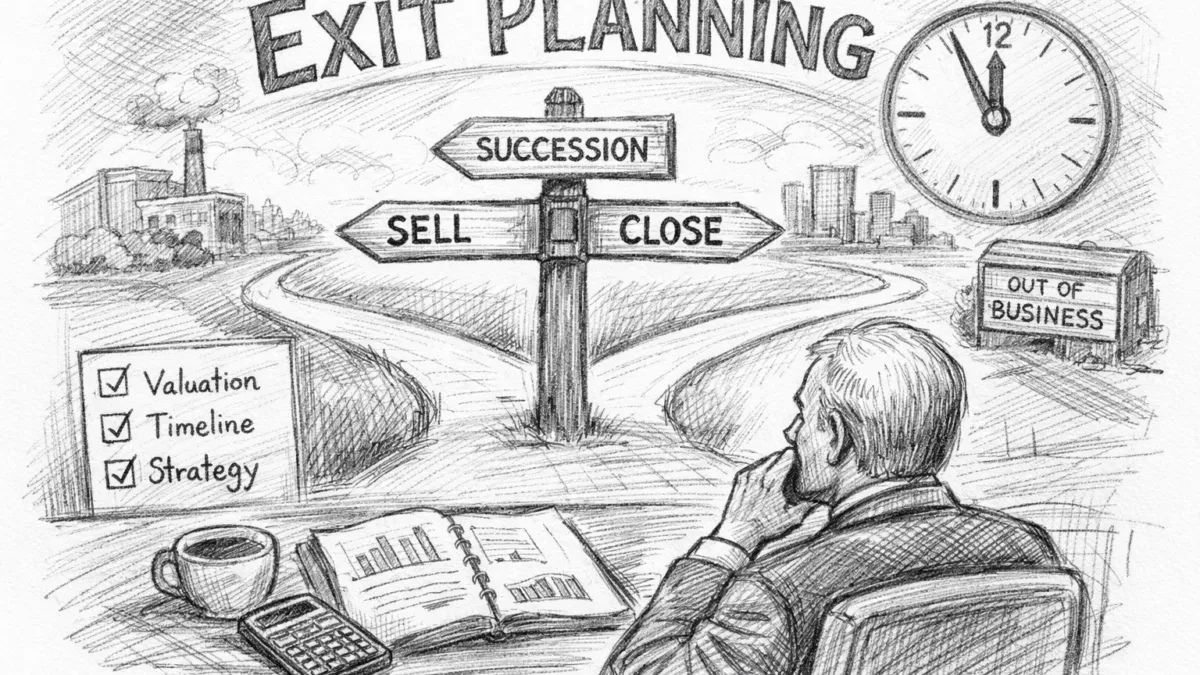
- Decide whether your likely path is sale, succession, continued ownership, or a phased step-back.
You are not committing to an exit date.
You are making sure you can choose one.
Your Move
Do not begin by asking, “Am I ready to sell?”
Ask a better question:
What would have to be true for me to have a real choice?
Then write down:
- Your best estimate of current business value.
- The amount you would need from a future exit.
- The three biggest points of owner dependence.
- The financial information you cannot currently trust.
- The one system you will document this month.
That is the beginning of an exit strategy.
You can keep running the business.
You can keep growing it.
You can keep enjoying the work.
But start building the company as if your future options matter: because they do.
For more guidance on thinking earlier and more intentionally about business exit planning, visit the exit planning section or work with Mike.