You tell yourself you have plenty of time.
The business is stable. Revenue is ticking upward. The team handles the day-to-day.
So exit planning gets pushed to next quarter. Or next year. Or whenever things "slow down."
Here is the brutal truth of business ownership: Waiting is not a neutral act.
Every month you delay exit planning carries a hidden, compounding price tag. It shows up in lower valuations, restricted buyer pools, painful deal structures, and lost leverage. When you wait until you are personally ready to leave, the market has already made its decision for you.
As explored in our deep dive on why most business owners wait too long, procrastination is the single most expensive habit an entrepreneur can cultivate.
Let’s dismantle the comforting illusions around timing and look at what delaying your exit actually costs.
1. The 20% to 50% Valuation Haircut
Most business owners believe their company is worth whatever number feels right in their head, or whatever peak year they experienced last cycle.
The market disagrees.
Buyers do not pay for potential that exists only in your imagination. They pay for durable, transferable, de-risked cash flow.
When you delay preparation, you leave your business exposed to predictable value killers:
- Customer concentration: Relying on two or three major clients for the bulk of revenue.
- Key-person dependency: A business where every major decision stops at your desk.
- Messy financials: Lack of clean reporting, normalized earnings, or audited statements.
Unprepared businesses routinely suffer a 20% to 30% valuation penalty compared to companies that spent years cleaning up their operations. On a $3 million EBITDA business trading at a 5x multiple, that delay costs you $3 million to $4.5 million in lost enterprise value.
As we outline in what your business is really worth and why most owners get it wrong, guessing your value without preparation is an expensive gamble.

2. Deal Terms That Favor the Buyer
The cost of waiting isn’t just paid in headline price. It is paid in the structure of the deal.
When you are forced into a rushed exit: triggered by burnout, health issues, or sudden market shifts: your negotiating leverage drops to zero.
Here is what happens when you have no runway:
- Heavy seller financing: Instead of walking away with cash at close, you are forced to finance a large portion of the purchase price over five years, tying your retirement to the future performance of a company you no longer control.
- Aggressive earnouts: Buyers demand complex performance milestones to bridge valuation gaps, shifting all downside risk onto your shoulders.
- Retrades during diligence: Every minor flaw discovered in due diligence becomes a weapon for the buyer to slash the price at the eleventh hour.
When you start early: ideally 3 to 5 years before your target transition: you control the narrative. You present clean financials, institutionalize processes, and attract multiple competing buyers.
3. The Toll of Operational Fatigue
What breaks if you disappear tomorrow?
If the honest answer is "everything," you do not own a business. You own a demanding job that you cannot quit.
Many owners fall into the trap of the "one more year" strategy. They push through exhaustion, putting off systematic delegation and automation, hoping the business will magically run itself by the time they reach retirement age.
It doesn’t.
In reality, operational fatigue causes owners to underinvest in growth, tolerate underperforming talent, and ignore emerging market threats. By the time the business actually hits the market, EBITDA has shrunk, growth has stalled, and fatigue is written all over the owner's posture.
Buyers smell desperation. They price it into their offers accordingly.

4. The Illusion of "Timing the Market"
Many owners delay selling because they are waiting for the "perfect macroeconomic window."
They want interest rates to drop, industry multiples to spike, or tax laws to shift in their favor.
This is a dangerous delusion.
You cannot control external market cycles. You can only control internal business readiness. A world-class, highly transferable business with clean financials and strong management can command a premium in almost any economic climate. Meanwhile, a fragile, owner-dependent business will struggle to sell even in a booming seller's market.
As discussed in the most expensive mistake business owners make, waiting for market perfection is often just a psychological defense mechanism against the discomfort of letting go.
5. Vision Fox Business Advisors: Turning Preparation into Leverage
You do not have to navigate this transition alone.
Understanding your company’s true baseline value and uncovering hidden operational risks requires an objective, outside perspective. That is where our partner firm, Vision Fox Business Advisors, steps in.
Vision Fox helps successful business owners evaluate their company’s market readiness, optimize valuation multiples, and build a concrete multi-year exit strategy before time forces their hand.
Preparation transforms you from a panicked seller into a confident builder who dictates terms on your own schedule.

Summary: The Math of Inaction
Let’s look at the simple ledger of delay:
- Lower valuation multiples due to unaddressed business risks.
- Less cash at close driven by heavy earnouts and seller financing.
- Eroding EBITDA caused by owner burnout and delayed capital reinvestment.
- Zero negotiating leverage when external events force a hasty exit.
The price of waiting isn't measured in abstract theory. It is measured in millions of dollars of lost wealth and years of compromised freedom.
Your Move
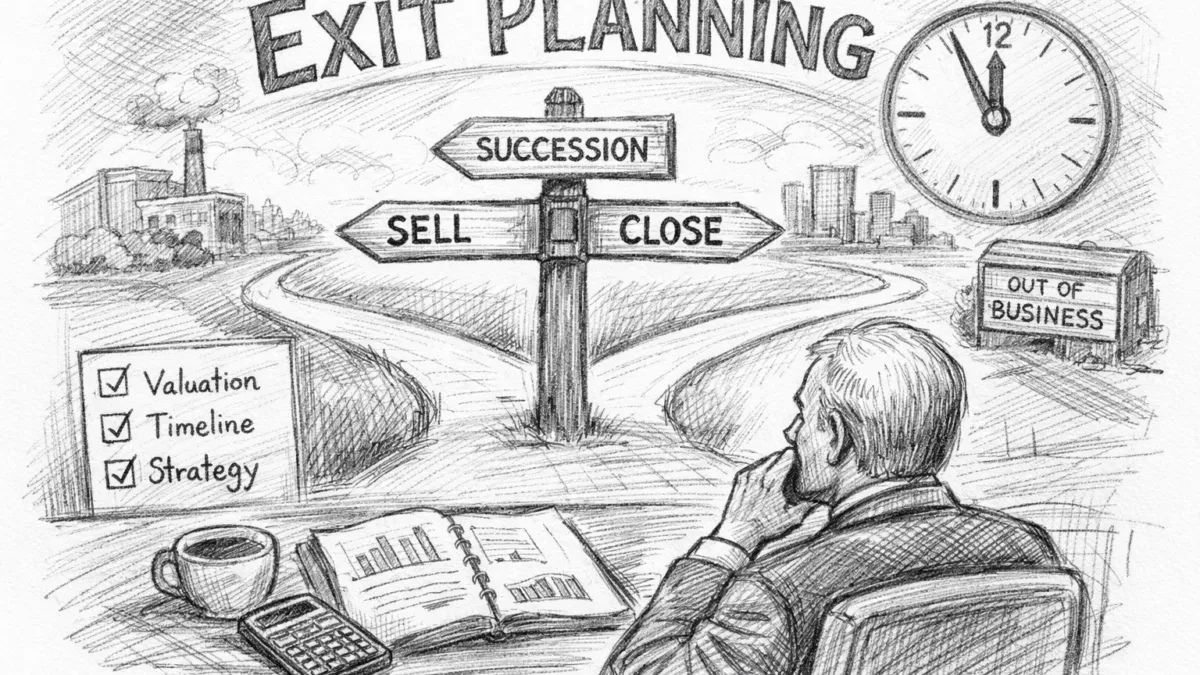
Stop treating your exit as a retirement event that happens to you. Treat it as a strategic project that you manage.
- Audit your dependence: List every critical function that requires your personal daily intervention. Make a 12-month plan to delegate or automate them.
- Get an objective valuation: Stop guessing what your company is worth. Find out what buyers will actually see.
- Build your runway: Give yourself a 3-to-5-year window to optimize earnings, clean up records, and position your company for maximum leverage.
The clock is ticking whether you plan for it or not. Decide what the outcome looks like before time decides for you.
{“@type”:”BlogPosting”,”author”:{“name”:”Mike Steward”,”@type”:”Person”},”@context”:”https://schema.org”,”headline”:”The Price of Waiting: What Delaying Exit Planning Actually Costs You”,”publisher”:{“url”:”https://beforetheclockdecides.com/”,”name”:”Before the Clock Decides”,”@type”:”Organization”},”description”:”Explore the financial, emotional, and opportunity costs of delaying business exit planning, and learn why proactive preparation protects your legacy and valuation.”,”mainEntityOfPage”:{“@id”:”https://beforetheclockdecides.com/blog”,”@type”:”WebPage”}}