You’ve spent decades building a business. You’ve survived recessions, outlasted competitors, and probably missed more than a few family dinners. Now, the finish line is in sight.
But as you look toward the exit, you’re faced with a choice that feels less like a financial transaction and more like a moral crossroads.
Do you sell to the people who helped you build it, your managers, your partners, or even your kids? Or do you put it on the open market and see who writes the biggest check?
Most owners get paralyzed here. They want the big payout, but they don’t want to see their life’s work dismantled by a corporate giant. They want to reward their team, but they don't want to act as the bank for the next ten years.
The truth is, "Legacy" is the most expensive word in the English language.
If you aren't careful, your desire for a legacy will cost you millions. If you aren't intentional, your desire for money will kill the very thing you created.
Let’s stop the guessing and look at the hard numbers and the harsh realities of Internal Buyouts versus Third-Party Sales.

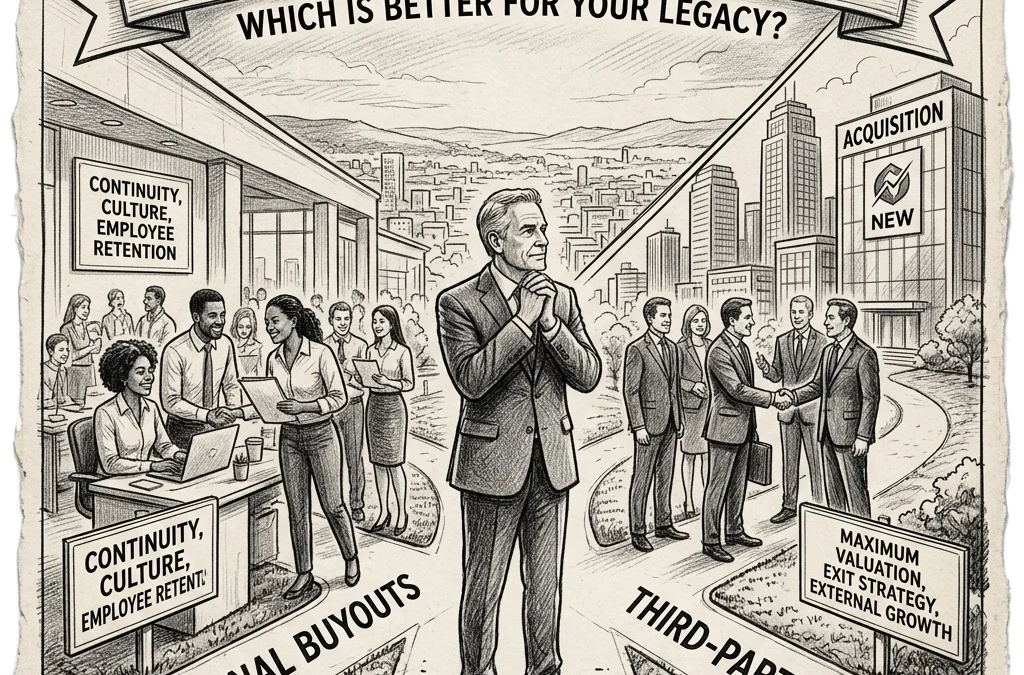
A black and white pencil sketch of a business owner standing at a crossroads, one path leading to a familiar office building and the other toward a shimmering city skyline.
The Internal Buyout: The "Feel Good" Choice That Costs You
Selling to your employees or family feels right. It’s the ultimate "thank you" to the people who stayed in the trenches with you. It’s the smoothest way to ensure the culture doesn't change and the clients don't get spooked.
But let’s be honest: Your employees don’t have your money.
When you sell internally, you aren't getting a bag of cash at the closing table. You are getting a promissory note. You are betting that the people you leave in charge can run the business well enough to pay you back over the next five to ten years.
The Reality of the Internal Sale:
- Lower Valuation: You will almost always get a lower price. Internal buyers don't have the "synergy" that a competitor has. They are buying a job; a competitor is buying market share.
- The Bank of You: Expect to carry 60% to 100% of the debt. If the business hits a wall two years after you leave, your retirement goes up in smoke.
- Emotional Complexity: It’s hard to negotiate a hard-nosed deal with someone who has sat in your office for fifteen years. You’ll likely leave money on the table just to keep the peace.
If you are considering this path, you need to be honest about whether your business can actually run without you. We’ve covered this in depth in our guide on The Owner-Optional Business. If the business breaks the moment you stop answering the phone, an internal buyout is a suicide mission for your retirement.
The Third-Party Sale: The "Cash Out" That Changes Everything
An external sale, selling to a competitor, a strategic buyer, or Private Equity, is a different animal entirely. This is where you find out What Your Business Is Really Worth.
External buyers aren't buying your history; they are buying your future cash flows. They are looking for ways to plug your company into theirs to make 1+1=3. Because of that, they will pay a premium that your managers simply can't afford.
The Reality of the External Sale:
- The Big Check: You get most (if not all) of your cash upfront. You walk away with liquidity.
- Loss of Control: Once the wire hits your account, it’s not your business anymore. If the new owners want to fire your favorite manager or change the company name to "Global Logistics X," they can.
- Due Diligence Hell: An external buyer will look under every rug and in every closet. They will find the skeletons. If your books are a mess, they will grind you down on price or walk away entirely.

Which Is Better for Your Legacy?
Owners often think a third-party sale is the "death" of their legacy. They worry about the "soul" of the company being lost.
But here’s the hard truth: A business that goes bankrupt under poor internal management is a much worse legacy than a business that thrives under new ownership, even if the name changes.
If your managers are great operators but terrible entrepreneurs, an internal buyout will kill the business. If a strategic buyer has the capital to take your invention to the global stage, that might be the greatest tribute to your work possible.
Ask yourself these three questions:
- Does the business depend on my "magic"? If yes, no one can buy it yet.
- Does my team actually want the risk of ownership? Many employees love the paycheck but hate the debt.
- Is my priority "The People" or "The Proceeds"? There is no wrong answer, but you can’t have 100% of both.
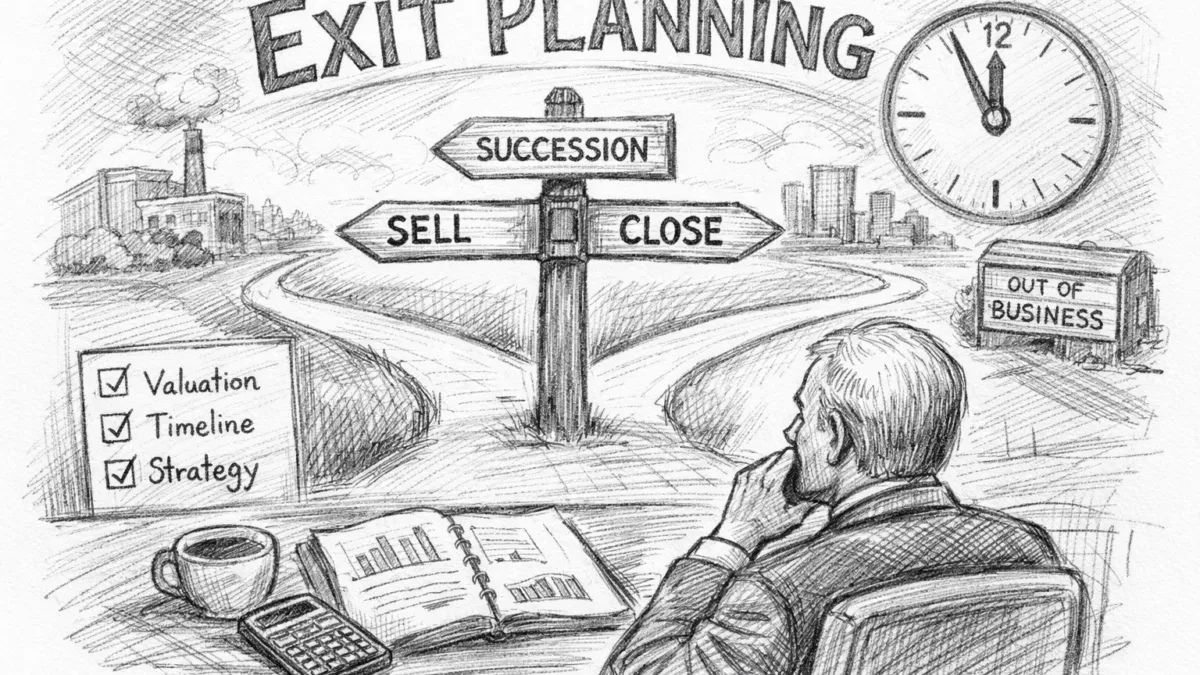
For many, the answer lies somewhere in the middle. This is why Selling a Family Business vs. Succession Planning is such a complex debate. You have to decide what "success" looks like when the clock finally stops.
The Mathematics of Choice
Let’s look at a hypothetical scenario.
Your business generates $1M in profit.
An Internal Buyout might value the company at 3x profit ($3M). You get $500k at closing and a $2.5M note paid over 7 years. You stay on as an advisor for 2 years to ensure they don't screw it up. Your legacy is safe, but your lifestyle is tied to their performance.
A Third-Party Sale might value the company at 5x profit ($5M). You get $4M at closing and $1M in an "earn-out" based on future performance. You walk away in 6 months. Your bank account is full, but your name might be off the building by next Christmas.
Which one allows you to sleep at night?
The Danger of Waiting Too Long
The worst thing you can do is avoid making the choice. Indecision is a decision for failure.
I see it every month: an owner who wanted an internal buyout but didn't train the team, or an owner who wanted an external sale but let the business decline while they "thought about it."
When you wait, you lose leverage. And when you lose leverage, your legacy becomes a fire sale. We call this The Most Expensive Mistake Business Owners Make.
If you want an internal buyout, you need to start preparing your successors five years before you leave. If you want a third-party sale, you need to clean up your balance sheet and remove yourself from the operations today.
The Truth About Transition
Neither path is easy.
Neither path is guaranteed.
An internal buyout preserves the "vibe" but keeps you at risk.
A third-party sale gives you freedom but forces you to let go.
The "better" option is the one that aligns with your actual goals: not the goals you think you should have. If you want to travel the world and never think about a P&L statement again, take the external money. If you want to see your protege's kids go to college on the profits of the firm you started, take the internal deal.
Just don't lie to yourself about the trade-offs.

Your Move
You can't decide your path until you know what you're actually holding. Most owners have a distorted view of their business's value and its readiness for transition.
- Get a Real Valuation: Stop using "back of the napkin" math. Know what an outsider would actually pay.
- Audit Your Team: Sit down with your key people. Ask them, honestly: if they want to own the place. You might be surprised to find out they don't want the headache.
- Check the "Owner-Optional" Meter: If you took a 90-day vacation starting tomorrow, what would happen? If the answer is "total chaos," you don't have a legacy; you have a job. You need to build a business that runs without you before you can sell it to anyone.
The clock is deciding for you every day you spend in "analysis paralysis." Pick a path, build the bridge, and cross it on your own terms.
Need to know where you stand? Explore our Exit Planning resources to start building your roadmap before the clock decides for you.