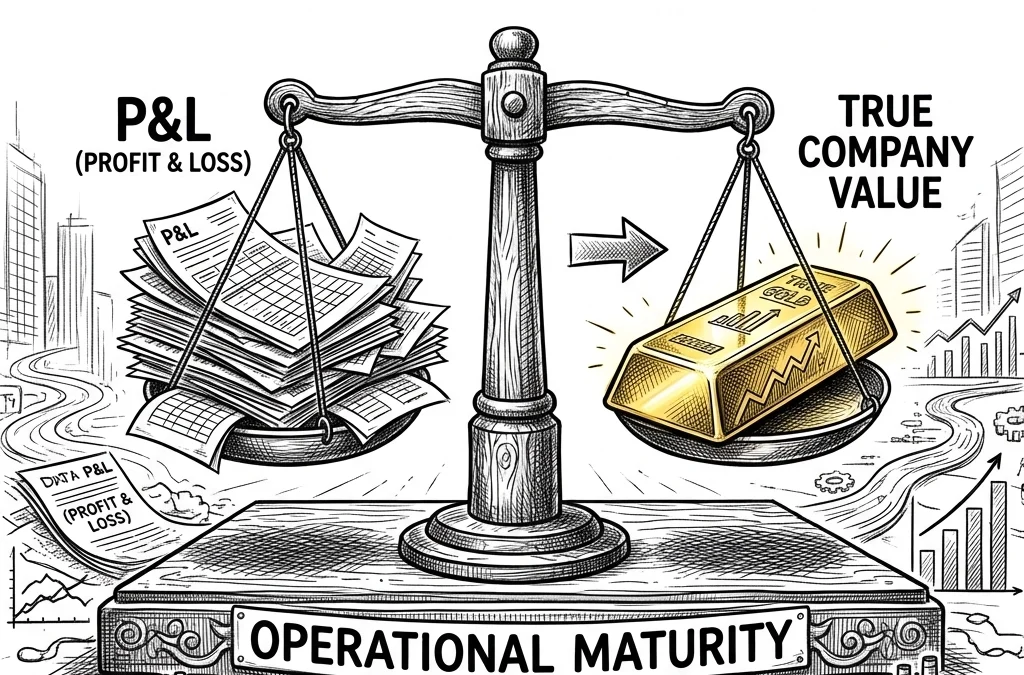
Your Profit and Loss statement is a lie.
Not a legal lie, I’m sure your CPA is doing their job. But it’s a conceptual lie. Most owners look at the bottom line and see a number that represents their hard work. They see "Net Income" and think they see "Value."
They are wrong.
In the world of professional buyers, private equity, and savvy competitors, your P&L is just the entry fee. It tells them if you have a business worth looking at. It does not tell them what that business is worth.
If you want to know what your business is really worth, you have to look past the numbers and into the machine. We call this Operational Maturity. It is the new gold standard for valuation.
The Myth of the "Profitable" Bottleneck
I see this every week. An owner brings me a business doing $2M in EBITDA. On paper, it’s a gold mine.
Then I start asking questions.
"Who handles the top three accounts?" The owner.
"Who approves the final designs?" The owner.
"Who steps in when a key employee quits?" The owner.
That business isn’t an asset. It’s a high-paying, high-stress job that the owner happens to own.
A business that depends on its owner is a liability, not an investment.
When a buyer looks at a business like this, they see risk. If you, the owner, are the "secret sauce," what happens when you leave? The value evaporates. This is why many owners are shocked to find that their "profitable" company commands a pathetic multiple, or worse, no interest at all.
 ]
]
What Operational Maturity Actually Is
Operational maturity isn't about how long you’ve been in business. It’s not about having the latest software or a fancy office.
Operational maturity is the measurable ability of your business to produce predictable results without your intervention.
It is the transition from Hero Culture to Process Culture.
- Hero Culture: A fire breaks out. You, the hero, grab the hose. You save the day. Everyone cheers. The business survives another 24 hours.
- Process Culture: A sensor detects heat. A sprinkler system activates. The fire is suppressed before anyone even smells smoke. You stay on vacation.
Buyers pay for the sprinkler system. They don’t want to buy the hero.
The Transferability Test
Value is found in transferability.
If I buy your company today, can I run it tomorrow? If the answer is "No, because Mike has all the relationships in his head," your valuation just dropped by 40%.
Operational maturity creates a "plug-and-play" environment. It’s why a McDonald's franchise is worth more than a local five-star bistro. The bistro has better food, but the McDonald's has a system that works regardless of who is flipping the burgers.
You need to build an owner-optional business. This isn't just about retirement; it’s about creating a transferable asset.

The Three Pillars of Operational Maturity
To move beyond the P&L, you must focus on three specific areas that professional buyers scrutinize during due diligence.
1. The Documentation of "How"
Most businesses have a "way" of doing things, but it’s tribal knowledge. It lives in the minds of employees who might leave for a 10% raise down the street.
Operational maturity requires Standard Operating Procedures (SOPs). Not a dusty manual on a shelf, but living, breathing processes that dictate exactly how value is created, sold, and delivered.
If it isn’t documented, it doesn’t exist in the eyes of a buyer.
2. The Management Layer
If you are the only one holding people accountable, you are the bottleneck.
A mature business has a middle management layer that manages the systems, not the people. They use KPIs (Key Performance Indicators) to measure success. They don't need to ask you what to do next because the data tells them.
3. Predictable Revenue (Not Just "Sales")
Anyone can have a good month. A mature business has a repeatable system for acquiring customers.
Is your revenue based on your personal "hustle"? Or is it based on a marketing and sales engine that functions 24/7? Buyers will pay a premium for recurring revenue or predictable lead flow. They will discount "lumpy" revenue that requires the owner's constant involvement to close deals.
The Math of Maturity: Why Multiples Matter
Let’s talk about the money.
In the middle market, businesses are valued as a multiple of EBITDA.
Imagine two companies, Company A and Company B. Both have $1M in EBITDA.
- Company A is operationally immature. The owner works 60 hours a week. There are no SOPs. Customer concentration is high.
- Company B is operationally mature. The owner works 5 hours a week on "big picture" strategy. Systems drive everything.
A buyer might offer Company A a 3x multiple ($3M).
That same buyer might offer Company B a 6x multiple ($6M).
The operational maturity of Company B literally doubled its value, even though the profit was identical.
This is why focusing solely on your P&L is a mistake. You can work yourself to death trying to squeeze out another $100k in profit, or you can build systems that move your multiple from a 3 to a 5.
The math is clear: Systematization yields a higher ROI than hustle.

The "Bus Test" Diagnostic
I want you to be honest with yourself.
If you were hit by a bus tomorrow: or more pleasantly, if you decided to disappear to an island with no cell service for 30 days: what happens to your business?
- Does it grow?
- Does it stay the same?
- Does it slowly decline?
- Does it immediately catch fire?
If your answer is 3 or 4, you are not building an asset. You are maintaining a job.
Most owners make the most expensive mistake of waiting until they are burnt out to start building systems. By then, it’s often too late to get the valuation they deserve.
Moving From Builder to Owner
There is a difference between being a "business builder" and a "business owner."
Builders are in the trenches. They are proud of their callouses. They think the "grind" is a badge of honor.
Owners are architects. They design the trenches. They hire the builders. They spend their time looking at the blueprints to ensure the structure is sound.
The market rewards architects. It ignores the weary builder.
If you want to sell your business without regret, you have to stop being the most important person in the room.
 ]
]
The Reality Check
Building operational maturity is boring.
It’s not as exciting as landing a big client or launching a new product. It involves writing things down, training people, and letting go of control.
But it is the only way to protect your legacy and maximize your exit.
Buyers are looking for reasons to pay you less. Every time you show them a process that requires your input, you give them a discount. Every time you show them a system that runs on its own, you add a zero to your net worth.
Don't wait until you want to sell to start this process. Exit planning starts earlier than you think. It should start the day you open your doors.
Your Move
Stop looking at your P&L for validation. Start looking at your operations for value.
- Identify the Bottleneck: For one week, write down every time a staff member asks you for a decision. That is a process that isn't documented.
- Document One System: Choose the most frequent question and write a one-page SOP for it.
- Delegate the Decision: The next time that question comes up, point to the document.
- Repeat: Do this until you are redundant.
You aren't just making your life easier. You are making your business more valuable.
If you aren't sure where to start, or if you want to know how your current operations would hold up under a buyer's microscope, we've laid out the entire roadmap in our book, Before the Clock Decides.
The clock is ticking. Either you build a mature business, or you build a job you can't leave.
The choice is yours. Make it before the market makes it for you.