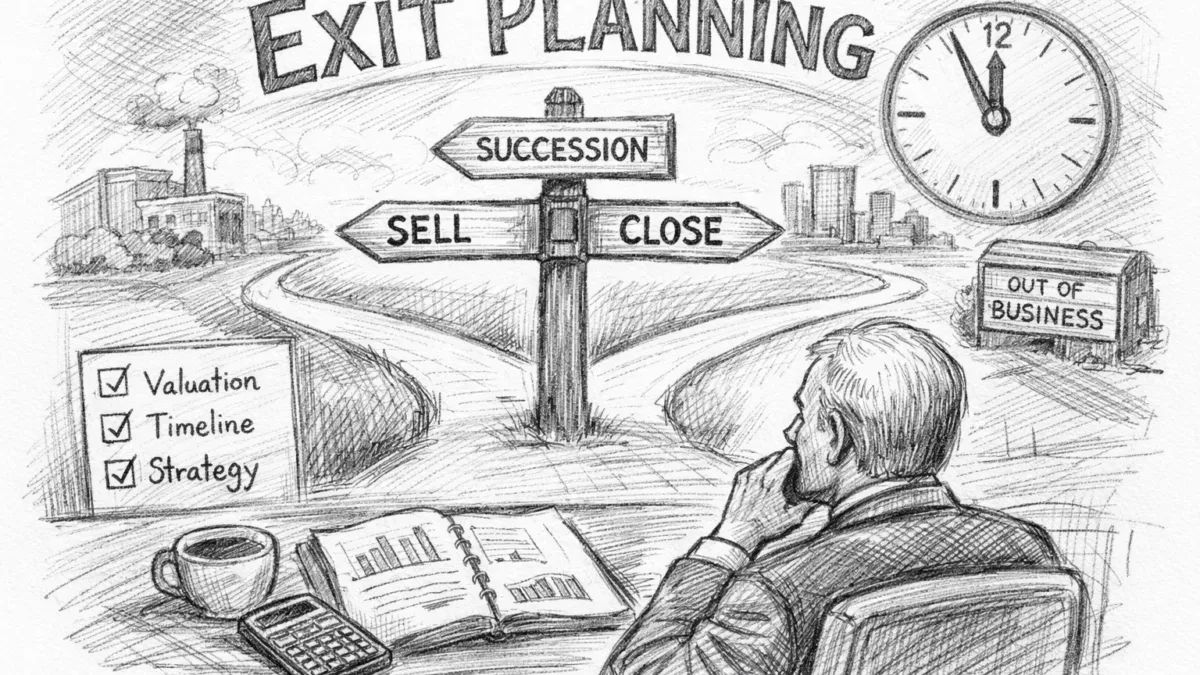
Most owners carry a number in their head.
They may call it the value of the business. But often, it is a guess built from:
- Revenue
- Years in business
- Equipment
- A friend’s sale
- An industry multiple heard at a conference
- What the owner needs to retire
That number may feel reasonable.
A buyer may not pay anything close to it.
The exact “14%” figure in this headline is not a universal, independently verified benchmark. But the warning is real. Recent survey data suggests many owners do not know their company’s value until they are already preparing to sell, while others track value through broad market trends rather than a formal valuation.
That is too late.
You do not need to be ready to sell to understand what your business is worth.
You need to understand it because value affects your options, your retirement, your succession plan, and your negotiating position.
Here are five practical steps to get closer to a real, defensible answer.
Step 1: Stop confusing revenue with value
Revenue is activity.
Value is the economic benefit a buyer believes the business can produce after the transaction.
Those are not the same thing.
A company generating $3 million in revenue with $200,000 in sustainable earnings may be worth less than a company producing $1.5 million in revenue with $400,000 in sustainable earnings.
Buyers follow the money.
They care about:
- Sustainable cash flow
- Profit margins
- Customer quality
- Growth
- Transferability
- Risk
If revenue rises but earnings do not, then the company may be getting bigger without becoming more valuable.
Start with the right question:
What economic benefit does this business produce for the next owner?
For a small, owner-operated company, that often means calculating Seller’s Discretionary Earnings, or SDE.
A basic version looks like this:
SDE = Net income + owner compensation + legitimate owner benefits + interest + depreciation + amortization + unusual one-time expenses
For a larger company with management in place, buyers may focus more heavily on EBITDA:
EBITDA = Earnings before interest, taxes, depreciation, and amortization
These figures are not interchangeable.
A buyer evaluating a company that depends on the owner will think differently from a buyer evaluating a business with an independent management team.
That distinction matters.
Step 2: Clean the numbers before applying a multiple
A valuation built on messy financial statements is not a valuation.
It is a spreadsheet with confidence problems.
Before you ask, “What multiple should I use?” gather:
- At least three years of income statements
- Balance sheets for the same period
- Current-year results
- Trailing twelve-month performance
- Tax returns
- Debt schedules
- Major customer information
- Payroll and owner compensation details
Then separate normal business expenses from items that will not continue after a sale.
Examples may include:
- Personal expenses paid through the company
- One-time legal costs
- Unusual repairs
- Non-recurring consulting fees
- Excess owner compensation
- Expenses tied only to a past event
Be careful here.
Owners often believe every personal expense should be added back. Buyers do not automatically agree.
An add-back is not valuable because you claim it. It is valuable because you can explain and support it.
The goal is not to make the business look artificially profitable.
The goal is to show what a reasonable buyer can expect to earn under normal operating conditions.
Harvard Business School’s overview of how to value a company explains why different methods produce different answers, and why basic book value alone often fails to capture the economic value of an operating business.
Step 3: Use the right valuation method: not the most flattering one
There is no single universal formula for business value.
There are several approaches, and each answers a different question.
Income approach
What can the business produce?
For many small businesses:
Estimated value = SDE × relevant SDE multiple
For larger companies:
Enterprise value = EBITDA × relevant EBITDA multiple
The multiple depends on risk, size, industry, growth, customer concentration, management depth, and owner dependence.
A 3x multiple is not a law.
It is a market judgment.
Market approach
What have similar businesses actually sold for?
This can include:
- Comparable transactions
- Industry sale data
- Price-to-SDE multiples
- EV-to-EBITDA multiples
- Revenue multiples where appropriate
The market approach helps prevent you from building a valuation around wishful thinking.
Asset approach
What are the assets worth after liabilities?
This matters more for asset-heavy companies, underperforming businesses, and situations where liquidation value creates a realistic floor.
Harvard Business School notes that simple book value can be unreliable because accounting records often reflect historical cost rather than current economic value.
Use the asset approach as a check.
Do not automatically treat it as the answer.
A business is not valuable merely because it owns equipment. It is valuable when those assets help produce transferable earnings.

Step 4: Discount the value for buyer risk
This is where many owner estimates fall apart.
The owner sees strengths.
The buyer sees exposure.
Ask yourself:
- What happens if the largest customer leaves?
- What happens if the owner stops answering calls?
- What happens if the top salesperson resigns?
- What happens if a key vendor changes terms?
- What happens if margins shrink by 10%?
- What happens if the business faces a six-month slowdown?
These questions do not mean the business is weak.
They reveal how much confidence a buyer can place in its future.
A company with $500,000 in EBITDA might attract a stronger multiple if it has:
- Recurring revenue
- Diversified customers
- Documented processes
- A dependable management team
- Clean financial reporting
- Stable or improving margins
- Limited owner dependence
The same $500,000 of EBITDA may receive a lower multiple if:
- One customer produces 40% of revenue
- The owner controls every important relationship
- Financial records require major cleanup
- Employees lack clear accountability
- Revenue depends on one product or contract
- The company has no repeatable sales process
Here is the math.
If a business earns $500,000 and receives a 3x multiple, the estimated enterprise value is $1.5 million.
If stronger systems and lower risk support a 4x multiple, the same earnings produce $2 million.
That is a $500,000 difference without adding a dollar of revenue.
Value is not only about how much the business earns. It is about how confident a buyer is that the earnings will continue.
The company must become more than profitable.
It must become transferable.
Step 5: Have someone challenge your number
A valuation is not useful if it only confirms what you already believe.
You need a defensible range.
Not a fantasy number.
Not a retirement target.
Not a price designed to make you feel better.
A credible valuation should help you understand:
- What the business may be worth today
- Which assumptions support that range
- What issues could reduce buyer confidence
- What improvements could increase value
- What the likely sale proceeds may be after debt, taxes, fees, and deal structure
This is where an experienced advisor can expose the gap between owner value and market value.
Vision Fox Business Advisors helps owners understand the value of their company, prepare for a potential sale, and determine whether selling now: or preparing for a few more years: makes the most sense. Their business valuation resources and business valuation calculator can provide a starting point, but a serious decision requires context beyond a calculator.
The purpose of valuation is not to force you into a sale.
It is to give you choices.
Mike Steward’s work with owners focuses on that same question: what is the business worth today, and what would move the number tomorrow?

What a real valuation changes
One owner may discover that the business is worth less than expected.
That is uncomfortable.
It is also useful.
If the owner has five years before a planned exit, there is time to:
- Reduce customer concentration
- Build a management layer
- Improve margins
- Document operations
- Clean up financial reporting
- Strengthen recurring revenue
- Remove personal expenses from the business
- Stop making every decision personally
The owner moves from bottleneck to builder.
Another owner may discover that the business is worth more than expected: but only if the company can keep performing without him.
That changes the conversation too.
A valuation is not a trophy. It is a diagnostic tool.
It tells you what is working.
It tells you what is fragile.
It tells you where time and capital will produce the greatest return.
Your Move
Do not wait until a buyer asks what your company is worth.
Create a first-pass valuation this month:
- Gather three years of financial statements.
- Calculate normalized SDE or EBITDA.
- Identify realistic comparable multiples.
- List the five risks a buyer would challenge.
- Ask an experienced advisor to test your assumptions.
Then ask the harder question:
If I disappeared from the business tomorrow, what would break?
The answer will tell you more about value than revenue ever will.
For more on the decisions owners face before an exit, read What Your Business Is Really Worth: and Why Most Owners Get It Wrong and explore the broader ideas behind Before the Clock Decides.
You do not need to sell today.
But you do need to know what you are building toward.
{“@graph”:[{“@type”:”Article”,”about”:[“Business valuation”,”Business valuation for sale”,”How to value a company”,”How to sell your business”],”image”:[“https://cdn.marblism.com/rkuDlM12uCU.webp”,”https://cdn.marblism.com/c17SOpQMMlW.webp”,”https://cdn.marblism.com/j7CaxGPTrkz.webp”],”author”:{“name”:”Mike Steward”,”@type”:”Person”},”headline”:”Only 14% of Owners Know Their Company’s Real Value. Here’s How to Join Them (in 5 Steps)”,”publisher”:{“url”:”https://beforetheclockdecides.com/”,”name”:”Before the Clock Decides”,”@type”:”Organization”},”description”:”A practical five-step guide for business owners who want to understand company value, prepare for a potential sale, and build a more transferable business.”,”mainEntityOfPage”:”https://beforetheclockdecides.com/”},{“name”:”How to Understand What Your Company Is Worth”,”step”:[{“name”:”Stop confusing revenue with value”,”text”:”Focus on sustainable earnings, cash flow, transferability, and buyer confidence rather than revenue alone.”,”@type”:”HowToStep”,”position”:1},{“name”:”Clean the financial statements”,”text”:”Gather at least three years of financial statements and normalize owner compensation, one-time expenses, and other supported adjustments.”,”@type”:”HowToStep”,”position”:2},{“name”:”Use the right valuation method”,”text”:”Compare income-based, market-based, and asset-based approaches to develop a realistic value range.”,”@type”:”HowToStep”,”position”:3},{“name”:”Discount for buyer risk”,”text”:”Evaluate customer concentration, owner dependence, management depth, recurring revenue, and operational systems.”,”@type”:”HowToStep”,”position”:4},{“name”:”Have an advisor challenge the number”,”text”:”Ask an experienced business advisor to test assumptions and identify what could increase or reduce buyer confidence.”,”@type”:”HowToStep”,”position”:5}],”@type”:”HowTo”,”description”:”Five practical steps business owners can use to develop a more realistic and defensible understanding of company value.”}],”@context”:”https://schema.org”}