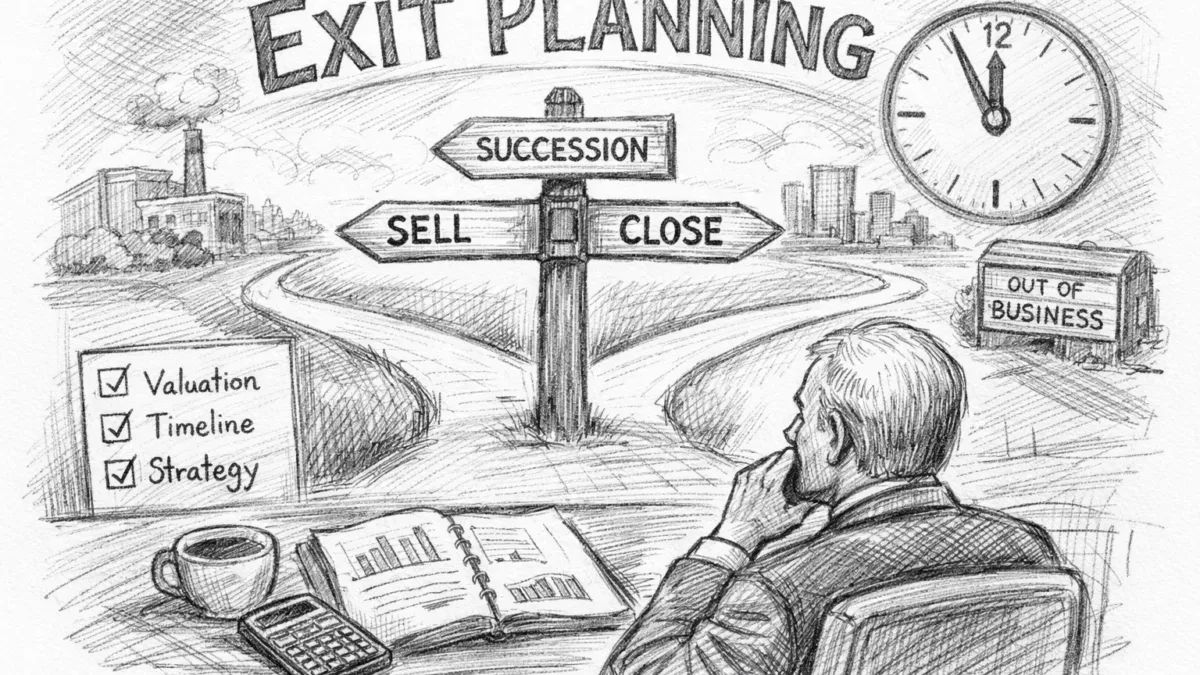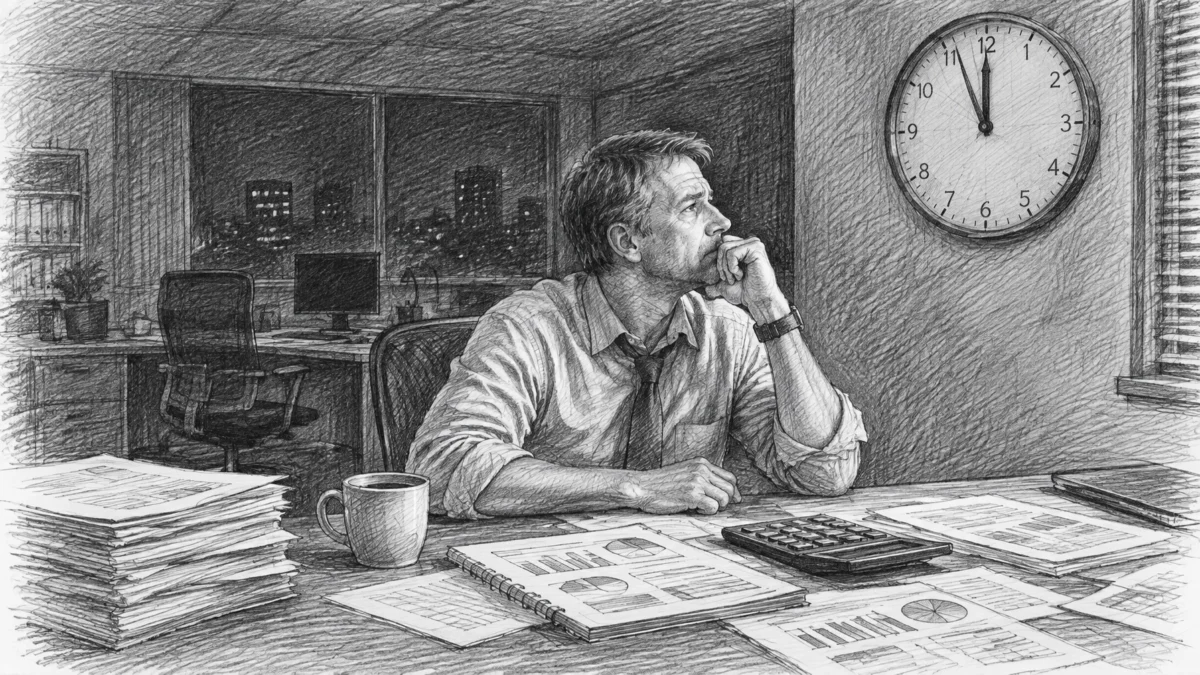
You may believe you will decide when to leave your business.
You may believe you will sell when the timing feels right.
You may believe your family, employees, or a buyer will figure out what happens next.
That belief is comfortable.
It is also dangerous.
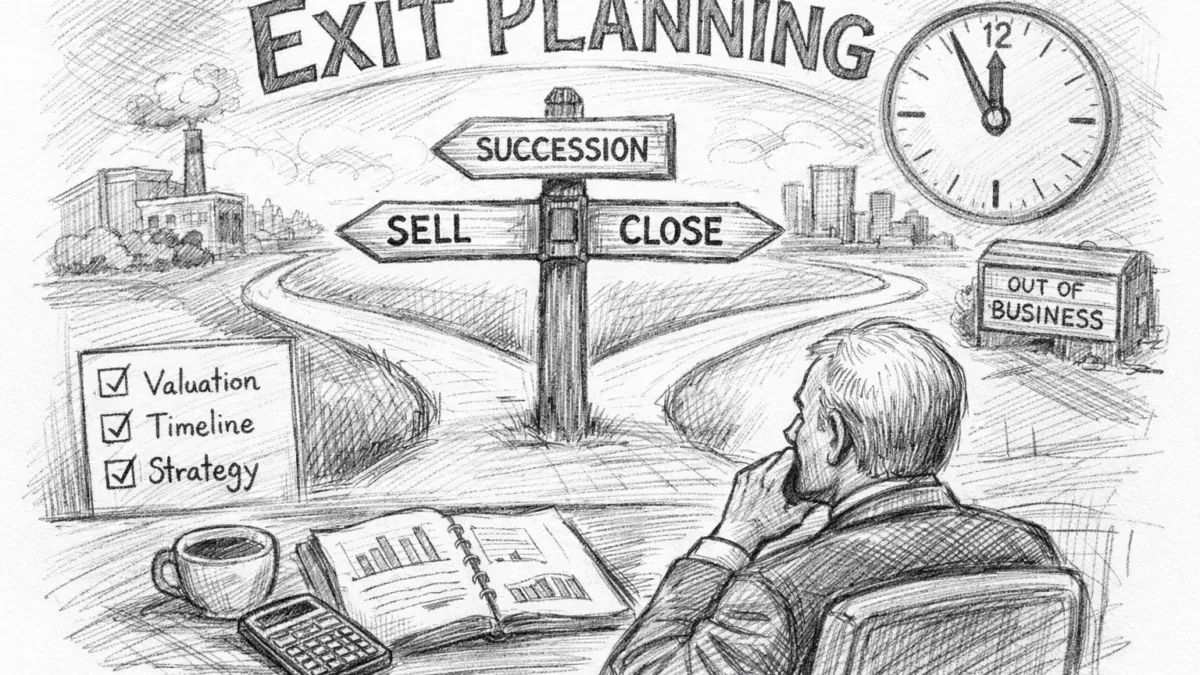
Every business eventually reaches an ending. It closes, sells, or passes to someone else.
The question is not whether your business will exit.
The question is whether you will shape that exit, or whether time, health, exhaustion, or market pressure will shape it for you.
The Exit You Don’t Choose
The exit you don’t choose is not always dramatic.
Sometimes it begins with a health problem.
Sometimes it begins with burnout you refuse to name.
Sometimes a key employee leaves, a major customer disappears, or your industry changes faster than your business can respond.
Sometimes the owner dies without a clear plan.
Then the clock takes over.
The family makes decisions under pressure.
Employees worry about their jobs.
Customers question the future.
Buyers see uncertainty.
And uncertainty lowers value.
This is not a prediction of disaster. It is a reminder of how ownership actually works.
If you do not create a plan while you have time, then circumstances will create one when you do not.
Planning Is Not Selling
Many owners avoid exit planning because they think it means putting the business on the market.
It does not.
Exit planning is not:
- Listing your company tomorrow.
- Telling your employees you are leaving.
- Committing to a buyer.
- Handing over control.
- Admitting that the business is failing.
It is something simpler.
It means understanding your options before you need them.
That includes knowing:
- What your business may be worth today.
- What makes the value rise or fall.
- How dependent the company is on you.
- Who could lead the business after you.
- How much money you actually need from an exit.
- How long it would take to prepare properly.
The owners who plan early are not necessarily leaving early.
They are building room to choose.
Read more about this distinction in Exit Planning Starts Earlier Than You Think.
Waiting Feels Safe. It Is Not.
Waiting avoids discomfort today.
That is the benefit.
It also creates a bill that arrives later.
Consider the math.
If your business generates $500,000 in annual earnings and a buyer values it at four times earnings, the rough value is $2 million.
If weak systems, owner dependence, customer concentration, or declining performance push that multiple down to three, the rough value becomes $1.5 million.
One turn of the multiple costs $500,000.
The problem is not always that earnings collapsed.
The problem is that buyer confidence did.
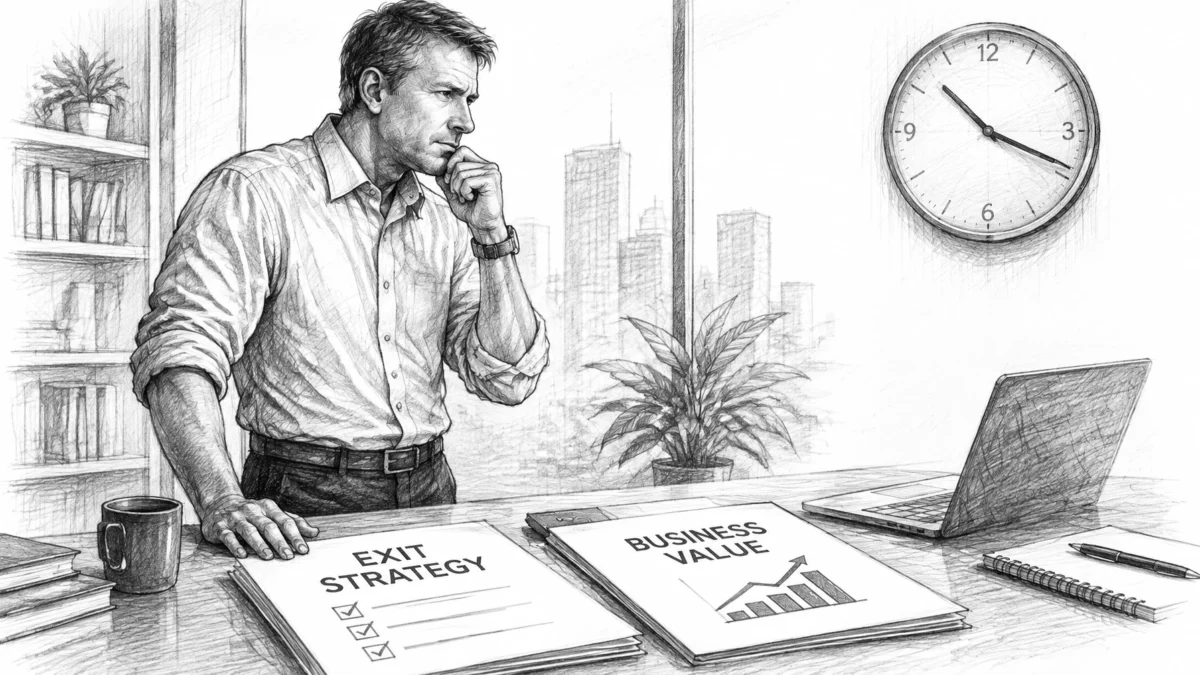
Value is not just earnings.
A practical way to think about it is:
Value = earnings × buyer confidence.
If earnings stay flat but confidence falls, value falls.
If earnings improve while confidence remains weak, the result may still disappoint.
Buyers do not pay for your effort.
They do not pay for how long you have worked.
They do not pay for the stress you carried home every night.
They pay for future cash flow and the confidence that the business can produce it without you.
That is why preparation matters.
What Buyers See When You Are the Business
You may see loyalty.
A buyer may see risk.
You may see personal relationships with customers.
A buyer may see revenue that could leave when you do.
You may see your ability to solve every problem.
A buyer may see a company that stops functioning when you step away.
This is the owner-dependency trap.
It often looks like:
- Every major decision requires your approval.
- Customers call your cell phone directly.
- Your best employees wait for your answer.
- Critical processes exist only in your memory.
- No one else can explain the numbers.
- The company slows down when you take a week off.
That may be how you built the business.
It is not how you make the business transferable.
A business that needs you every day may be successful. It is not yet independent.
If you disappear for 60 days, what breaks first?
The answer is not an insult.
It is a diagnostic tool.
The broken areas show you where value is trapped inside the owner.
You can start addressing them with documented processes, clear decision authority, stronger managers, and reliable reporting.
For more on this, see Build a Business That Runs Without You.
The Cost of a Forced Timeline
A planned exit gives you time to improve the company.
A forced exit gives you time to react.
Those are not the same thing.
With three to five years of runway, you may be able to:
- Clean up financial reporting.
- Reduce your personal involvement.
- Diversify your customer base.
- Improve margins.
- Develop second-layer leadership.
- Document critical systems.
- Resolve legal, tax, and ownership issues.
- Understand your personal financial requirements.
With three to five months, you may only be able to explain why those problems exist.
If a weakness takes three years to fix, then discovering it three months before a sale is not a strategy. It is a compromise.
The same principle applies to succession.
A successor cannot be prepared through a single meeting.
Authority must be transferred.
Relationships must be built.
Decisions must be tested.
Employees must gain confidence.
Customers must see continuity.
That takes time because trust takes time.

Why Smart Owners Still Delay
Most owners who delay are not careless.
They are busy.
They are optimistic.
They are emotionally attached to the company.
They also have a powerful excuse:
“I’m not ready to leave.”
That may be true.
But it does not answer the question.
You do not have to be ready to leave in order to prepare the business for your eventual departure.
You can keep running the company.
You can keep growing.
You can keep improving operations.
You can even decide never to sell.
The point is not to force an exit.
The point is to prevent a lack of preparation from forcing the outcome.
There is a difference between prepared waiting and passive waiting.
Prepared waiting looks like:
- Reviewing value annually.
- Building leadership depth.
- Documenting operations.
- Tracking customer concentration.
- Defining personal financial goals.
- Creating an if/then timeline.
Passive waiting sounds like:
- “We will figure it out later.”
- “The business will always be worth more next year.”
- “My son or daughter will take over.”
- “A buyer will understand what we have built.”
- “I know what it is worth.”
Hope is not a plan.
A Short Story Owners Recognize
I have seen owners who were the company’s greatest asset and its greatest bottleneck at the same time.
They knew every customer.
They solved every problem.
They carried every important decision.
At first, they believed that made the business strong.
Then they started changing the structure.
They gave managers real authority.
They documented the work.
They moved relationships from the owner to the team.
They reviewed the numbers more consistently.
The business did not become weaker.
It became more valuable, and the owner became less trapped inside it.
That is the transformation.
From bottleneck to builder.
From operator to owner.
From exhaustion to options.
What to Do Before the Clock Gets Loud
You do not need a 100-page exit plan this week.
Start with four direct questions.
1. What happens if I cannot work for 90 days?
Do not answer with confidence.
Answer with evidence.
Who makes decisions?
Who handles customers?
Who understands the cash?
Who has authority to act?
2. What is my business worth today?
Not what you hope it is worth.
Not what a friend says.
Not what another company sold for.
Get a grounded view of the earnings, transferability, risk, and buyer confidence that shape value.
What Your Business Is Really Worth, and Why Most Owners Get It Wrong explains why revenue alone does not answer the question.
3. Which exit paths are realistic?
Your choices may include:
- Selling to an outside buyer.
- Passing the company to family.
- Transferring ownership to management.
- Merging with another company.
- Continuing to operate it.
- Closing it responsibly.
Each path requires different preparation.
4. What must be true before I am ready?
Use if/then logic.
- If I want to sell within five years, then I need a value and risk review now.
- If family succession is possible, then the next generation needs development and authority, not just a title.
- If I want freedom from daily operations, then I need to build a company that can run without me.
- If I cannot explain what I need financially, then I am not ready to evaluate an offer.

Your Exit Should Be a Decision
The goal is not to predict every problem.
You cannot.
The goal is to build enough strength and clarity that problems do not make the decision for you.
A prepared owner has options.
A prepared business has resilience.
A prepared family has direction.
A prepared buyer sees less risk.
That does not guarantee a perfect outcome.
It does something more important.
It gives you a better chance to choose the outcome.
Before the Clock Decides was written for owners who want to understand value, build a transferable company, and create a 2–10 year path toward an intentional exit.
When the time comes, you may still decide to keep the business.
You may sell it.
You may pass it on.
But the decision should come from clarity, not panic.
Your Move
Write down three answers before the end of this week:
- What would break if I disappeared for 90 days?
- What do I believe my business is worth, and what evidence supports that number?
- What must improve before I can choose my exit with confidence?
Then take one action.
Document one process.
Delegate one decision.
Schedule one valuation conversation.
Identify one potential successor.
Small actions create strategic runway.
The clock is already moving.
Your advantage is not stopping it. Your advantage is deciding before it decides for you.
For help understanding your business value and future options, visit Vision Fox Business Advisors.