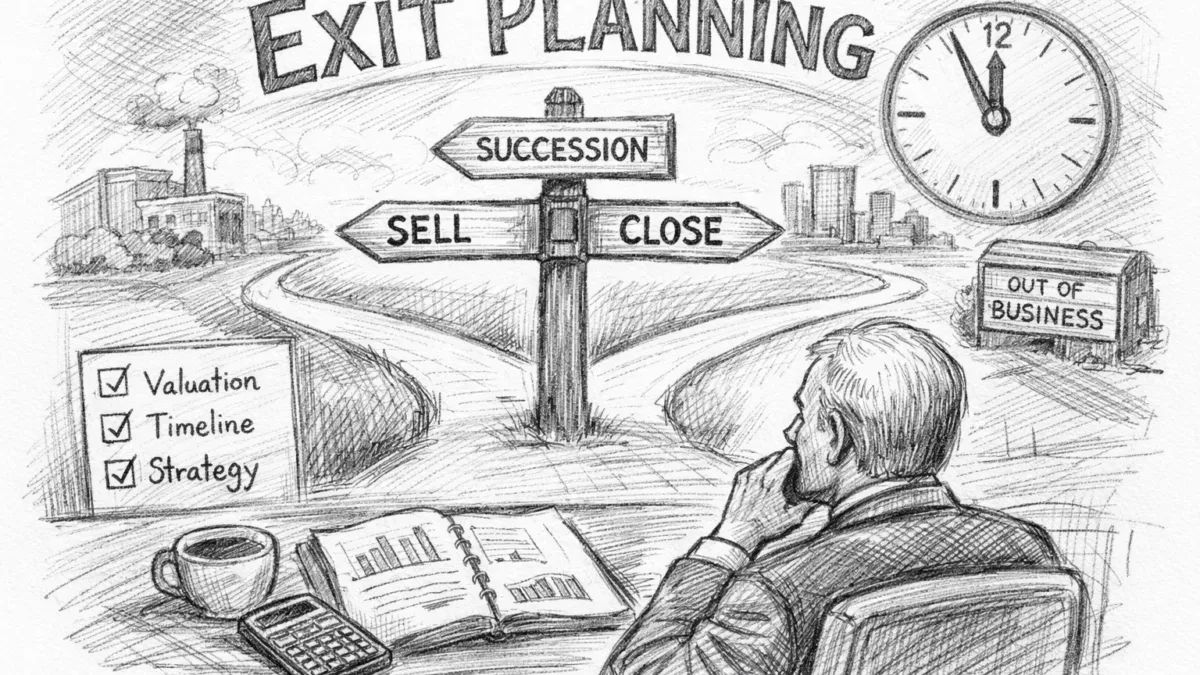
You sold the business.
The check cleared.
The wire hit your account.
Then the buyer calls.
A customer is upset. An employee wants approval. A supplier needs an answer. A major decision is sitting on the desk.
And somehow, you are still running the company.
That is the transition trap.
You believe the sale transferred the business.
The buyer knows whether it actually did.
You cannot cash the check and still remain the operating system.
If the company depends on your judgment, relationships, memory, and daily presence, then the buyer did not purchase a truly transferable business.
They purchased a business that still needs you.
That difference affects:
- The price you receive.
- The amount paid at closing.
- The size of any earnout.
- The length of your transition.
- Your ability to actually leave.
The Check Does Not Mean You Are Free
A sale is not the same as an exit.
The sale is a transaction.
The exit is a transfer of responsibility.
Those two events may happen months, or years, apart.
Many owners imagine a clean sequence:
- Sign the agreement.
- Receive the money.
- Say goodbye.
- Walk away.
That is possible.
But only when the business can operate without the owner.
If the business cannot operate without you, then the buyer has a problem. And when the buyer has a problem, the deal structure changes.
You may be asked to:
- Stay for 90 days, six months, or longer.
- Train managers and employees.
- Introduce the buyer to major customers.
- Protect key relationships.
- Help maintain revenue.
- Remain available for strategic decisions.
- Accept part of the purchase price as an earnout.
The sale may close.
But your dependence on the business does not disappear at closing.

Buyers Are Not Paying for Your Sacrifice
You may believe buyers are paying for:
- The years you spent building the company.
- The nights and weekends you sacrificed.
- The loyalty of your customers.
- The fact that everyone trusts you.
- The personal reputation you created.
Those things matter emotionally.
They do not automatically transfer economically.
Buyers pay for future cash flow they believe they can control.
That is the hard line.
If customers only trust you, the revenue is fragile.
If employees only listen to you, the team is fragile.
If you approve every meaningful decision, the operation is fragile.
If critical knowledge exists only in your head, the company is fragile.
A buyer sees those facts as risk.
And risk gets priced into the deal.
Here is the basic math:
- $1 million of earnings with low owner dependence may attract strong interest.
- $1 million of earnings that disappear when the owner leaves may receive a discount.
- If the buyer must replace your role, preserve your relationships, and rebuild your systems, the business is worth less to that buyer.
Same revenue. Same profit. Different transferability. Different value.
That is why understanding what your business is really worth requires more than looking at the income statement.
The Transition Period Is a Test
A transition period is not just a courtesy.
It is a test.
It answers one question:
How much of the business can the buyer operate without the seller?
A simple, well-documented business may need only a short handoff.
A relationship-heavy or technically complex business may require months of support.
That is not automatically bad.
But a long transition should make you uncomfortable, not because long transitions are always wrong, but because they expose dependence.
If the buyer needs you for 30 days to understand the systems, that may be normal.
If the buyer needs you for 12 months to keep the business functioning, that is a different story.
A structured transition period should define:
- Your responsibilities.
- The number of hours expected.
- The people you will train.
- The customers you will introduce.
- The decisions you will no longer control.
- The end date.
- Any separate compensation.
“Stay involved until things settle down” is not a transition plan.
It is an open-ended obligation.
The Earnout Makes the Trap Worse
An earnout can make the offer look larger.
It can also keep you tied to the business long after you thought you were done.
Imagine the buyer offers:
- $7 million at closing.
- $3 million paid over three years.
- Payment based on future earnings.
- The buyer controls operations after closing.
That is not the same as receiving $10 million.
You have received $7 million.
The remaining $3 million is exposed to future performance, buyer decisions, customer behavior, employee retention, and the terms of the agreement.
Now add owner dependence.
If the business still needs you to protect revenue, maintain relationships, or guide the team, you may be stuck in the worst position:
- You no longer own the company.
- You no longer control the decisions.
- You are still judged by the results.
- Your remaining payment depends on performance.
You carry responsibility without authority.
That is not freedom.
That is a delayed argument.
The answer is not to reject every earnout. Some earnouts serve a legitimate purpose.
The answer is to understand what the structure is telling you.
If the buyer wants you involved for years, then either:
- The company has real complexity that needs a deliberate handoff, or
- The company is too dependent on you.
You need to know which one before you sign.
The Owner Is Often the Bottleneck
Here is how the trap develops.
At the beginning, your involvement creates momentum.
You make fast decisions.
You solve problems personally.
You build customer relationships.
You train employees directly.
That works when the company is small.
Then the company grows, but your role does not change.
Every decision still comes to you.
Every major customer still calls you.
Every unusual problem still lands on your desk.
The business becomes successful.
It also becomes trapped.

I have seen owners describe themselves as the company’s greatest asset.
Sometimes they are.
But if the company cannot function without them, they are also the company’s greatest risk.
A buyer does not want to purchase your personal workload.
They want to purchase an operating company.
That means the business must move from owner-dependent to owner-optional.
Owner-optional does not mean owner-irrelevant.
It means the company can perform when you are absent.
You can still provide strategy.
You can still hold equity.
You can still lead from a higher level.
But daily execution cannot depend on your constant intervention.
Ask the Questions Buyers Will Ask
Do not wait for a buyer to expose the weaknesses.
Ask yourself now:
- If I disappeared for 60 days, what would break first?
- Which customers would immediately call me?
- Who approves pricing, hiring, spending, and major commitments?
- What knowledge exists only in my head?
- Who could replace me in a customer meeting?
- Who can run the business when I am unavailable?
- Which employee has real decision-making authority?
- What would happen if I stopped working tomorrow?
Your answers are not a judgment.
They are a map.
Each answer reveals a dependency that can reduce your future options.
If one customer relationship depends entirely on you, then transfer that relationship.
If one manager waits for your approval, then define decision authority.
If a process is undocumented, then document it.
If no one can explain how the business makes money, then your business is not ready for a clean handoff.
Build the Exit Before You Need It
You do not fix owner dependence during negotiations.
By then, the buyer already sees it.
You fix it years earlier.
Start with four moves:
1. Document the Work
Write down how the company actually operates.
Not a glossy manual that nobody uses.
The real process.
- How leads become customers.
- How work gets scheduled.
- How quality is checked.
- How problems are escalated.
- How invoices are collected.
- How key relationships are maintained.
2. Build a Second Layer
A company with no second layer has no transition plan.
Develop managers who can make decisions without waiting for you.
Give them authority before you need to give them the company.
3. Transfer Relationships
If every major customer sees you as the only trusted contact, start changing that.
Bring other leaders into meetings.
Let them solve problems.
Make the relationship belong to the company, not just to you.
4. Measure Independence
Take a week away.
Then two weeks.
Then 30 days.
Do not disappear recklessly. Test the system deliberately.
Track what comes back to you.
Every interruption is evidence.
Every repeated question is a missing process.
Every stalled decision is a leadership gap.
This is the work behind building a business that runs without you.
The Goal Is Not to Leave Tomorrow
The goal is to create choice.
You may sell.
You may pass the company to family.
You may bring in a partner.
You may keep ownership and step back.
You may continue working because you want to, not because the business collapses without you.
That is the difference between control and dependence.
A strong company gives you options.
A dependent company gives you obligations.

Your Move
Do not ask whether you could sell your business today.
Ask whether a buyer could run it tomorrow.
Write down the five decisions, relationships, or processes that still depend on you.
Then choose one to transfer this quarter.
If the business cannot function without you, you do not own an asset yet. You own a job with employees.
That can change.
But only if you start before the deal is on the table.
Read Before the Clock Decides, then begin building a company that can survive your absence.
When you are ready for a clearer view of value and future options, Vision Fox Business Advisors can help you evaluate the business before the market evaluates it for you.