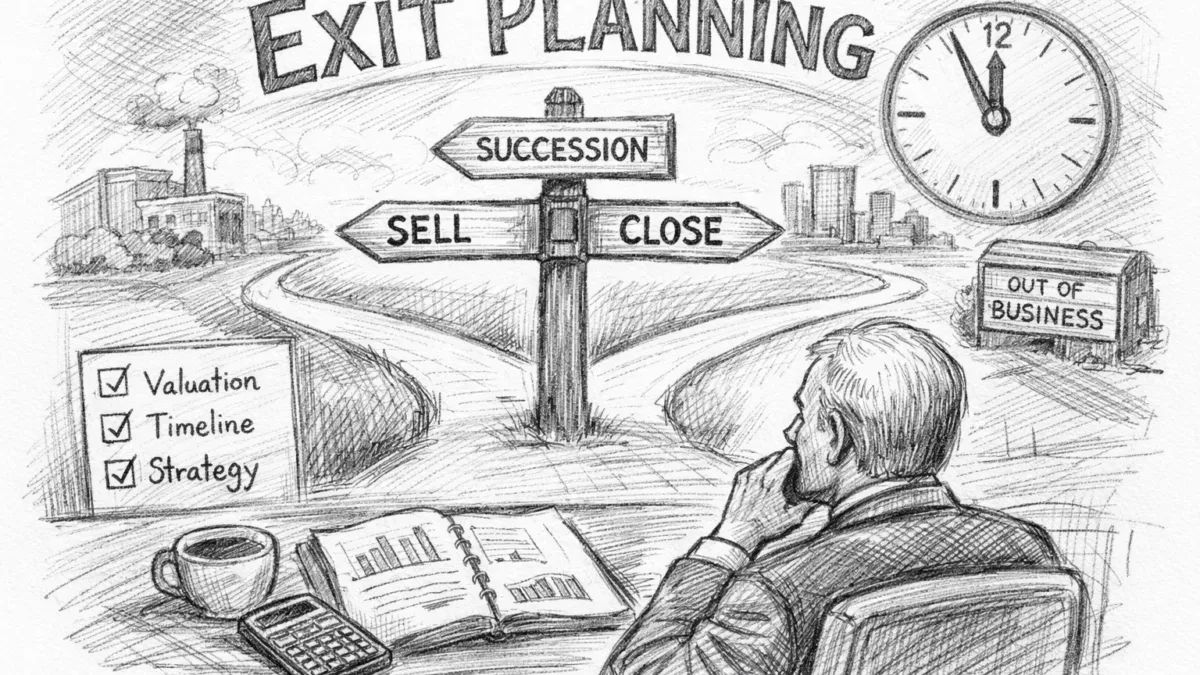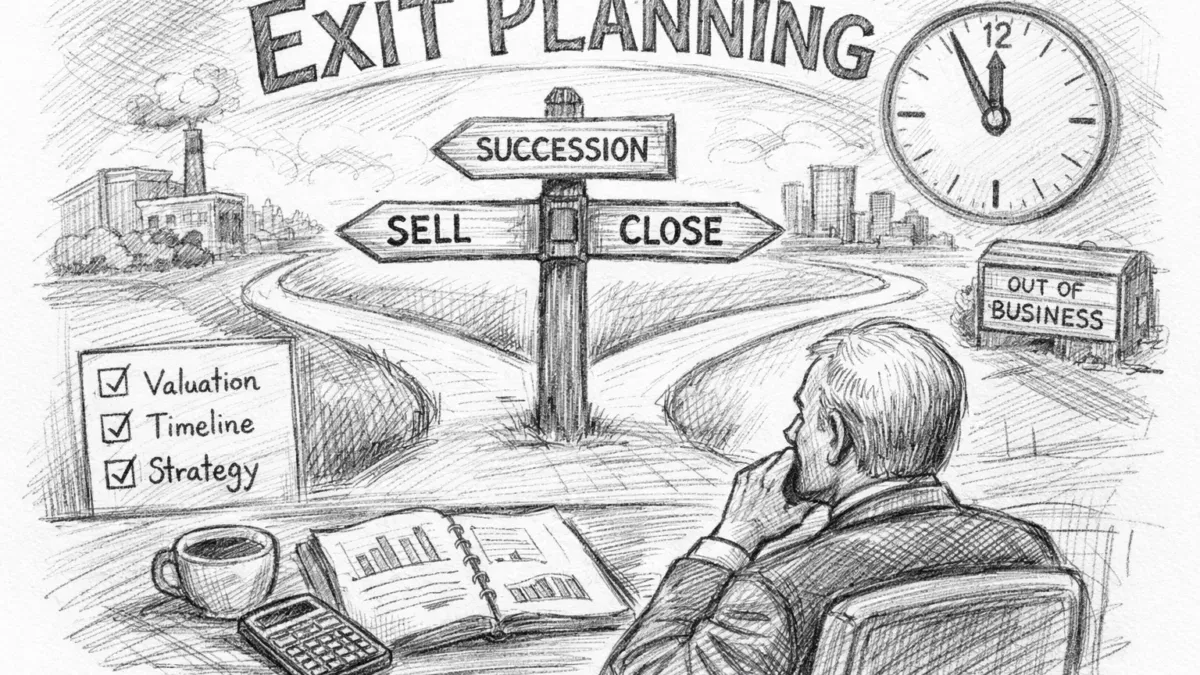
Most owners think preparing a business for sale means cleaning up the books, calling a broker, and hoping a buyer appears.
That is not a plan.
That is a fire drill.
A strong business exit strategy starts long before the business goes to market. Give yourself 24 months, and you have time to improve the company instead of disguising its weaknesses.
That matters even if you never sell.
A cleaner business gives you:
- More freedom
- Less owner dependence
- Better financial control
- Stronger leadership
- More options if circumstances change
- A better chance of passing the business to family or employees
If you do sell, those improvements can increase value and reduce buyer objections.
If you do not sell, you still own a stronger company.
That is the point.
The Hard Truth About Preparing a Business for Sale
You may believe buyers pay for your years of sacrifice.
They do not.
You may believe buyers pay for revenue.
Not by itself.
You may believe buyers will understand the business the way you do.
They will not.
Buyers pay for earnings, transferability, and confidence.
A business generating $2 million in revenue with weak margins and total owner dependence may be worth less than a business generating $1.2 million with clean earnings, recurring customers, and a capable management team.
Same industry.
Different risk.
Different value.
A simple equation explains the tension:
Business value = sustainable earnings × buyer confidence
If earnings rise but confidence falls, value may not improve.
If earnings stay steady but the company becomes easier to transfer, value can rise.
That is why a 24-month runway is better than a last-minute checklist.
Months 24–18: Find the Truth Before You Fix Anything
The first six months are not about making the business look attractive.
They are about finding out what you actually own.
Start with a baseline review.
1. Understand your current value
Get an objective view of what the business may be worth today.
Not what you hope it is worth.
Not what a competitor supposedly sold for.
Not what you need for retirement.
Value is not a feeling. It is math plus confidence.
Review:
- Revenue and earnings trends
- Customer concentration
- Recurring or contracted revenue
- Owner compensation and personal expenses
- Debt and liabilities
- Equipment and inventory
- Key employees
- Contracts and intellectual property
- Dependence on you personally
The business valuation guide on Before the Clock Decides explains why revenue alone does not determine value.
Your job is to identify the gap between current value and possible value.
If the company is worth $2 million today and you need $3 million to support your next chapter, you have a $1 million problem.
Good.
Now you know the problem.
2. Decide what “exit” means
A sale is not the only outcome.
Your options may include:
- Selling to a third-party buyer
- Selling to a competitor or strategic acquirer
- Transferring ownership to family
- Completing a management or employee buyout
- Selling part of the business and staying involved
- Closing the business
Do not wait until the final year to decide which path fits your life.
Your preferred exit affects the work you need to do now.
A family successor needs training.
A management buyer needs leadership and financing capacity.
A third-party buyer needs clean records, transferable systems, and confidence in future earnings.
3. Identify the two biggest risks
Do not create a 40-item improvement list that nobody follows.
Find the two issues that could damage value the most.
They may be:
- You control every major decision
- One customer creates 40% of revenue
- Financial reports arrive months late
- Key processes exist only in your head
- A critical employee could leave tomorrow
- The company relies on informal agreements
- Profit depends on your personal relationships
Fix the largest risks first.
Months 18–12: Clean the Financials and Remove the Fog

Messy financials do not make a business look entrepreneurial.
They make it look risky.
Buyers will examine your financial records to determine whether reported earnings are real, repeatable, and transferable.
Start building a clean financial history.
Clean up the numbers
Work with your accountant and advisors to:
- Separate personal and business expenses
- Resolve related-party transactions
- Reconcile bank accounts monthly
- Track revenue by customer and service line
- Maintain accurate accounts receivable and payable
- Document unusual expenses
- Produce timely monthly financial statements
- Build a clear earnings adjustment schedule
A buyer should not need to guess what your business earns.
If your books require a long explanation, expect the buyer to apply a discount.
For example, assume a buyer applies a 4× multiple to normalized earnings.
- $400,000 in credible earnings × 4 = $1.6 million
- $300,000 in credible earnings × 4 = $1.2 million
A $100,000 difference in recognized earnings can create a $400,000 difference in value.
That is not a bookkeeping detail.
That is money.
Strengthen the revenue base
Buyers do not only ask, “How much revenue do you have?”
They ask:
- How predictable is it?
- How many customers produce it?
- How often do customers return?
- What happens if your largest account leaves?
- Are contracts assignable?
- Can the next owner grow the revenue?
If one customer represents 35% of revenue, then your business carries a large concentration risk.
You may not be able to eliminate that risk in 24 months.
You can reduce it.
Build a broader sales pipeline.
Improve retention.
Develop additional service lines carefully.
Avoid desperate growth that damages margins.
Revenue growth that creates more risk is not value creation.
Months 12–6: Build an Owner-Optional Business

The phrase “owner-optional” does not mean the owner becomes irrelevant.
It means the business does not collapse when the owner steps away.
That is what buyers want.
The owner-optional business is not a business where nobody needs leadership. It is a business where leadership is distributed, decisions are clear, and essential work does not depend on one person.
Ask the diagnostic question:
What breaks if you disappear for 30 days?
Be specific.
- Who approves pricing?
- Who handles the top customers?
- Who solves operational problems?
- Who hires and trains people?
- Who manages cash?
- Who knows the critical vendor relationships?
- Who can make a decision without calling you?
Then build the answer.
Move from bottleneck to builder
A business owner I have seen in this situation once handled nearly every major function personally.
Sales.
Operations.
Hiring.
Customer relationships.
Problem solving.
He thought his involvement proved the business was strong.
It proved the opposite.
The company was dependent on him.
The work changed when he took three steps:
- Document what he did
- Delegate repeatable decisions
- Train people to own outcomes
Within months, his team handled a larger share of the daily work.
The business did not become weaker because he stepped back.
It became more valuable because the company could function without him.
Document the operating system
Write down the processes that make the business work.
Start with:
- Sales and quoting
- Customer onboarding
- Service delivery
- Billing and collections
- Purchasing
- Hiring and training
- Quality control
- Complaint resolution
- Weekly reporting
- Emergency procedures
These documents do not need to be beautiful.
They need to be usable.
If a competent manager cannot follow the process, you have not documented the process.
You have created another owner dependency.
Months 6–3: Prepare the Business for Inspection
At this point, stop making random improvements.
Begin preparing for buyer questions.
Organize a secure data room with:
- Financial statements
- Tax returns
- Customer and vendor contracts
- Employee records and policies
- Lease documents
- Insurance information
- Licenses and permits
- Intellectual property records
- Equipment schedules
- Organizational charts
- Standard operating procedures
- Major customer and supplier information
You do not need to expose sensitive information casually.
You do need to know where everything is.
A buyer’s diligence process will test whether the story matches the records.
If the records are incomplete, the buyer sees risk.
If the records are organized, the buyer sees control.
This is also the right time to work with qualified legal and tax professionals on sale structure, ownership, and personal planning.
Do not assume the best structure can be created at closing.
Some decisions require time.
Months 3–0: Choose Your Next Move

The final three months are for decision-making, not panic.
Review the business again.
Compare current performance with your baseline.
Ask:
- Did earnings improve?
- Did owner dependence decrease?
- Are the financials credible?
- Is customer risk lower?
- Can the leadership team operate without me?
- Are the major agreements documented?
- Do I still want to sell now?
- Would waiting create more value or more risk?
You may discover that the company is now worth more.
You may discover that you do not need to sell yet.
You may discover that the business is finally ready for a buyer.
All three outcomes are useful.
The goal of business exit planning is not to force a transaction.
It is to create options before time removes them.
Vision Fox Business Advisors helps owners understand business value and prepare for a potential future sale. That kind of outside perspective can help you see risks you have normalized because you live with them every day. You can learn more at VisionFox.com.
The 24-Month Plan in One Page
If you need the short version, use this:
Months 24–18
- Establish your current valuation
- Clarify your preferred exit
- Identify the two largest value risks
- Review owner dependence and customer concentration
Months 18–12
- Clean the financials
- Improve margins
- Strengthen recurring revenue
- Reduce customer concentration
- Resolve legal, tax, and contract problems
Months 12–6
- Build leadership depth
- Delegate key decisions
- Document operating procedures
- Test whether the business can run without you
Months 6–3
- Organize the data room
- Update valuation
- Prepare financial and operational reports
- Coordinate with legal, tax, and exit advisors
Months 3–0
- Decide whether to sell, wait, transfer, or pursue another path
- Protect performance during the process
- Negotiate from facts instead of urgency
A 24-month runway does not guarantee a perfect sale.
Nothing does.
It does something more important.
It gives you time to replace hope with evidence.
Your Move
Set a 90-minute meeting with yourself this week.
Write down:
- What your business may be worth today
- What breaks if you disappear for 30 days
- Which customer creates the most risk
- Which financial record is least trustworthy
- What must improve before you would feel ready to sell
Then choose one action and assign it a date.
Do not wait until you are ready.
Preparation is how you become ready.
If you want a broader framework for valuation, ownership dependence, and choosing your ending, explore Mike Steward’s book, Before the Clock Decides.
The business you build over the next 24 months should give you more than a possible sale. It should give you control over what happens next.