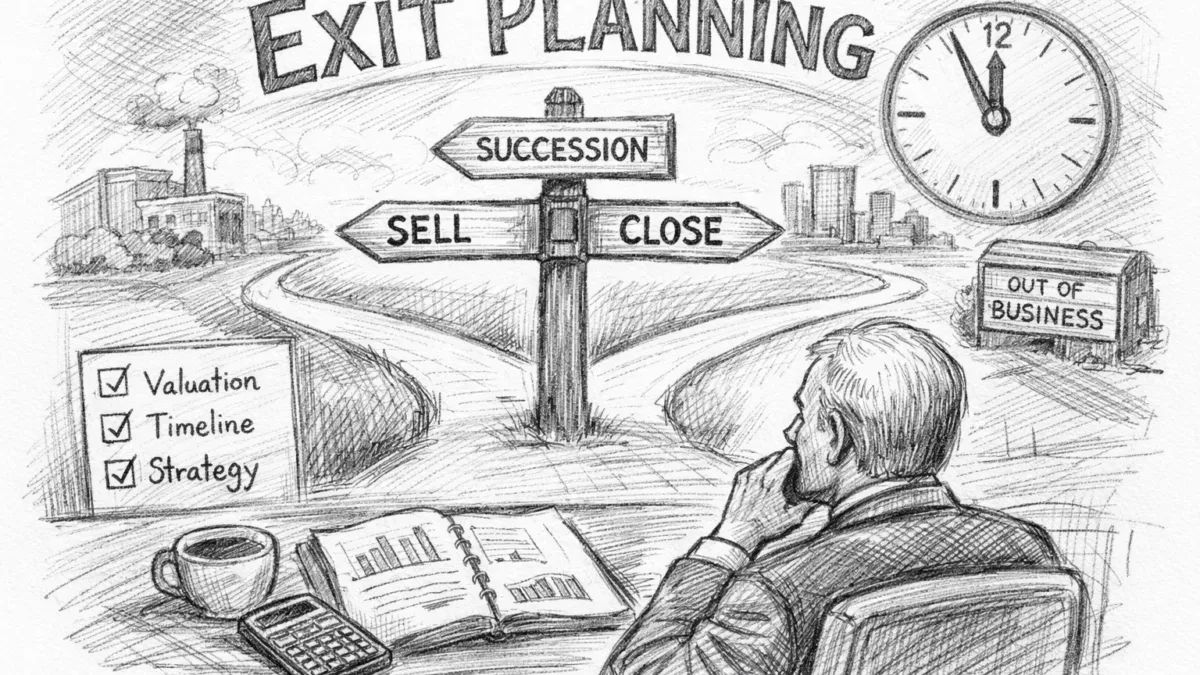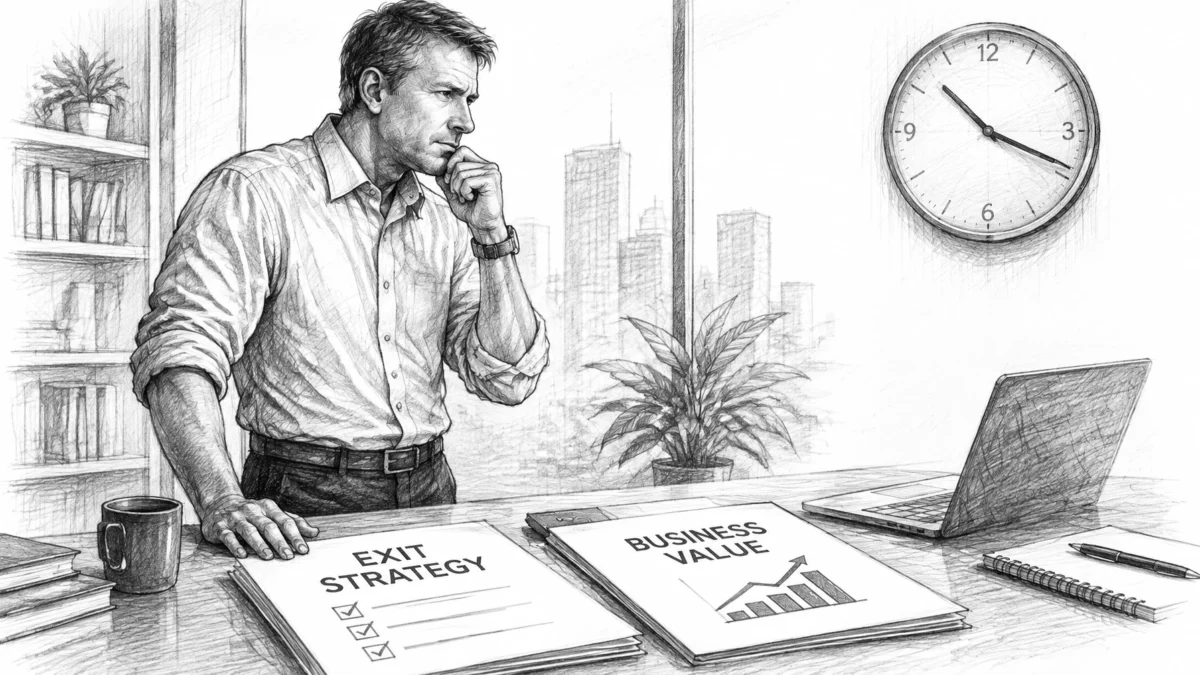
The number is not exact.
It is still revealing.
Research from the U.S. Small Business Administration found that small business owners expected to retire at an average age of 72.6, compared with 68.4 for employees.
That figure is often rounded to 71.
The point is not the exact birthday.
The point is that business owners stay longer because leaving feels impossible.
The business needs them.
The customers need them.
The employees need them.
The owner’s retirement plan needs the sale proceeds.
So the owner keeps working.
Then one year becomes five.
Five becomes ten.
And the business becomes harder to sell with every year the owner remains the only person who can make it work.
Retirement planning for a business owner is not just a personal finance exercise. It is a business value exercise.
If the business cannot operate without you, your retirement date is not the real problem.
Your business model is.
The Belief: “I’ll Leave When I’m Ready”
Most owners believe retirement begins with a personal decision.
They imagine saying:
“I’m ready to retire. Now I’ll sell the company.”
That sounds reasonable.
It is often backward.
You do not become ready to retire because you decide to leave. You become ready because the business can survive your departure.
Those are different things.
You may be emotionally ready.
Your spouse may be ready.
Your investment portfolio may be ready.
But if every major customer calls you, every employee waits for your approval, and every important process lives in your head, the business is not ready.
And buyers notice.
They do not pay a premium for your years of sacrifice.
They pay for future cash flow they believe will continue after you leave.
The Reality: Buyers Purchase Transferable Earnings
A business is not valuable because you worked hard.
Hard work matters.
It just does not transfer automatically to the next owner.
Buyers look for:
- Reliable earnings
- Clean financial records
- Repeatable processes
- Strong customer relationships
- A capable management team
- Revenue that does not depend entirely on the owner
- A realistic path to continued growth
This is why business valuation for sale cannot be separated from retirement planning.
Suppose your company produces $500,000 in annual earnings.
If a buyer believes those earnings are dependable, the business may support a stronger valuation.
If the buyer believes $150,000 of those earnings disappear when you leave, the calculation changes quickly.
The math is simple:
- $500,000 of dependable earnings × 4 = $2 million in value
- $350,000 of dependable earnings × 3 = $1.05 million in value
The exact multiple will vary by industry, buyer, risk, and market conditions.
The principle does not.
Higher risk produces lower value, weaker terms, or both.

Owner Dependence Is Not Job Security
Many owners take pride in being essential.
That pride can become expensive.
Ask yourself:
What breaks if you disappear for 30 days?
Be specific.
- Who approves pricing?
- Who handles the largest accounts?
- Who solves employee disputes?
- Who knows the vendors?
- Who closes new sales?
- Who understands the numbers?
- Who makes the final call when something goes wrong?
If the answer to most of those questions is “me,” then you do not own an owner-optional business.
You own a job with employees.
That may be a profitable job.
It may be a respected job.
It may have produced a very good life.
But a buyer still has to step into it.
And nobody wants to pay a premium to buy a demanding job they cannot leave.
The owner-optional business is not one where the owner does nothing.
It is one where the owner’s departure does not threaten the company’s survival.
The Extra Years Have a Cost
Working longer is not automatically a mistake.
Some owners enjoy the work.
Some want to grow the company.
Some are not financially ready to leave.
The problem begins when the owner stays because there is no viable alternative.
That creates at least four costs.
1. You lose time to improve value
If you need three to five years to build management depth, document operations, diversify customers, and clean up financial reporting, waiting until retirement feels urgent removes your best leverage.
You cannot compress every improvement into six months.
2. You increase key-person risk
The longer the business depends on one person, the more fragile the transition becomes.
A health event, family crisis, burnout, or sudden loss can force an unwanted sale.
That is not a strategy.
That is a distressed outcome waiting for an event.
3. You narrow your buyer pool
A transferable business can attract different types of buyers.
An owner-dependent business may appeal only to someone willing to purchase their own new job.
Fewer qualified buyers usually means less competition.
Less competition means weaker negotiating power.
4. You postpone personal clarity
When you do not know what the company is worth, you cannot confidently answer basic retirement questions:
- Can I afford to leave?
- Do I need to work another five years?
- Should I sell, transfer, or keep the company?
- What happens if the sale price is lower than expected?
- What must improve before I go to market?
Uncertainty keeps owners working longer than they planned.

Revenue Is Not Retirement Security
Many owners start with revenue.
They say:
“We do $3 million a year. The business must be worth a lot.”
Maybe.
Revenue is not the same as value.
A $3 million company with weak margins, inconsistent books, customer concentration, and heavy owner dependence may be worth less than a $1.5 million company with stronger earnings and better systems.
Buyers follow the cash.
Then they assess the risk around that cash.
A useful planning formula is:
Business value = sustainable earnings × buyer confidence
You can raise sustainable earnings through better margins and stronger operations.
You can raise buyer confidence by reducing the reasons a buyer might doubt the future.
That means:
- Documenting key processes
- Training people to make decisions without you
- Moving customer relationships toward the company and team
- Building recurring or repeatable revenue
- Separating personal expenses from business expenses
- Producing accurate, consistent financial statements
- Creating a leadership team with real authority
These actions are not administrative busywork.
They are value creation.
A Short Story About Becoming Replaceable
I once worked with an owner who believed the business could not function without him.
He handled sales, operations, hiring, pricing, and the most important customer relationships.
He was proud of that.
He was also trapped by it.
The first step was not finding a buyer.
It was identifying every decision that required his involvement.
Then the company documented the work, assigned responsibility, and trained people to act without waiting for permission.
Within six months, the team handled most of the work that had once flowed through the owner.
The owner did not disappear.
He moved from bottleneck to builder.
That distinction changed the company’s future options.
It also improved the business’s value story.
Nothing magical happened.
The owner simply stopped treating dependence as proof of success.
A Better Retirement Planning Sequence
Do not wait until you are ready to sell.
Use this sequence instead.
1. Define the life you want after ownership
Estimate what retirement will cost.
Do not use a vague number.
Calculate housing, healthcare, travel, family support, debt, taxes, and the lifestyle you actually want.
2. Estimate the business value today
Do not use a friend’s opinion or an industry rumor.
Get a market-grounded view of value based on earnings, industry, growth, customer mix, financial quality, and owner dependence.
Vision Fox offers a business valuation calculator as a preliminary starting point.
A preliminary estimate is not a formal appraisal.
It is still better than guessing.
3. Compare value to your retirement need
If your retirement requires $3 million and the company may currently produce $1.5 million before taxes and transaction costs, you have a gap.
That gap is not a reason to panic.
It is a reason to start early.
4. Build a three-to-five-year value plan
Choose the biggest weaknesses first.
For example:
- Build a second layer of leadership.
- Transfer key customer relationships.
- Improve margins.
- Clean up financial records.
- Document operations.
- Reduce owner involvement in daily decisions.
5. Reassess annually
Business value moves.
Your personal needs move.
The market moves.
Review the plan every year instead of pretending the original estimate will remain accurate forever.

The Hard Truth About Waiting
You may believe waiting gives you more time.
Sometimes it does.
But if you are not using that time to make the business more transferable, waiting is not preparation.
It is delay.
If the company remains equally dependent on you each year, then the business may be growing without becoming more sellable.
That is a dangerous trade.
More revenue.
More responsibility.
More personal wealth tied to the company.
No better exit option.
Growth without transferability can make the owner more valuable to the business while making the business less valuable to a buyer.
The objective is not to leave tomorrow.
The objective is to make leaving possible.
Your Move
Answer these three questions without softening the answers:
- What would stop working if you disappeared for 30 days?
- What is your business worth today if a buyer does not trust your earnings to continue without you?
- What must change in the next three years to make the business easier to transfer?
Write the answers down.
Then choose one value problem to address this quarter.
Not five.
One.
Talk with an experienced advisor who can help you understand the gap between your current business and the business a buyer wants to purchase. Vision Fox Business Advisors helps owners evaluate value, reduce owner dependence, prepare for a future sale, and decide whether selling now: or preparing first: makes sense.
Retirement is not the day you stop working.
It is the day your future no longer depends on you being the only person who can keep the business alive.
Start building that business before the clock decides for you.