You’ve heard the rumors at the country club or in your industry forums.
"Joe sold his widget company for 8x EBITDA."
"Software companies are trading at 10x revenue."
You look at your bottom line, do some quick back-of-the-napkin math, and start picking out the color of your retirement boat.
Stop.
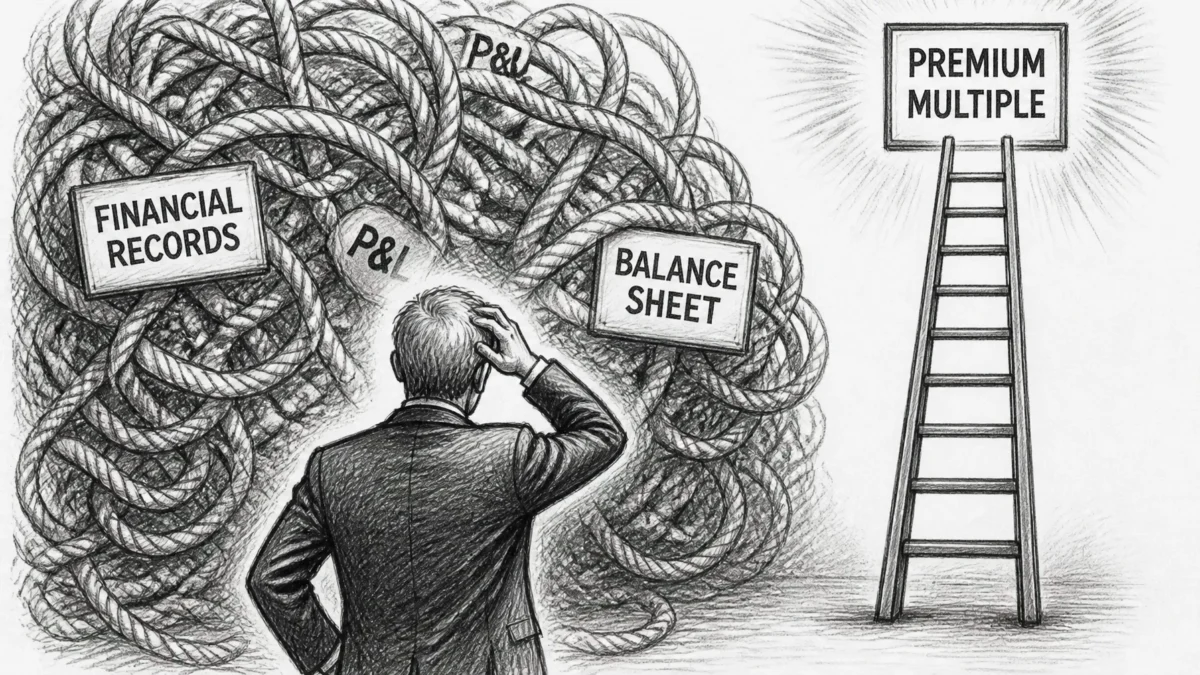
The "multiple" is the most dangerous drug in the world of business exits. It’s an intoxicating number that makes you feel wealthy on paper while ignoring the structural rot underneath your floorboards.
Here is the truth: In 2026, high multiples are not dead.
But they are no longer a participation trophy.
They are reserved for the elite, the organized, and the transparent.
If your financials are a "work in progress," your multiple is a fantasy.
The Delusion of the "Average" Multiple
Most owners think a multiple is something they get because they exist in a certain industry.
They believe if the "industry average" is 6x, they are entitled to 6x.
Buyers don’t buy averages. They buy cash flow and they buy certainty.
When a buyer looks at a business with messy books, they don’t see an "average" company. They see a high-risk gamble.
Risk is the ultimate multiple-killer.
If a professional buyer, whether it’s private equity or a strategic competitor, cannot verify your numbers in thirty minutes, they won’t offer you the average.
They will offer you a "Risk Discount."
Or, more likely, they will just walk away.
What "Messy" Actually Looks Like
Let's define the enemy.
Messy financials aren't just "doing your own taxes." It's deeper than that.
- Co-mingled personal expenses: If your boat, your spouse’s SUV, and your kids' tuition are buried in "Marketing Expenses," you have messy financials.
- Cash-basis accounting: If you only record income when the check hits the bank, you aren’t running a business; you’re running a lemonade stand.
- Lack of accruals: If you can’t show me what you owe and what you’re owed in real-time, you have no visibility.
- Inventory guesswork: If your "Inventory" line on the balance sheet hasn't changed in three years, you’re lying to yourself and the market.
- Owner-dependency: If the "financials" are just a spreadsheet only you understand, the business has zero value without you.

The 2026 Reality: The "Data Maturity" Gap
We are in a tighter, more selective market.
According to recent M&A data, while middle-market deals are still closing at healthy multiples (often around 7.2x to 7.5x EBITDA for top-tier firms), the gap between the "clean" and the "messy" has widened significantly.
Buyers in 2026 are using AI-driven due diligence tools.
They don't just "glance" at your P&L. They run algorithms through your ledger to find inconsistencies, margin compression, and customer churn.
If your data is fragmented across three different systems that don't talk to each other, those tools return an "Error" code.
In the buyer’s mind, "Error" equals "Discount."
The hard truth: You are being benchmarked against companies that have spent years preparing for this moment.
If you want a premium multiple, you have to prove you deserve it. You don't get a premium for just showing up.
The "Earnings Credibility" Trap
Why do buyers care so much about clean books? It’s not because they are accountants.
It’s because of Earnings Credibility.
If a buyer finds one mistake in your financials: say, an unreconciled credit card account: they will assume there are ten more they haven't found yet.
Once credibility is lost, the deal changes instantly.
- The Price Chip: The buyer lowers the multiple (e.g., from 6x to 4.5x).
- The Structure Shift: The buyer moves cash at closing into an "Earn-out," meaning you only get paid if the business performs after you leave.
- The Indemnity Trap: They demand massive escrows to cover potential "surprises" they think you’re hiding.
Messy financials don't just lower your price; they destroy your leverage.
If/Then: The Math of Preparation
Let’s look at the direct consequences of your behavior.
Scenario A: The Prepared Owner
- Condition: Professional accrual accounting, clean tax returns, sell-side Quality of Earnings (QoE) report ready.
- Multiple: 7.0x EBITDA.
- Outcome: $10M Sale. 90% Cash at Close. 60-day Diligence.
Scenario B: The "I’ll Fix It Later" Owner
- Condition: Hand-written ledgers, co-mingled expenses, "trust me" revenue figures.
- Multiple: 4.0x EBITDA (after a 30% "Risk Discount").
- Outcome: $5.7M Sale. 50% Cash at Close. 6-month Diligence.
Waiting to "clean up" until you have a buyer is like trying to paint your house while it’s on fire. It’s too late.

Why You Are Hesitating
I get it. Cleaning up your financials is boring. It’s expensive. It requires you to look at the parts of your business you’ve ignored for a decade.
But let's be honest: You aren't avoiding the cleanup because it's hard. You're avoiding it because it might reveal that your business isn't as profitable as you've been telling yourself.
You are choosing the comfort of a delusion over the clarity of the market.
In the book Before the Clock Decides, I talk about the reality that every owner eventually exits. The only question is whether you exit on your terms or the market's terms.
If you wait for the clock to decide, the market will punish your lack of preparation.
The Solution: Building a Transferable Asset
A "multiple" is just a reflection of how easily your business can be handed to someone else.
If your financials are clean, the business is a machine. If they are messy, the business is a "job" that requires you to be the mechanic.
Buyers pay for machines. They discount jobs.
If you want to know what your business is actually worth: not the "multiple" you heard at the golf course: you need to look at it through the eyes of a buyer.
This is exactly why firms like Vision Fox Business Advisors exist. We don't just look at the numbers; we look at the credibility of the numbers.
Your Move
You have two choices today.
You can continue to believe the myth of the "Industry Average Multiple" and hope a buyer is lazy enough to overlook your chaos. (Spoiler: They aren't.)
Or, you can start treating your financials like the product you are actually selling.
Here is your checklist for Monday morning:
- Audit your expenses: Pull your last 12 months of credit card statements. Anything that isn't 100% related to generating revenue needs to be flagged. Stop paying for your personal life through the business.
- Fire your "Bookkeeper" and hire a Controller: If your books are only updated once a month (or once a quarter), you are flying blind. You need real-time data maturity.
- Commission a Quality of Earnings (QoE): Don't wait for a buyer to audit you. Audit yourself. Find the holes before they do.
- Read the blueprint: If you haven't yet, get the book. Understand the mindset shift required to move from an "operator" to an "owner."
The market in 2026 is rewarding the prepared.
The clock is ticking. Are you going to fix the books, or are you going to let the buyer fix your price?

Ready to see where you stand?
Work with Mike to evaluate your business value before the market decides for you.
{“@type”:”BlogPosting”,”image”:”https://cdn.marblism.com/2FuVB6f7_08.webp”,”author”:{“name”:”Mike Steward”,”@type”:”Person”},”@context”:”https://schema.org”,”headline”:”Are High Multiples Dead? Why Buyers Won’t Pay a Premium for Messy Financials”,”publisher”:{“logo”:{“url”:”https://beforetheclockdecides.com/favicon.ico”,”@type”:”ImageObject”},”name”:”Before the Clock Decides”,”@type”:”Organization”},”description”:”Discover why high business valuation multiples in 2026 are reserved for companies with clean, credible financials. Learn how messy books lead to a ‘Risk Discount’ and what steps you can take to protect your exit value.”,”datePublished”:”2026-06-06″,”mainEntityOfPage”:{“@id”:”https://beforetheclockdecides.com/are-high-multiples-dead-messy-financials”,”@type”:”WebPage”}}