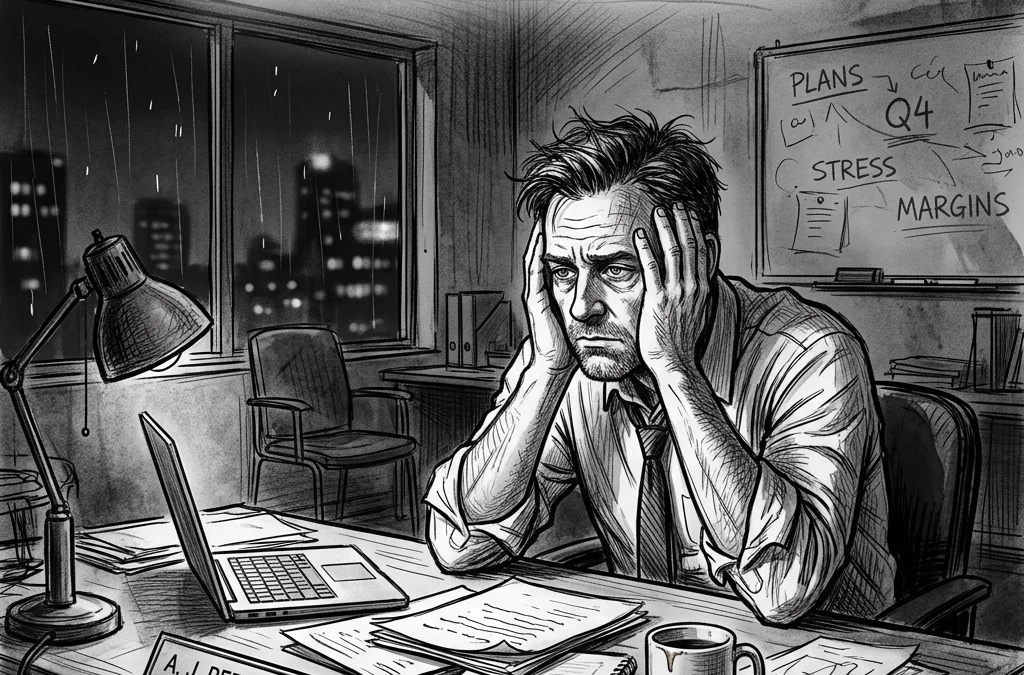
You still show up at 8:00 AM.
You still sit in the big chair.
You still sign the checks and nod during the management meetings.
But you aren’t really there anymore.
You’ve checked out. Mentally, the bags are packed. The car is idling in the driveway. You’re just waiting for the clock to tell you it’s okay to leave.
This is the Quiet Crisis. It is the most dangerous phase of business ownership because it doesn’t look like a disaster. It looks like "maintenance." It looks like "stability."
In reality, it is a slow-motion car crash that destroys millions of dollars in enterprise value before the owner even realizes they’ve hit the wall.
The Slow Fade
Most people think business failure happens because of a market crash or a bad product.
They’re wrong.
In the mid-market world, businesses often die, or lose their value, because the owner stopped caring 24 months before they decided to sell.
I see it every week. An owner calls me to talk about an exit. They tell me the business is "running fine." They say they’re just "ready for the next chapter."
Then I look at the numbers.
The revenue is flat. Not because the market is down, but because the owner stopped chasing new leads in 2024.
The culture is toxic. Not because the employees are bad, but because the owner stopped enforcing standards in 2025.
The "Quiet Crisis" is a psychological departure that precedes the physical one. It’s an emotional "quiet quitting" at the highest level of the organization.
Why You Stopped Caring (And Why It’s Not Your Fault)
Owning a business is an endurance sport.
You’ve spent fifteen, twenty, maybe thirty years carrying the weight of every payroll, every lawsuit, and every customer complaint.
The adrenaline that fueled you in the early years has been replaced by a low-grade, chronic fatigue. You are tired of being the person with all the answers.
The "Quiet Crisis" isn't a lack of character; it’s a lack of a finish line.
When you don’t have a clear exit strategy, the work feels infinite. And when work feels infinite, the human brain naturally tries to conserve energy by doing the bare minimum.
You start telling yourself lies:
- "We don't need to upgrade that software yet; the next guy can do it."
- "I'll let that underperforming manager slide; I don't have the energy for a confrontation."
- "As long as the P&L stays steady, I'm fine."
If you are saying these things, you aren't managing a business. You are babysitting a corpse.

The Math of Apathy
Let’s talk about the cost. Because "not caring" isn't free.
Buyers aren't stupid. When a private equity group or a strategic buyer looks at your company, they aren't just looking at your EBITDA. They are looking for momentum.
They want to see a business that is climbing. They want to see an owner who is still innovating.
If you stop caring, you stop growing.
If your growth rate drops from 10% to 0%, your valuation multiple doesn't just stay the same, it shrinks.
A business growing at 10% might command a 6x multiple. A business that is flatlining might only get a 4x.
On a $2M EBITDA business, that "quiet quitting" just cost you $4 million.
That is the price of your apathy. That is the cost of "waiting until you’re ready."
The Invisible Rot

Visual suggestion: A black and white sketch of a business owner’s silhouette sitting at a desk, looking out a window while his shadow remains hunched over a laptop, symbolizing the mental departure from the physical work.
When the owner checks out, the "rot" begins at the top and trickles down.
Your best employees are the first to notice. They are the ones who thrive on vision and growth. When they see you coasting, they start looking for the exit.
Your worst employees notice too. They realize the cat is away, so the mice can play. Accountability disappears. Margins start to leak.
By the time you finally decide to work with Mike to sell the business, the "engine" is rusted.
I’ve had to tell owners that their business is worth half of what it was three years ago. Not because the world changed, but because they changed.
Diagnostic Questions: Are You in the Crisis?
Be honest with yourself. Nobody is watching.
- What breaks if you disappear for a month? If the answer is "everything," you aren't an owner; you're a bottleneck. If the answer is "nothing, and I haven't checked the stats anyway," you’ve already checked out.
- When was the last time you made a "hard" decision? If you can't remember the last time you fired someone or cut a failing product line, you’re in maintenance mode.
- Do you find yourself daydreaming more about your "post-exit" life than your current projects?
- Are you avoiding your top-tier customers because you don't want to hear their feedback?
If you answered "yes" to more than two of these, the "Quiet Crisis" has moved into your office.
The Trap of "One More Year"
Business owners love the phrase "one more year."
- "I'll sell after one more good year."
- "I'll fix the systems in one more year."
But if you are already in the "Quiet Crisis," that extra year is a trap. You won't use it to build value. You will use it to erode value.
You will spend that year doing the bare minimum while your competitors eat your lunch and your key staff members update their resumes.
Time is not your friend when you’ve lost your fire.
How to Snap Out of It (Or Get Out Fast)
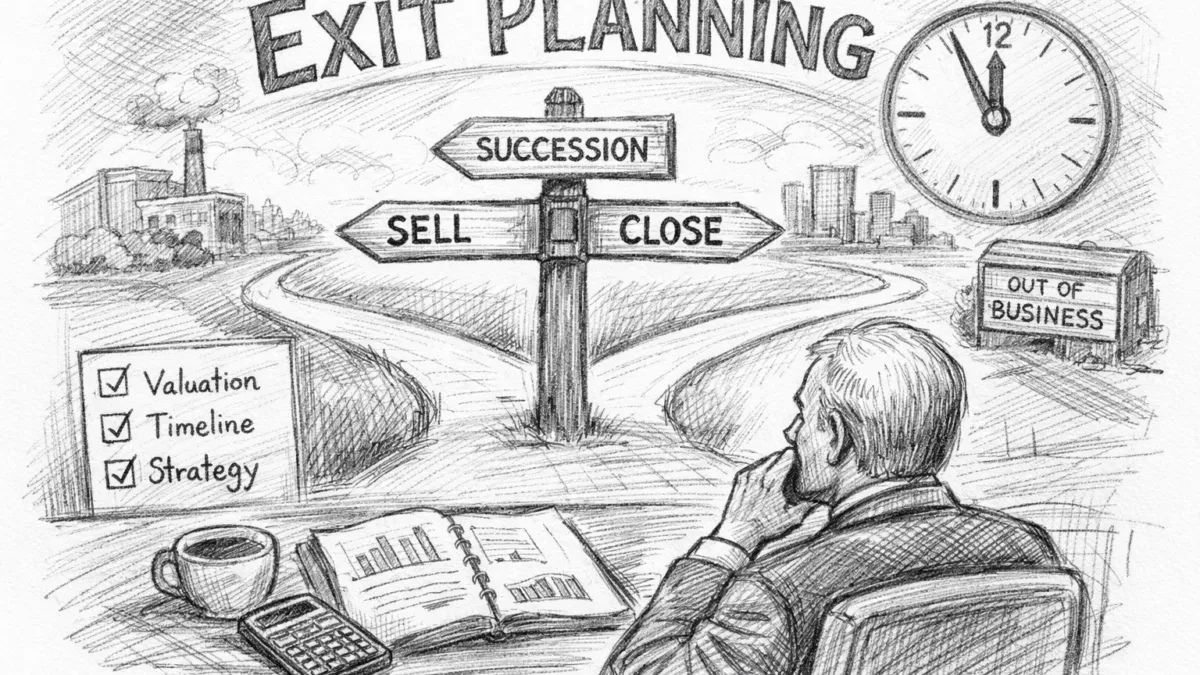
There are only two ways to handle the "Quiet Crisis."
Option A: Reignite the Fire.
You have to find a reason to care again. This usually requires a radical shift. You have to stop being the operator and start being the architect. You hire a COO. You invest in a new product. You give yourself a "second act" within your own company.
Option B: Accelerate the Exit.
If the fire is truly gone, stop pretending. Every day you wait is money coming out of your retirement fund. You need to start the valuation process immediately. You need to clean up the books and get the business to market while there is still enough momentum to attract a high-quality buyer.
You can't stay in the middle. The middle is where businesses go to die.
The Owner's Delusion
Many owners believe they can "flip the switch" whenever they want. They think they can coast for two years and then, six months before the sale, work like a maniac to "pretty up" the business.
It doesn't work.
A buyer’s due diligence is like an MRI. They will see the deferred maintenance. They will see the lack of recent investment. They will talk to your staff and realize nobody has been "at the helm" for a long time.
Real value is built on consistency, not a last-minute coat of paint.
If you want to maximize your exit, you have to be "all in" until the moment you are "all out."
Your Legacy is At Stake
This isn't just about money. It’s about the legacy you leave behind.
Do you want to be remembered as the leader who built an empire, or the one who let it crumble because they got bored?
Your employees, your customers, and your family deserve the "100% version" of you: or they deserve a new leader who can provide it.
Don't let the clock decide your fate. Don't wait until the business is worth zero to realize you should have left two years ago.
Take a look at our free resources to see where you stand. Or, if you’re ready to stop the rot, grab a copy of our book Before the Clock Decides to map out your path forward.

Your Move
You have two choices this morning.
- Close this tab. Go back to your cold coffee. Keep pretending that "flat" is "fine." Watch your valuation bleed out over the next 18 months.
- Acknowledge the crisis. Admit that you’ve checked out. Decide that you are either going to get back in the game or get out of the way.
If you choose the latter, the first step is knowing what your business is actually worth today: not what it was worth three years ago.
Stop waiting. The clock is already ticking.
Check out our valuation category to understand how the market sees your "Quiet Crisis."
Then, make a decision. Before the clock decides for you.