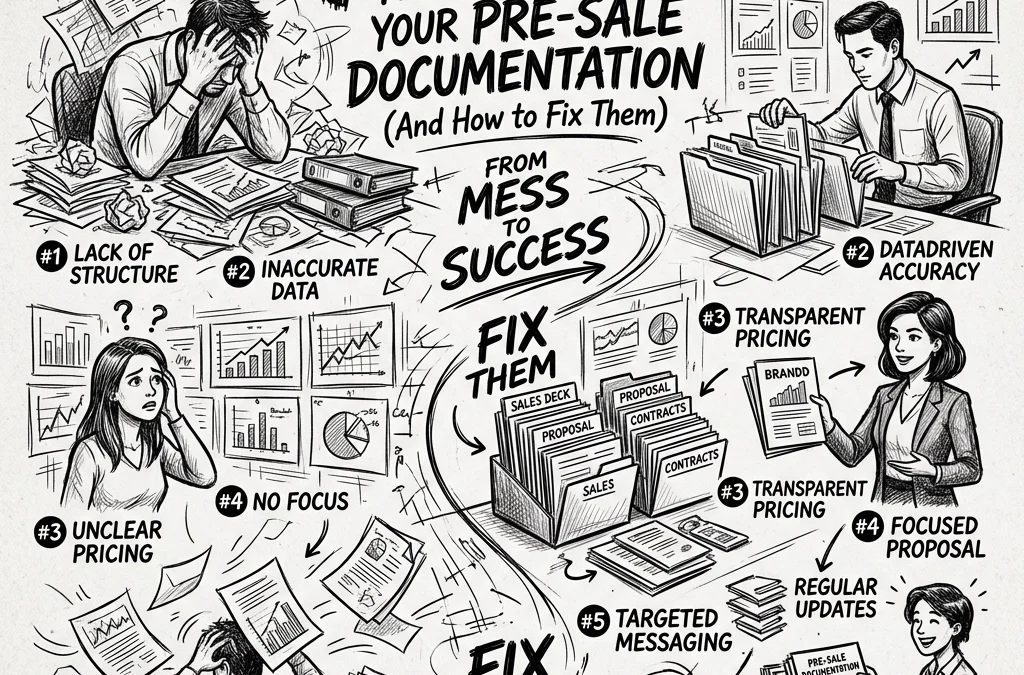
You think you’re selling a business.
You aren’t.
When you go to market, you are selling a stack of paper. You are selling a narrative supported by data. If the data is missing, the narrative is a lie.
I’ve spent years sitting across from owners who built incredible companies but couldn't sell them for a dime over the asset value. Why? Because their documentation looked like a crime scene.
Buyers don’t buy your word. They buy your proof.
If you want to exit on your terms: before the clock decides for you: you need to stop treating your paperwork like an afterthought.
Here are the seven most common mistakes I see owners make with their pre-sale documentation and exactly how to fix them before a buyer laughs you out of the room.
1. The "Financial Fog" Mistake
Most business owners treat their P&L like a personal tax-shielding tool. You want to show as little profit as possible to the IRS.
But when it’s time to sell, you suddenly want to show the world how rich you are. You can’t have it both ways without a massive amount of cleanup.
The Believable Lie: "The buyer will understand that my personal truck, my kid's cell phone, and my country club fees are just 'add-backs.'"
The Harsh Reality: Every time a buyer sees a personal expense buried in the business, they lose trust. They start wondering what else you’re hiding. If they can’t see a clean trail of cash flow, they’ll discount your valuation by 20% just for the "uncertainty tax."
The Fix:
- Start "cleaning" your books at least 24 months before you list.
- Separate personal and professional expenses with surgical precision.
- Get a Quality of Earnings (QofE) report done before you talk to a single buyer.

Sketch Description: A black and white pencil sketch of a magnifying glass hovering over a messy spreadsheet, where the numbers are turning into clear, bold figures under the glass.
2. Relying on "Handshake" Agreements
You’ve done business with "Old Joe" for twenty years on a handshake. You trust him. He trusts you.
A buyer trusts nobody.
The Believable Lie: "Our customers are loyal. They don’t need contracts; they love us."
The Harsh Reality: A buyer isn't buying "Old Joe." They are buying the contract with Old Joe. If that contract doesn't exist in writing, the revenue from that customer is worth exactly zero in a valuation model.
The Fix:
- Audit every major customer and supplier.
- If there isn't a signed, assignable contract, get one now.
- The "Assignable" Clause: Ensure your contracts state they can be transferred to a new owner without the other party's consent. Without this, your customers have a "kill switch" on your deal.
3. The "Secret Sauce" Stayed in Your Head
If your business stops working the moment you go on vacation, you don't have a business. You have a job. And nobody wants to buy your job.
The Believable Lie: "I’ll just train the new guy for a few weeks after the sale."
The Harsh Reality: Buyers want a machine, not a master. If your Standard Operating Procedures (SOPs) are not documented, the buyer sees a massive risk. They see a "Key Man" dependency that makes the business un-transferable.
The Fix:
- Document every recurring process.
- Create a "Playbook" for every department: Sales, Ops, HR, and Finance.
- The Test: Give an SOP to a junior employee. If they can’t complete the task without calling you, the documentation is a failure.

4. The Lease Limbo
I’ve seen $10 million deals die at the closing table because of a $5,000-a-month lease.
Owners often forget that their landlord is a silent partner in their exit. If your lease expires in 12 months and has no renewal options, or if it doesn't allow for a change in ownership, you are at the landlord’s mercy.
The Believable Lie: "The landlord is a nice guy; he won't be a problem."
The Harsh Reality: Landlords know that when you sell your business, you're getting a big payday. They often want a piece of it. They might demand a "lease assignment fee" or a massive rent hike to approve the new owner.
The Fix:
- Review your lease immediately.
- Ensure you have at least 5–10 years of "runway" (including options) to show a buyer.
- Secure a "Consent to Assignment" clause that cannot be "unreasonably withheld."
5. Ghost Intellectual Property (IP)
Who owns your logo? Your website? Your software code?
If you hired a freelancer on a whim five years ago and didn’t have them sign a "Work for Hire" agreement, you might not legally own your own brand.
The Believable Lie: "I paid for it, so it’s mine."
The Harsh Reality: Legally, that’s not always true. In due diligence, a buyer’s attorney will look for "Chain of Title" for every piece of IP. If there’s a gap, they’ll force you to track down that developer from 2019 to get a signature before they close.
The Fix:
- Gather every independent contractor agreement you’ve ever signed.
- Verify that "Work for Hire" and "Assignment of IP" language is present.
- If it’s missing, work with a professional to fix the chain of ownership now.

Sketch Description: A black and white sketch of a person looking through a filing cabinet with a flashlight, pulling out a single, glowing folder labeled "OWNERSHIP."
6. Employee Handbooks That Don't Exist
You think your "family culture" is your greatest asset. A buyer thinks your lack of formal HR documentation is a lawsuit waiting to happen.
The Believable Lie: "My employees are happy; they’d never sue."
The Harsh Reality: The moment a "new boss" walks in, the culture changes. If you don't have a signed employee handbook, clear job descriptions, and non-disclosure agreements (NDAs) on file, the buyer sees a liability.
The Fix:
- Update your Employee Handbook.
- Ensure every employee has a signed copy on file.
- Check that your key people have signed non-solicitation or non-compete agreements (where legal).
7. The Corporate Record "Black Hole"
When was the last time you held a board meeting? When were your last corporate minutes filed?
If you’re like most small to mid-sized business owners, the answer is "never."
The Believable Lie: "It’s my company; I don’t need to hold meetings with myself."
The Harsh Reality: To a buyer’s lawyer, a lack of corporate records suggests the company isn't a real legal entity. This is called "piercing the corporate veil." If your records are a mess, the buyer’s risk profile skyrockets.
The Fix:
- Go back and reconstruct your corporate minutes.
- Ensure your capitalization table (who owns what percentage) is 100% accurate and signed.
- Keep a "Data Room" ready at all times.

The Price of Laziness
If you wait until you have a Letter of Intent (LOI) to fix these mistakes, you have already lost.
You will be playing defense. You will be scrambling to find documents while the buyer is looking for reasons to "re-trade" (lower the price).
Documentation is not about being "organized." It is about removing friction.
Friction kills deals.
The cleaner the documentation, the faster the close. The faster the close, the higher the probability you actually get your money.
If you want to know how deep the rabbit hole goes, check out the resources we have at Before the Clock Decides. We’ve built tools specifically to help you stop being a bottleneck in your own business.
Or, if you’re ready to get serious about what your business is actually worth, you can find the hard truths in my book, Before the Clock Decides.
Your Move
Don't try to fix all seven today. You'll quit by lunchtime.
- Pick one. Start with the "Financial Fog" or the "Handshake Trap."
- Audit it. Find the gaps between what you think you have and what is actually on paper.
- Fix it. Hire the lawyer, talk to the accountant, or write the SOP.
The clock is already ticking. Are you going to decide your exit, or are you going to let the mess decide for you?

Sketch Description: A black and white sketch of a clean, organized path leading toward a sunrise, symbolizing a successful and clear business transition.