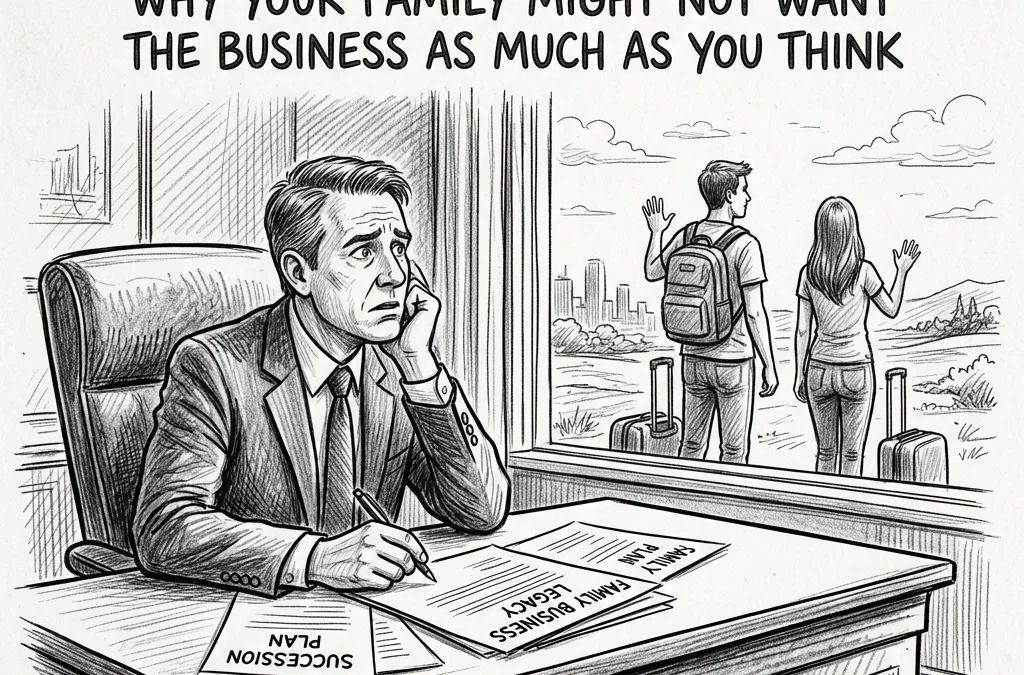
You’re building a legacy.
At least, that’s what you tell yourself when you stay at the office until 8:00 PM on a Tuesday. It’s what you tell your spouse when you miss another anniversary. It’s the narrative you’ve constructed to justify three decades of grinding: I’m doing this for the kids.
But here’s the cold, hard truth most brokers won’t tell you.
Your children might not want your business.
In fact, they might actively resent it. To you, the company is a monument to your hard work, sacrifice, and success. To them, it might just be the "other sibling" that always got more attention than they did.
At Before the Clock Decides, I see this play out every single month. A founder spends years grooming a successor who has zero interest in the industry. The result? A botched transition, a destroyed family dynamic, and a business that loses its value faster than a dropped stone.
It’s time to dismantle the "Legacy Fallacy."
The Monument vs. The Burden
You see a kingdom. They see a cage.
When you assume your children want to take over the family business, you’re often projecting your own identity onto their future. You’ve spent your life building this entity. Your ego, your social standing, and your daily purpose are all tied to the logo on the front of the building.
Your legacy is your identity. It is not theirs.
If your son or daughter takes over the business out of a sense of "duty" rather than "desire," you aren’t giving them a gift. You’re giving them an obligation.
Research shows that family legacy is a complex force. It can provide trust and cohesion, but when it becomes dogma, it kills innovation. This is known as the "Tradition Trap." It’s the mindset where preserving the past becomes more important than securing the future.
If your kids are forced into this trap, they won't lead. They’ll babysit a dying flame until it eventually goes out.

The Statistics Are Against You
The numbers don’t lie, and they don’t care about your feelings.
- 70% of family-owned businesses fail or are sold before the second generation gets a real chance to lead.
- 90% don’t make it to the third generation.
These failures rarely happen because the market shifted or the economy crashed. They happen because of a lack of passion.
Running a business is hard. It requires a level of obsession that most people simply don’t have unless they built the thing themselves. If your "successor" is only there because they felt they had no other choice, they will fold the moment things get difficult.
Passion cannot be inherited.
You can leave them the equipment, the client list, and the bank account. You cannot leave them the fire in your gut that kept you going during the lean years.
The "Family Ego" Problem
Often, the push for family succession isn't about what's best for the business or the children. It’s about the owner’s ego.
We want to see our name on the letterhead for another forty years. We want to be the "patriarch" or "matriarch" of a business dynasty. We use the word "legacy" as a polite mask for "vanity."
A business is an asset, not a family heirloom.
If you treat it like a piece of jewelry to be passed down, you’ll likely destroy its value. A business requires active, competent, and motivated management. If the most qualified person to lead your company doesn't share your DNA, hiring them is the only way to actually preserve the "legacy" of what you built.

A black and white sketch showing a tense family dinner, the father pointing at a business report while the children look away.
The Conversation You’re Avoiding
Most owners wait too long to have "The Talk."
They drop hints. They bring the kids into the office for summer jobs. They assume that because the kids aren't actively protesting, they’re onboard.
Silence is not a succession plan.
You need to ask the hard questions now, before the clock decides for you. And you need to ask them in a way that allows for an honest answer. If you ask, "Do you want to take over one day?" while looking them in the eye with a hopeful grin, they’ll say "Yes" just to avoid breaking your heart.
Try these diagnostic questions instead:
- "If I sold the business tomorrow and gave you the cash, would you be relieved or devastated?"
- "What is the career you would pursue if this business didn't exist?"
- "Do you love the industry, or do you just love me?"
If the answer to that last one is "I just love you," then do not give them the business. You will end up losing both the company and the relationship.
Why Selling Might Be the Most Loving Act
If your family doesn't want the business, selling it to a third party isn't a failure. It’s a strategic win.
By selling the business at its peak value, you convert a complex, high-risk asset into liquid wealth. You can then use that wealth to support your children’s actual dreams.
- Instead of a struggling print shop, they get a seed investment for their tech startup.
- Instead of a distracted parent, they get a retired mentor who is actually present.
- Instead of a "legacy" of stress, they get a legacy of freedom.
Selling allows the business to go to someone who actually wants to grow it, and it allows your family to stay a family.

The Tradition Trap: Is Your Business a Liability?
We’ve seen it a thousand times at Before the Clock Decides. An owner stays too long because they are "waiting for the kids to be ready."
Meanwhile, the kids are waiting for the owner to leave so they can finally live their own lives.
During this stalemate, the business stagnates. No new tech is invested in. No new markets are explored. The "legacy" becomes a liability. By the time the owner finally realizes the kids aren't coming, the business has lost 40% of its market value.
Don't let your attachment to the past steal your family's future.
What Breaks If You Disappear?
If you died tonight, what would happen tomorrow?
If your plan is "My kids will figure it out," you don't have a plan. You have a disaster. If they don't have the skills, the interest, or the legal framework to take over immediately, the business will be in probate or in chaos within a week.
True legacy isn't about the name on the door. It’s about the stability of the people you leave behind.
If you want to protect your family, you need to get real about their capabilities and their desires. Read more about these hard truths in our books or check out the resources we've compiled for owners in this exact position.

Stop Building a Prison
You've worked too hard to end up as the villain in your children's story.
The "Legacy Fallacy" is a comfort to you, but it’s a weight on them. Be the leader who has the courage to see things as they really are.
If they want the business, great. Train them like you’d train a stranger, with high standards and clear boundaries. If they don't want it, that’s also great. You now have the clarity to sell, maximize your exit, and enjoy the life you’ve earned.
Either way, you need to decide.
Before the clock decides for you.
Your Move
- Schedule a private meeting with your potential heirs this week. Not at the office. Not at a family holiday. A neutral ground.
- Ask the "Relief or Devastation" question. Be prepared for the answer to hurt.
- Review your valuation. If you had to sell tomorrow because they said "No," what is the business actually worth? Check our shop for tools to help you figure this out.
- Read "Before the Clock Decides." It’s the guidebook for exactly this moment.
Your legacy isn't the business. Your legacy is the impact you have on the people you love. Don't confuse the two.