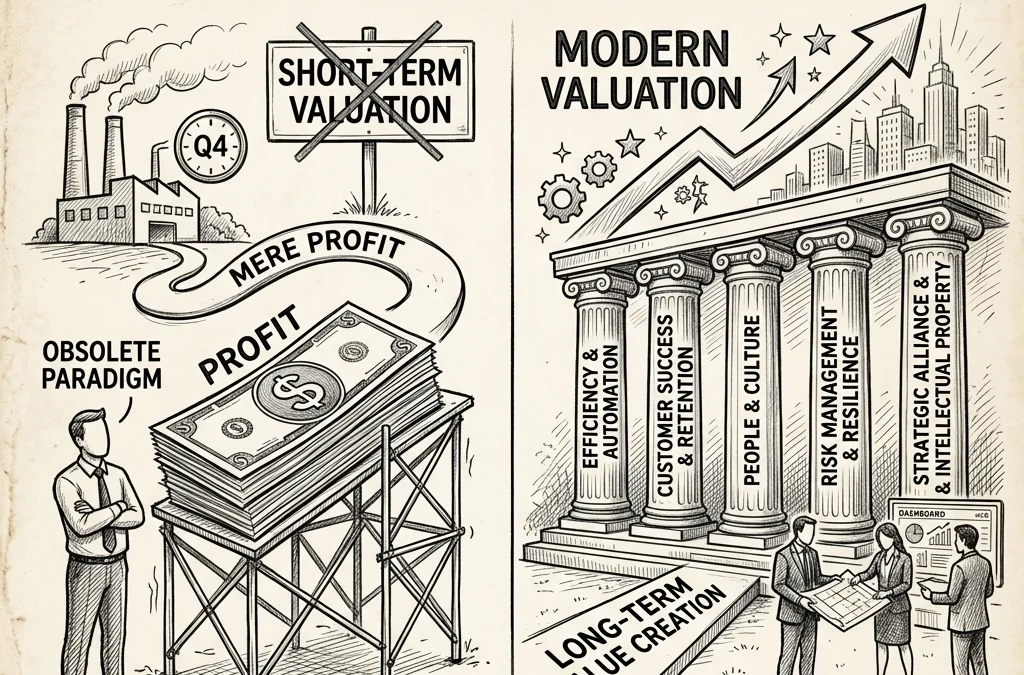
You think your business is worth ten million dollars because your EBITDA says so.
You’re wrong.
In 2026, the market doesn’t care about what you did last year. It cares about what the business can do without you next year.
The gap between a 4x multiple and an 8x multiple isn't found in your revenue growth. It’s found in your Operational Maturity.
If your business relies on your "heroics" to function, you don't own an asset. You own a high-paying, high-stress job. And buyers are tired of buying jobs.
The Profit Trap
For decades, we’ve been told that profit is king.
If the bottom line is black and the margins are healthy, the valuation should follow. That was the old world. In 2026, profit is just the entry fee. It’s the ante to get into the game.
The real value, the "multiple" that determines your final check, is now dictated by how "mature" your operations are.
Profit is a snapshot of the past.
Operational Maturity is a prediction of the future.
Buyers today are looking at your company and asking one question: “If I remove the owner today, does this machine keep spinning, or does it fly apart?”
If the answer is "it flies apart," your valuation just got cut in half. I don't care how much money you made last July.
What Operational Maturity Actually Is
Let’s be clear about what it isn't.
It isn't just having a handbook or a few Google Docs with instructions. It isn't "being busy." It isn't having a team that likes you.
Operational Maturity is the institutionalization of excellence.
It means your processes are documented, automated, and, most importantly, followed without supervision. It means your data is clean, your leadership is deep, and your revenue is predictable.

The Three Pillars of 2026 Valuation
If you want to maximize what you walk away with, you need to stop obsessing over the P&L and start obsessing over these three pillars.
1. The "Owner Independence" Factor
What happens if you disappear for ninety days?
If you can’t answer that question with "the business grows," you are a bottleneck. In the 2026 M&A landscape, bottlenecks don't get top-tier valuations.
Buyers want to see a leadership team that owns the results. They want to see that the "secret sauce" isn't locked inside your head. If every major decision has to cross your desk, you are devaluing your company every single day.
2. Digital Readiness and Data Maturity
In 2026, "we have it in a spreadsheet" is code for "we aren't scalable."
Operational maturity requires a tech stack that provides real-time visibility. Can you see your customer acquisition cost by channel instantly? Do you know your lifetime value (LTV) per segment?
Buyers, especially Private Equity, are looking for "digital readiness." They want to see that you’ve automated the grunt work so they can focus on the growth work.
3. Workflow Stability
Chaos is expensive.
A mature company has a repeatable way of doing things. From how a lead is captured to how a product is shipped, there is a "Company Way."
When your workflows are stable, your margins are predictable. When your margins are predictable, your risk is low. Low risk equals a high multiple. It’s that simple.

(Image description: A minimalist black and white sketch of a complex set of interlocking gears, representing a perfectly synchronized operational system.)
Why the Shift?
Why did the world change? Why is profit no longer the sole metric?
Because the 2026 buyer is smarter than the 2016 buyer.
Private equity firms and strategic acquirers have seen too many "profitable" companies collapse six months after the founder exits. They’ve learned that a spike in earnings can be faked with a marketing blitz or by cutting R&D.
But you can’t fake a mature culture. You can’t fake automated workflows that have been running for two years.
Valuation is now a measure of risk.
A company with $2M in profit and high operational maturity is worth significantly more than a company with $4M in profit and zero systems. The $4M company is a gamble. The $2M company is an investment.
The Diagnostic: What Breaks If You Disappear?
Be honest.
- Does sales stop because you’re the only one who can close the big deals?
- Does the culture rot because you’re the only one holding the team accountable?
- Does the product quality dip because you’re the only one with "the eye" for detail?
If you answered "yes" to any of these, you are currently burning money. You are working hard to build a business that is essentially unsellable at a premium price.
You can find more tools to assess your current state in our free resources section.

How to Build Operational Maturity Before You Sell
You don't build maturity overnight. You build it through a series of intentional, often boring, decisions.
- Document the "Non-Negotiables": Stop documenting everything. Document the 20% of tasks that drive 80% of the value.
- Fire Yourself from the Day-to-Day: Start delegating outcomes, not tasks. If your team is coming to you for "how-to" answers, you haven't delegated enough.
- Invest in Systems, Not People: People leave. Systems stay. Build a system that makes a "B" player perform like an "A" player.
- Clean Your Data: If your books are a mess or your CRM is empty, you are hiding the truth from yourself and your future buyer.
The 2026 Reality Check
The market in 2026 is crowded. There are thousands of owners looking to exit as the "silver tsunami" of retiring entrepreneurs continues.
If you want to stand out, you can't just be profitable. Everyone is profitable. You have to be transferable.
A transferable business is one where the buyer can see themselves stepping into the cockpit and flying the plane without it crashing.
If you want to know what your specific "maturity score" looks like, it might be time to work with me. We don't look at just the numbers; we look at the machine.
The Bottom Line
Profit is what you take home today. Operational maturity is what determines how much you take home when you leave.
Don't wait until you're ready to sell to start building a mature company. By then, the clock has already decided for you. You’ll be forced to take whatever the market offers for your "job," rather than what your "asset" is actually worth.
Build a business that doesn't need you. That is the highest form of professional success.

Your Move
1. Audit your time. For the next week, track every time you have to make a decision that a system or a manager should have made. That’s your "Maturity Gap."
2. Standardize one core process. Pick the one thing that causes the most "fires" in your office. Document it. Train it. Then stay out of it.
3. Get an outside perspective. You’re too close to the business to see the cracks. Check out our books to see how other owners have made the transition from bottleneck to builder.
The clock is ticking. Are you building a business, or are you just busy?