You may believe selling your business is mainly about price.
It isn’t.
It is also about people.
The employees who helped build the company. The managers who know how work actually gets done. The customers who trust familiar faces. The team members who have spent years depending on your leadership and your decisions.
When ownership changes, all of that gets tested.
Most owners avoid this question because it feels uncomfortable:
What happens to my team when I’m no longer in charge?
That question does not disappear because you postpone it.
It gets more expensive.
The Belief: “The Buyer Will Take Care of the Team”
Many owners assume the buyer will keep everyone.
That may happen.
It may not.
A buyer is not purchasing your memories, your sacrifices, or the loyalty people showed you over the years. A buyer is purchasing an operating company with expected cash flow, customers, systems, assets, and risk.
Your team matters because it helps produce those results.
But the buyer will evaluate each role through a different lens:
- Does this position create value?
- Is this person difficult to replace?
- Is the role duplicated elsewhere?
- Does the employee support customers or revenue?
- Is the position tied to the owner rather than the business?
- Can the work be performed through a documented process?
That is the hard reality.
Employees are not automatically protected by the sale. The business has to make retaining them make sense.
In many small-business transactions, most employees continue working after the sale. But the legal and practical details depend on the structure of the deal.
In an asset sale, employees may technically leave the seller’s entity and receive offers from the buyer’s entity. In a stock sale, the company itself may remain in place while ownership changes.
Either way, the team experiences a transition.
Pay may change.
Benefits may change.
Reporting lines may change.
The culture may change.
Some people will stay because they believe in the future. Others will leave because they no longer recognize the business.
The First Question Employees Ask
Employees usually want an answer to one question before they care about your long-term strategy:
“Do I still have a job?”
Everything else comes after that.
They want to know:
- Who owns the company now?
- Will my pay remain the same?
- Will my benefits continue?
- Who will I report to?
- Will my schedule change?
- Will the location change?
- Is the buyer planning layoffs?
- What happens to my accrued time off?
- What does this mean for my future?
If leadership does not answer those questions, employees fill in the blanks.
That is where rumors begin.
A quiet office becomes a nervous office. One employee hears that “there will be cuts.” Another hears that the buyer is “replacing management.” A third starts calling competitors.
Silence does not create stability. It creates speculation.
A strong transition does not require you to promise what you cannot control.
It requires you to communicate what you know, admit what you do not know, and explain when people can expect better answers.
The announcement should be direct.
The seller and buyer should present a consistent message.
The team should have a chance to ask questions publicly and privately.
And the new owner should show up early, not as a distant name in a document, but as a person who intends to understand the company before changing it.

The People Most at Risk
Not every employee faces the same level of uncertainty.
Customer-facing and revenue-producing employees are often highly valuable to a buyer. They hold relationships, practical knowledge, and trust that cannot be transferred through a spreadsheet.
Other positions may face more pressure.
Overlapping administrative, finance, marketing, or management roles can become vulnerable when the buyer already has those functions in place.
That does not mean cuts are inevitable.
It means owners should understand the risk before the buyer does.
Ask yourself:
- Which employees hold key customer relationships?
- Who knows the unwritten rules of the operation?
- Who can solve problems without calling you?
- Who has the trust of the rest of the team?
- Which roles exist only because you have not built a better system?
- If two departments were combined, who would remain essential?
- What breaks if your top manager leaves three months before closing?
These are not pleasant questions.
They are useful questions.
A buyer will ask them. You should ask them first.
Your Team Is Part of Your Business Value
Owners often say, “My people are my greatest asset.”
That may be true.
But buyers do not value employees based on compliments. They value the strength of the operating system those employees support.
A strong team does not simply work hard.
A strong team can:
- Make decisions without constant owner approval
- Follow clear processes
- Train new employees
- Manage customer relationships
- Track performance
- Solve routine problems
- Maintain standards when leadership is absent
That is the difference between a team and a collection of people dependent on one owner.
If every important decision still comes through you, the buyer sees risk.
If one manager knows how everything works but has no documented backup, the buyer sees risk.
If your best customer relationships belong to you personally, the buyer sees risk.
If employees stay only because of your personality, the buyer sees risk.
The more the business depends on you, the more the team’s future depends on the sale going perfectly.
Sales rarely go perfectly.
The Owner-Dependent Team Is Not a Transferable Team
This is where many owners misunderstand loyalty.
They believe being needed proves the strength of their leadership.
Sometimes it proves the opposite.
If employees wait for your approval, customers insist on speaking with you, and managers bring every problem to your office, you may not have built independence. You may have built dependence.
That dependence can feel like control while you are running the business.
It becomes a liability when you leave.
A business that cannot operate without its owner is not fully transferable. It is a job with employees attached to it.
As Mike Steward explains in The Owner-Optional Business, the goal is not to make the owner irrelevant. The goal is to build a company that can operate successfully with or without the owner present.
That changes the team’s experience after a sale.
Instead of wondering who will approve every decision, employees know where authority sits.
Instead of waiting for you to solve every problem, managers have the tools to act.
Instead of treating the buyer as a threat, the team can show the buyer how the business works.
A Short Story About the Shift
I once worked with an owner who believed stepping back was impossible.
Sales ran through him.
Operations ran through him.
Customer relationships ran through him.
Hiring ran through him.
He was proud of that involvement, but it had made him the bottleneck.
The work did not improve because he pushed harder. It improved when he began transferring responsibility deliberately.
He documented key processes.
He developed managers.
He clarified decision rights.
He stopped answering every question immediately.
Within six months, his team was handling much of the work he had previously carried alone. Over the following two years, the business became more valuable because it became less dependent on one person.
The transformation was not from weak team to strong team.
It was from owner-controlled to team-enabled.
That is the kind of change that protects employees and expands your future options.

What to Do Before You Sell
You do not need to announce a sale today.
You do need to prepare the team before a transaction forces the issue.
Start with these five moves.
1. Identify the people the business cannot afford to lose
Do not rely on memory.
Write down the employees who hold essential knowledge, customer trust, technical skill, or leadership influence.
Then ask why they matter.
If the answer is “because only they know how to do it,” you have found a documentation problem.
2. Build a retention plan
Some employees may need a clear reason to stay through the transition.
That could include:
- A defined role after closing
- Direct access to the buyer
- A written transition timeline
- Career development opportunities
- A retention or stay bonus
- Protection for certain compensation or benefits
Retention plans should be handled with appropriate legal and financial advice. But ignoring retention risk is not a strategy.
3. Document the work
Write down the processes that keep customers served and revenue moving.
Include:
- Key customer contacts
- Vendor relationships
- Pricing rules
- Scheduling practices
- Quality standards
- Hiring and training steps
- Recurring deadlines
- Common problems and their solutions
Documentation is not bureaucracy.
It is how knowledge stops walking out the door with one employee.
4. Develop a second layer of leadership
If every manager still needs your approval, you do not have leadership depth.
Give people responsibility before you need them to carry it.
Let them make decisions.
Review the results.
Coach the gaps.
Then give them more authority.
5. Tell the truth about what is changing
Do not promise that nothing will change.
That promise is rarely credible.
Instead, explain:
- What will remain stable
- What is still being evaluated
- When decisions will be made
- Who employees can contact
- How questions will be handled
Clear uncertainty is better than false certainty.
The Sale Is Not the End of the Team’s Story
A sale can give employees new opportunity.
A new owner may bring capital, technology, training, and growth that the previous owner could not provide.
But that outcome is not automatic.
It depends on preparation.
It depends on whether the company has systems instead of tribal knowledge. It depends on whether managers can lead instead of wait. It depends on whether the seller treats the team as part of the transition rather than an inconvenience to manage at closing.
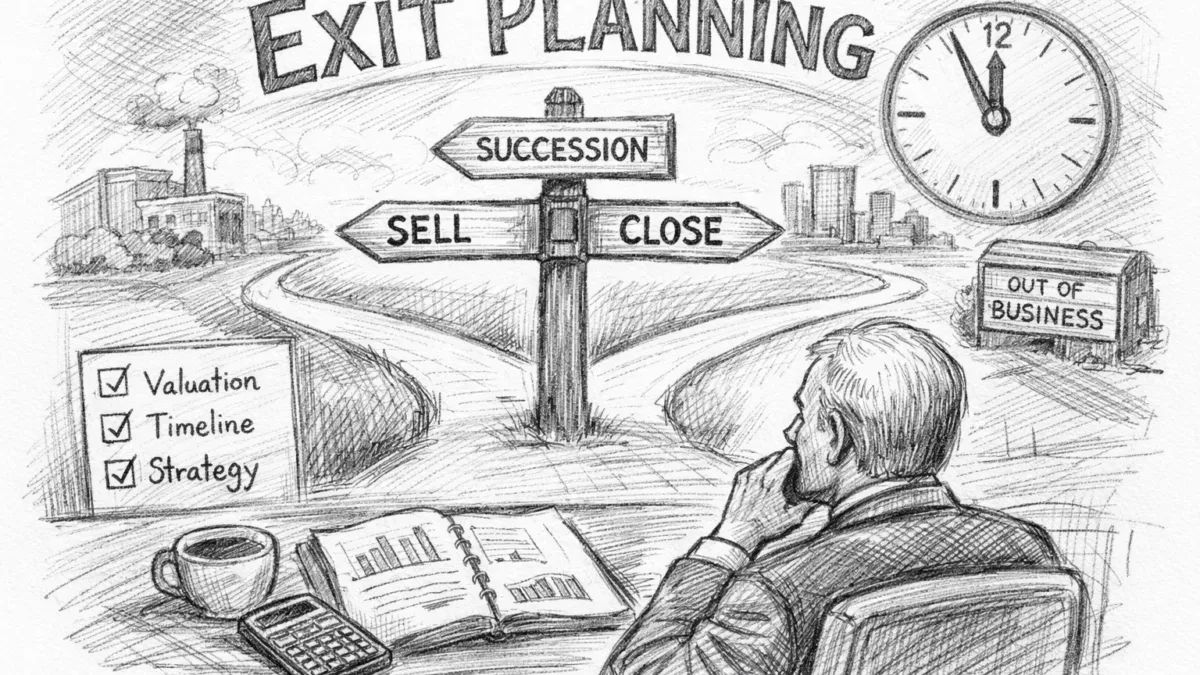
Your business will eventually leave your control through sale, succession, or closure.
The team will live with the consequences of how prepared you were.
That is why exit planning should begin before you are ready to sell. Exit planning starts earlier than most owners think, because strong teams, clear systems, and trusted leadership take time to build.
Your Move
Ask your leadership team three questions this week:
- What breaks if I disappear for 30 days?
- Who would employees trust if I were no longer here?
- What would a buyer worry about in our team today?
Write down the answers.
Do not defend them.
Use them as a work plan.
If you want a clearer view of your company’s value, team risk, and future options, you can work with Mike Steward through a confidential conversation.
You are not planning only for the day you sell. You are building the kind of company your team can survive, and strengthen, after you leave.