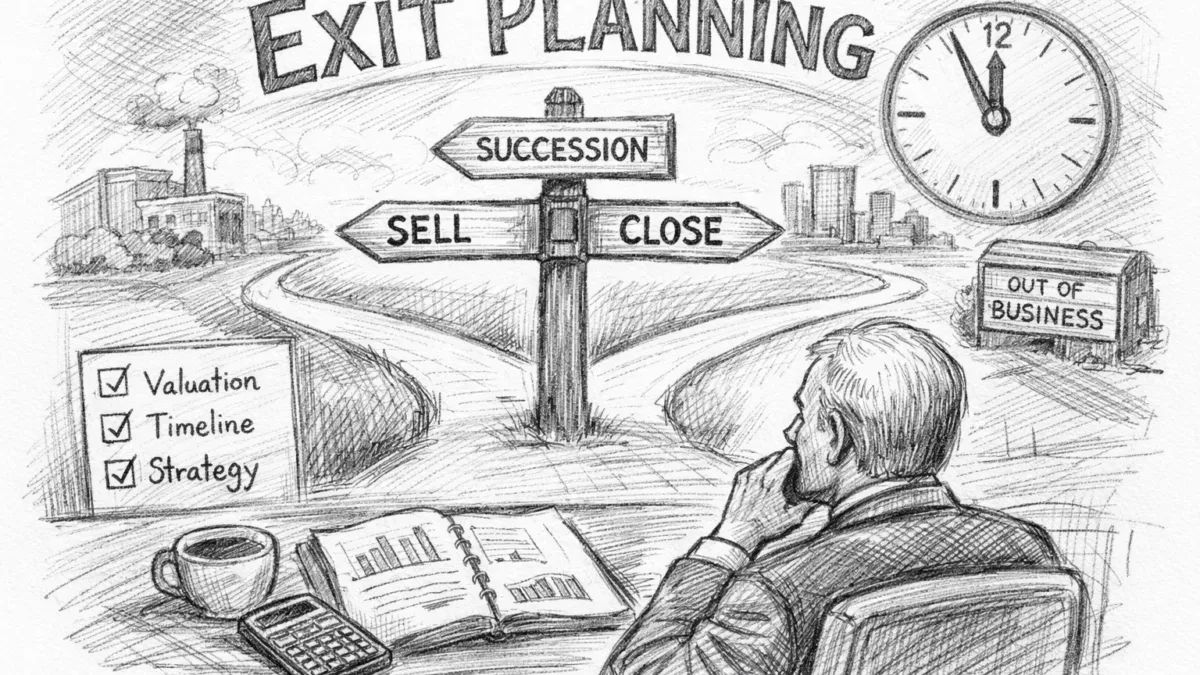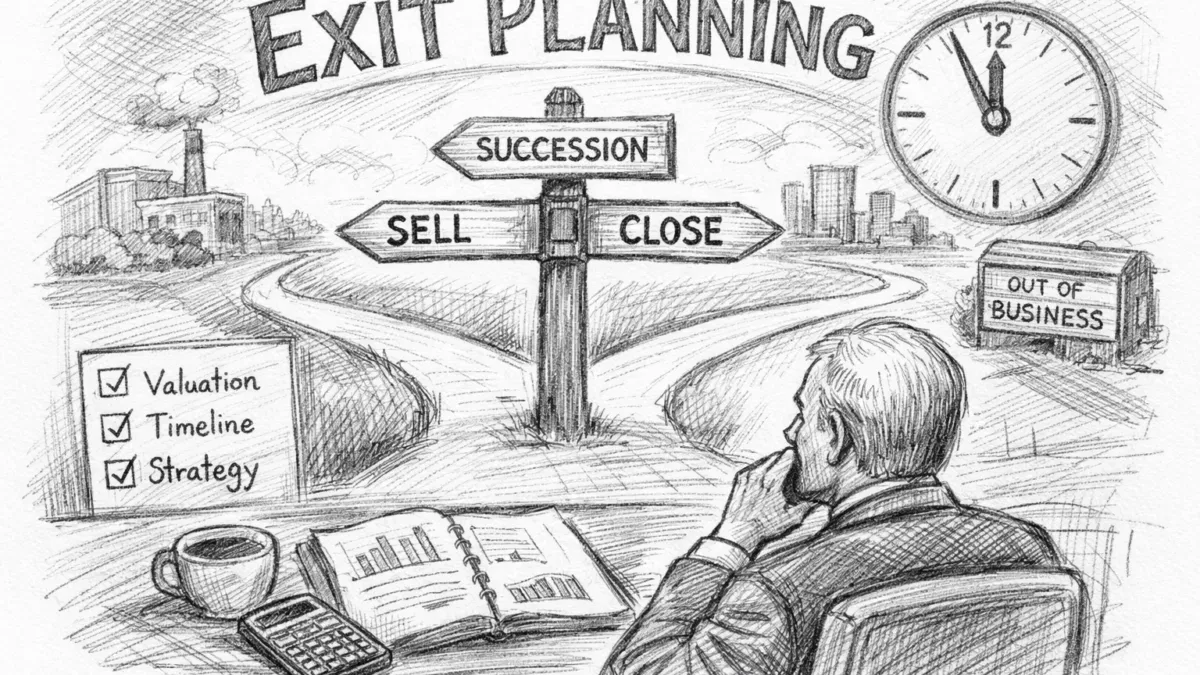
Almost every business owner carries a number in their head.
Sometimes it comes from a friend.
Sometimes it comes from an industry rule of thumb.
Sometimes it comes from adding up years of sacrifice and deciding the business must be worth at least that much.
Most of the time, that number is wrong.
That does not mean you built a bad business.
It means you may be confusing value with revenue, effort, assets, hope, or a future sale price.
A valuation is not designed to flatter you. It is designed to show you what the market may recognize today, and what it may ignore.
According to BDC’s guidance on business valuation, valuation is a complex exercise. Different methods, assumptions, and business conditions can produce different conclusions.
That is not a flaw.
That is reality.
Here are five things owners commonly get wrong about their own number.
1. A valuation is not one exact, permanent truth
Many owners expect a valuation to produce one clean number.
“Your business is worth $2,437,000.”
That sounds precise.
It is also misleading.
A valuation is an informed estimate based on a specific date, specific assumptions, specific financial information, and a specific purpose. It is not a permanent certificate attached to your company forever.
Your business may be worth one amount today and a different amount eighteen months from now.
Why?
Because value responds to changing conditions:
- Earnings rise or fall.
- A major customer leaves.
- A new manager takes over key responsibilities.
- Interest rates change.
- Industry demand shifts.
- The owner becomes less central to daily operations.
- The company becomes more, or less, predictable.
If risk rises, value usually falls. If confidence rises, value usually improves.
That is the basic equation.
A serious valuation may produce a range instead of a single number. The range reflects uncertainty, business size, buyer demand, and the quality of the information available.
Do not reject a valuation because it fails to give you a number precise to the dollar.
Reject a valuation only if the assumptions are weak, the information is incomplete, or the analysis does not match the question you need answered.
Your goal is not false precision.
Your goal is useful clarity.
2. A valuation is not your revenue multiplied by a magic number
Revenue is visible.
It is easy to talk about.
It looks impressive on a scoreboard.
But buyers do not buy revenue by itself. They buy the future cash flow, stability, and transferability that revenue may create.
Consider two companies:
- Company A produces $3 million in annual revenue and $200,000 in earnings.
- Company B produces $1.6 million in annual revenue and $400,000 in earnings.
Which one is worth more?
You cannot answer from revenue alone.
Company B may have stronger margins, better customer retention, lower overhead, cleaner books, and less dependence on the owner.
More sales do not automatically create more value.
A business with $10 million in revenue and no dependable profit may be less attractive than a business with $2 million in revenue and strong, repeatable earnings.
Buyers ask harder questions:
- How much cash does the business generate?
- Are those earnings repeatable?
- How much depends on the owner?
- Are customers diversified?
- Is revenue recurring or tied to one-off projects?
- Can the team operate without constant owner intervention?
- What could break after the sale?
A multiple is not a shortcut around these questions.
It is a way of translating risk and earnings into an estimate of value.
For example:
- $500,000 in dependable earnings × 4 = $2 million.
- $500,000 in fragile earnings × 2 = $1 million.
- $500,000 in growing, transferable earnings × 6 = $3 million.
Same earnings.
Different confidence.
Different value.
You can read more about the practical drivers behind that difference in What Your Business Is Really Worth, and Why Most Owners Get It Wrong.

3. A valuation is not the same as the eventual sale price
This is where many owners get hurt.
They receive a valuation and assume it guarantees what a buyer will pay.
It does not.
Value is an analysis. Price is a negotiated outcome.
Those are related.
They are not identical.
A valuation generally estimates what the business may be worth under stated conditions. A sale price depends on the actual buyer, the actual deal, the actual market, and the actual structure of the transaction.
A strategic buyer may pay more because your company gives them access to customers, geography, technology, staff, or capacity they already need.
Another buyer may pay less because financing is difficult or because the transition looks risky.
The price can also change based on:
- Cash paid at closing.
- Seller financing.
- Earnouts.
- Assumed debt.
- Working capital requirements.
- Contingent payments.
- Post-sale employment obligations.
- Due diligence findings.
A buyer offering $3 million is not necessarily offering $3 million in cash.
If the offer includes $2 million at closing and $1 million tied to future performance, then your risk has not disappeared. It has moved into the deal structure.
The valuation helps you understand the business.
The sale process determines what a buyer is willing to commit.
Those are different jobs.
This is why The Earnout Trap matters. The headline price is not always the money you will actually receive.
4. A valuation is not reimbursement for what you invested, or what you endured
You may have invested twenty years of your life.
You may have worked nights, missed vacations, signed personal guarantees, and carried payroll when the company was barely breathing.
That sacrifice matters to you.
It may matter to your family.
It does not automatically increase the market value of the business.
Buyers pay for future economic benefit, not your personal history.
The market does not ask:
- How many hours did you work?
- How much stress did you carry?
- How many times did you rescue the company?
- How much money did you put into the business?
- How badly do you need the proceeds?
The market asks:
- What earnings can continue?
- What risks come with those earnings?
- What assets and relationships transfer?
- How difficult will the transition be?
- How likely is the buyer to succeed?
Book value creates another common trap.
Book value is an accounting measure based largely on historical cost. It may not reflect the current market value of equipment, property, customer relationships, brand reputation, processes, or intellectual property.
A business can be worth far more than its book value.
It can also be worth less than the owner’s investment.
If you spent $1 million building a company that now produces weak earnings, the market may not give you that $1 million back.
If you built a company with strong recurring revenue, a capable team, and valuable customer relationships, the business may be worth several times more than its recorded assets.
Money spent is not the same as value created.
That distinction is painful.
It is also necessary.
5. A valuation is not a verdict. It is a diagnostic tool
Owners often treat valuation like a final grade.
They want to know whether they passed.
But a useful valuation is not merely a judgment about what you have built. It should show you why the business carries its current value and what could move that value higher or lower.
A good valuation should make you ask better questions:
- What happens if I disappear for 30 days?
- Which customer represents too much revenue?
- What decisions still require my approval?
- Are my financial records clean enough for a buyer to trust?
- Who can run operations without me?
- Is the business growing, or am I simply working harder?
- What would make a buyer nervous?
The owner-optional question is especially important.
If every important customer calls you, every employee depends on you, and every major decision runs through you, the buyer is not purchasing a business.
The buyer is purchasing a job.
That usually creates a discount.
If the business cannot operate without you, then your exit plan depends on your continued presence.
That is not freedom.
That is a delayed problem.
In The Owner-Optional Business, the central test is simple:
What breaks if you disappear?
The answer reveals where value is trapped inside the owner.
I once worked with an owner who believed stepping back was impossible. Sales, hiring, operations, and customer relationships all ran through him.
He did not need a new logo.
He needed to stop being the bottleneck.
Over time, he documented key processes, delegated decisions, and developed people who could carry responsibility. The business became easier to run, and more credible to a future buyer.
Nothing magical happened.
The risk went down.
The confidence went up.
That is how value improves.

The number is useful only if you use it
A valuation is not meant to sit in a drawer while you wait for the “right time” to sell.
It should influence what you do now.
If your value is lower than expected, you have information.
If your value is higher than expected, you have information.
The question is what you do next.
Start with these five moves:
-
Separate revenue from earnings.
Know what the business actually produces after expenses. -
Identify the risks that create a discount.
Owner dependence, customer concentration, weak records, and unstable revenue all matter. -
Test the business without you.
Leave for thirty days and document what breaks. -
Treat value as time-specific.
Revisit the number as the business, market, and risk profile change. -
Build before you need to sell.
Buyers reward proof. They do not reward last-minute promises.
Your business will eventually close, sell, or pass to someone else.
The question is whether you understand the number before that decision becomes urgent.

Your Move
Write down the number you believe your business is worth.
Then write down what supports it.
Not your years in business.
Not your personal sacrifice.
Not your revenue alone.
Write down the earnings, stability, transferability, customer strength, and team depth that a buyer could actually trust.
If you cannot support the number, you do not have clarity yet.
You have an assumption.
Start by reviewing the valuation resources on this site, or schedule a confidential conversation with Mike to understand what your business may be worth today, and what could move that number tomorrow.
Your number is not the finish line.
It is the starting point.