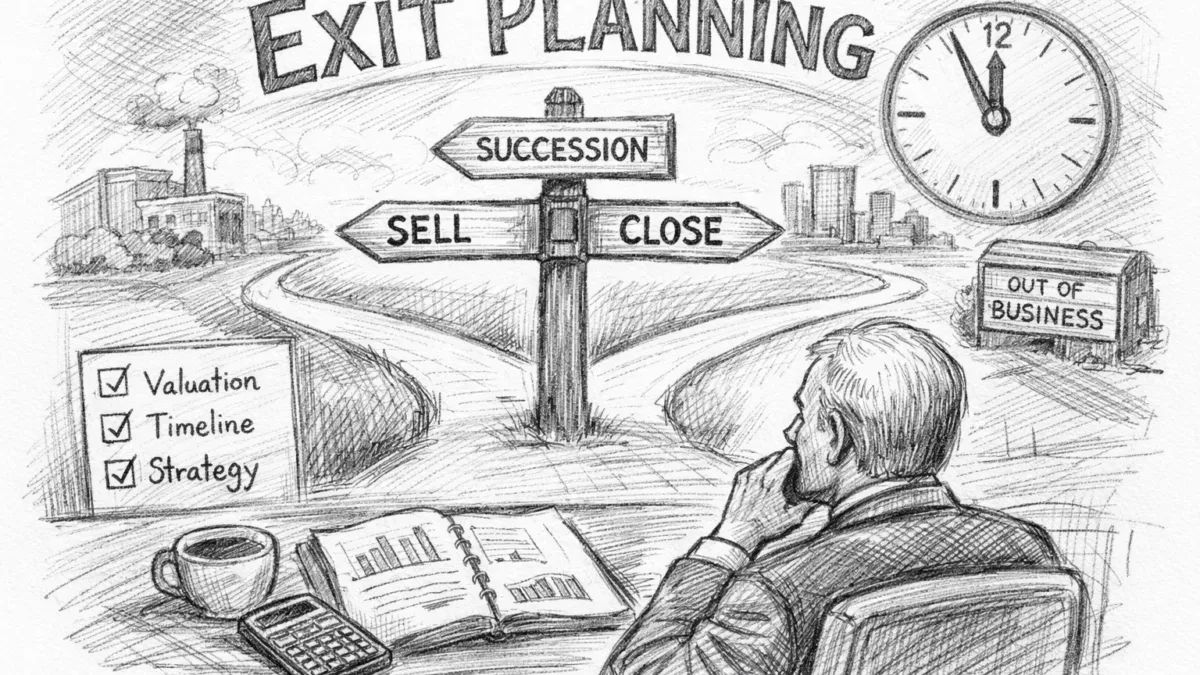
Every business owner eventually exits.
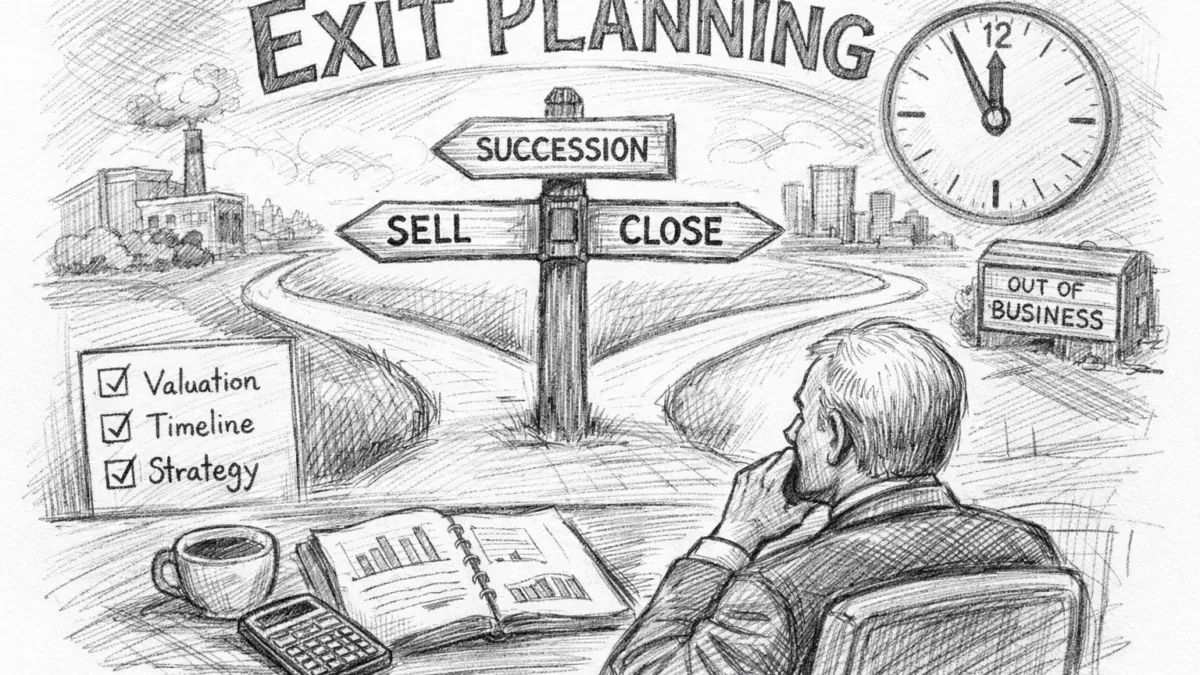
You will sell it.
You will pass it down.
Or you will close the doors.
There is no fourth option called “keep going forever.”
Yet many owners avoid the decision until circumstances make it for them. A health problem. A family conflict. A lost customer. A weak financial year. A buyer who arrives before the business is ready.
That is not an exit strategy.
That is surrendering control.
The path you choose matters. But the preparation required for each path matters more.
Selling a business demands proof, transferability, and value.
Passing it down demands capable successors, clear authority, and honest family conversations.
Closing demands discipline, timing, and an orderly plan to protect what can still be protected.
These are not interchangeable paths.
The Owner’s Comfortable Belief
Many owners believe they can decide later.
They assume the business will remain healthy, the family will agree, the team will be ready, and buyers will still be interested when the time comes.
That is not planning.
That is optimism wearing a business suit.
The reality is simpler:
- If you want to sell, you must build a business buyers can trust.
- If you want to pass it down, you must build leaders who can run it without you.
- If you may close, you must understand the business’s assets, obligations, and remaining value before distress forces the decision.
If you do not choose the path early, the condition of the business will choose it for you.
Path One: Sell the Business
Selling is not automatically the best exit.
It is simply the path that usually provides the clearest opportunity for liquidity and wealth diversification.
A sale may fit if:
- You need substantial cash from the business.
- Your family does not want to operate it.
- The company has reliable earnings and strong market demand.
- You are willing to give up control.
- You want the business to continue under new ownership.
But a sale is not a reward for effort.
Buyers do not pay for your sacrifice, your long hours, or the fact that you built the company from nothing.
They pay for future performance they believe they can actually achieve.
That means they look for:
- Clean and accurate financial statements.
- Sustainable earnings.
- Diverse customers.
- A capable management team.
- Repeatable processes.
- Limited dependence on the owner.
- A business that can continue after the transaction.
A business that collapses when the owner leaves is not a valuable company.
It is a job with payroll.
The preparation required for a sale
If selling is one of your possible paths, start building proof years before you need a buyer.
That means:
- Know what the business is worth today.
- Separate personal expenses from business expenses.
- Document how important work gets done.
- Reduce customer and employee dependence on you.
- Develop leaders who can make decisions without waiting for your approval.
- Build a record of stable or improving performance.
The goal is not to make the company look perfect.
The goal is to make the company understandable and transferable.
As I wrote in What Your Business Is Really Worth, and Why Most Owners Get It Wrong, value is not a feeling.
Value is math plus confidence.
If earnings are strong but confidence is weak, value suffers.
If the company performs well only because you are constantly involved, the buyer sees risk. Risk becomes a discount.
Path Two: Pass It Down
Family succession can preserve a name, a culture, and a legacy.
It can also create years of conflict if the owner confuses family loyalty with leadership readiness.
Passing the business to a child is not the same as preparing that child to lead it.
A family member may love the business and still be the wrong person to run it.
That is not an insult.
It is a leadership question.
Selling a family business, or transferring it through a structured family succession plan, requires hard conversations about:
- Who actually wants the responsibility.
- Who has earned the authority.
- Who has the skills to lead.
- How ownership will be divided.
- How non-operating family members will be treated.
- What happens if the successor fails.
- How the founder will be paid or supported.
- When the founder will stop making decisions.
Family succession is not a handoff ceremony. It is a leadership system.
The next generation needs more than a title.
They need experience with:
- Hiring and firing.
- Cash flow.
- Customer retention.
- Pricing.
- Conflict.
- Capital decisions.
- Accountability.
They also need room to lead.
That means the current owner must eventually stop being the final answer to every question.

The preparation required for family succession
Start with a direct question:
Does your family member want to own the business, or do they simply want to avoid disappointing you?
The answer matters.
Then ask:
- Would this person be selected as the leader if they were not related to you?
- What gaps must they close?
- Who will evaluate their performance?
- Can you accept decisions you would not have made?
- Can the business support both the successor’s income and your financial needs?
If the answer to those questions is unclear, the succession plan is not ready.
A family business should not be transferred based on emotion alone.
It needs an independent understanding of value, clear ownership terms, and professional legal and tax guidance.
The structure may involve a sale, a gift, staged ownership, or another arrangement. The exact structure depends on the family, the company, and the owner’s financial goals.
But the principle is constant:
Do not transfer responsibility faster than you transfer capability.
Path Three: Close the Doors
Closing is often treated as the embarrassing option.
That is a mistake.
Closure is not automatically failure.
Sometimes the business has reached the end of its useful life. There is no capable successor. No buyer sees enough value. The market has changed. The owner’s health or finances no longer support a turnaround.
In those situations, an orderly closure may be more responsible than a desperate sale or a forced family transfer.
Closure is not “doing nothing.”
It requires decisions about:
- Customer and employee communication.
- Inventory and equipment.
- Lease obligations.
- Debt and vendor relationships.
- Intellectual property.
- Outstanding contracts.
- Taxes and legal requirements.
- The timing of the wind-down.
- The owner’s personal financial exposure.
The worst version of closure is an emergency shutdown.
That is when customers are surprised, employees are stranded, creditors are calling, and valuable assets are sold under pressure.
The better version is deliberate.
You identify the warning signs early. You understand what can be sold, what must be settled, and what should be preserved.
The preparation required for closure
If closure is even a remote possibility, know your downside.
Ask:
- What assets could be sold?
- What obligations survive the business?
- Which contracts create risk?
- How long would an orderly wind-down take?
- What would happen to employees and customers?
- What personal guarantees have you signed?
- What would closure do to your family’s finances?
You do not need to decide today that the business will close.
You do need to stop pretending the option does not exist.
Compare the Three Paths Honestly
Here is the decision in plain terms:
| Exit path | Main priority | What must be true | Main risk |
|---|---|---|---|
| Sell | Liquidity and wealth diversification | The business can operate without the owner | Buyers identify risk and reduce the price |
| Pass it down | Legacy and continuity | A capable, willing successor exists | Family emotion overrides business reality |
| Close | Risk control and an orderly ending | No viable buyer or successor justifies continuation | Waiting turns an orderly process into a crisis |
There is also a fourth idea worth understanding: you may not need to choose one path forever.
You could prepare the company for a sale while developing a family successor.
You could reduce your involvement while testing whether the next generation can lead.
You could strengthen operations now so the business has more value whether you sell, transfer it, or eventually wind it down.
Preparation creates options.
Neglect removes them.
That is why an owner-optional business matters. As The Owner-Optional Business: Why It Matters More Than You Think explains, if you disappeared for 30 days, what would break?
Your answer is a diagnostic report.
If everything breaks, you are still the bottleneck.
If the team can operate, customers stay, and decisions move forward, you are building something transferable.
The Decision Framework
Use these five questions to pressure-test your exit path.
1. What do you need financially?
Do you need maximum cash at closing?
If yes, a sale may deserve serious attention.
Do you have enough outside wealth to accept payments over time?
If yes, family succession or an internal transition may become more realistic.
2. Who can lead after you?
Not who loves you.
Not who has worked there the longest.
Who can actually lead?
If no credible successor exists, do not force one into the role.
3. What does the business require from you?
If every major customer, hire, price, and decision runs through you, the company is not ready for any successful transition.
Start removing that dependence now.
4. What matters more: price, continuity, or simplicity?
You may not get all three.
- Maximum price often requires giving up control.
- Continuity may require accepting a slower or lower payout.
- Simplicity may mean closing rather than forcing a complicated transfer.
Know the tradeoff before the pressure arrives.
5. What happens if you wait three more years?
Will the business be stronger?
Will your successor be more prepared?
Will your health, energy, and market conditions improve?
Or will the company become more dependent on you and less attractive to everyone else?
If waiting does not improve your options, waiting is not a strategy.
It is a cost.
Start Before You Feel Ready
You do not need a final answer today.
You do need a working direction.
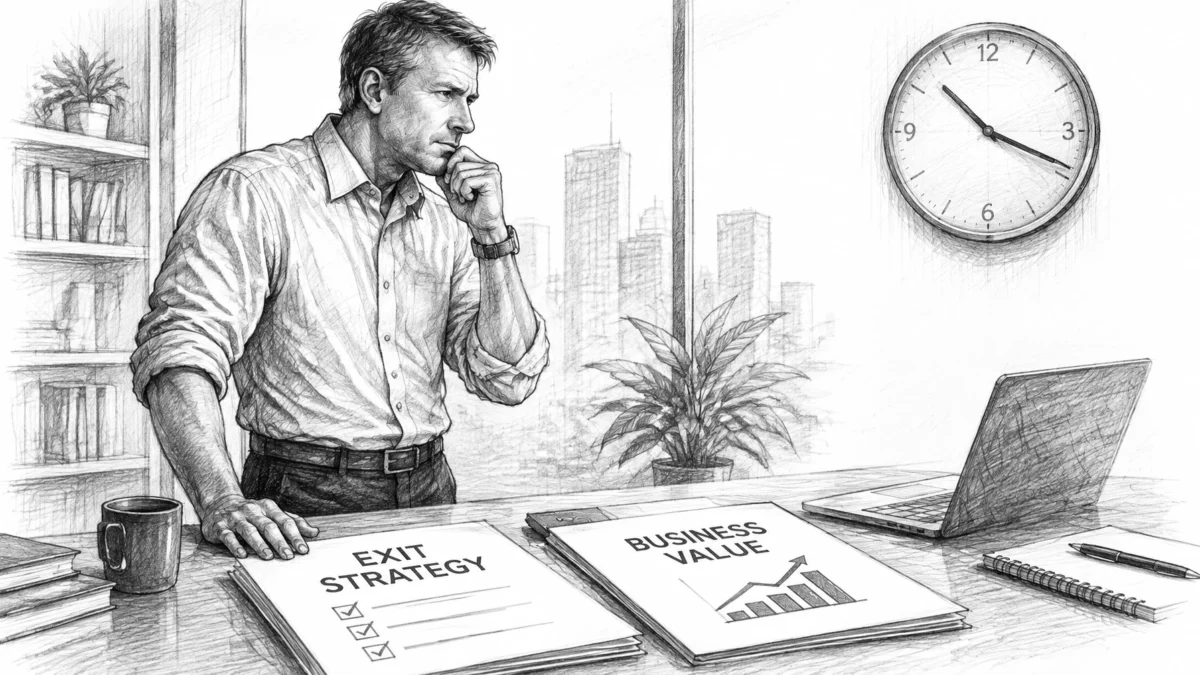
Begin by reviewing your valuation, leadership depth, family expectations, and personal financial needs. Vision Fox Business Advisors helps owners understand business value and prepare for potential future transitions. You can also work with Mike to bring structure to the questions you have been postponing.
The earlier you examine the options, the more freedom you keep.
Your business will end one day. The question is whether you choose the ending: or inherit it.
Your Move
Write three headings on one page:
- Sell
- Pass It Down
- Close
Under each heading, write:
- What would make this path work?
- What would make it fail?
- What must I begin doing this year?
Then answer the question most owners avoid:
If I could not work in the business tomorrow, which path would still be possible?
That answer is where your real exit planning begins.