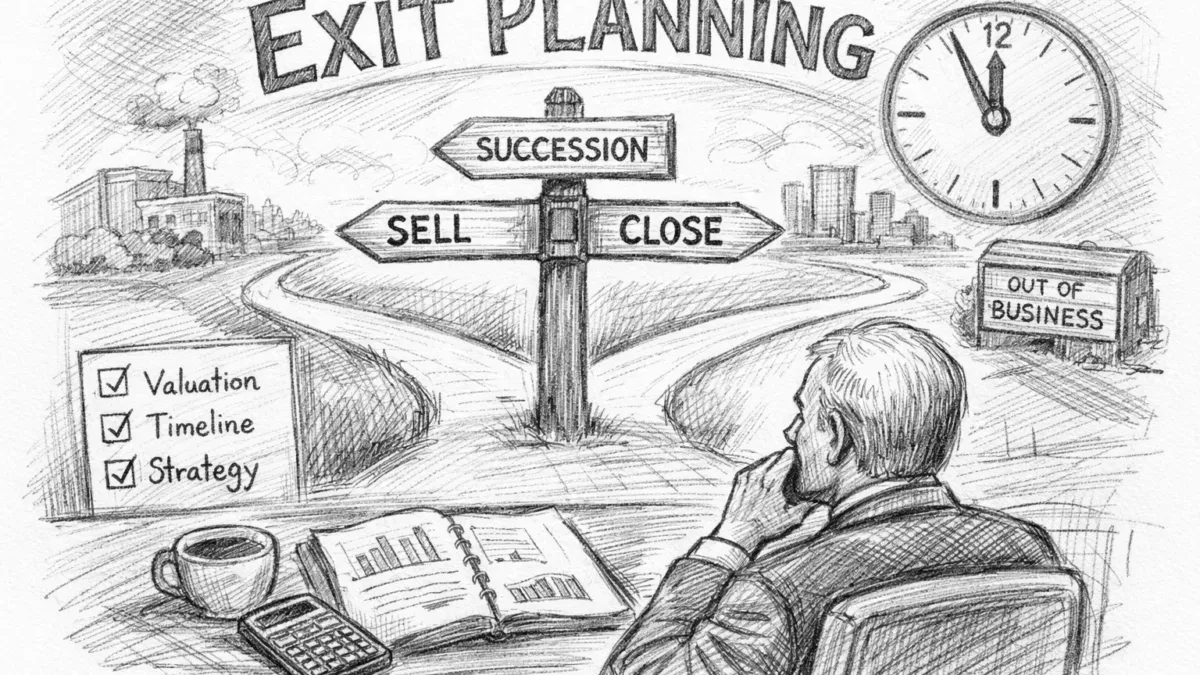
Your business may be your largest asset.
That does not make it a retirement plan.
It makes it a large, concentrated, illiquid asset with no guaranteed buyer, price, or closing date.
That distinction matters.
Many owners spend decades reinvesting every available dollar into the company. They skip outside investments. They keep personal savings thin. They tell themselves the same sentence:
“I’ll sell the business when I retire.”
That sounds like a plan.
It is not.
It is a hope attached to a future transaction.
The belief: “My business will pay for my retirement”
The business has paid for your house, your family, your employees, and your lifestyle.
You built something valuable.
You have every right to expect a return.
But buyers do not pay for your effort. They pay for future cash flow, transferable systems, reliable customers, and reduced risk.
Those are not the same thing.
Your business is not a bank account. It is not a pension. It is not a guaranteed check waiting for you at age 65.
It is a company that must remain attractive to someone else at the exact time you need to leave.
That creates several risks:
- The buyer may not appear.
- The buyer may not agree with your valuation.
- The market may weaken.
- Your health may change.
- Your key people may leave.
- Your customers may become less loyal.
- Your business may depend too heavily on you.
If the business cannot operate without you, its value may fall when you need it most.
That is the hard truth behind business owner retirement planning.
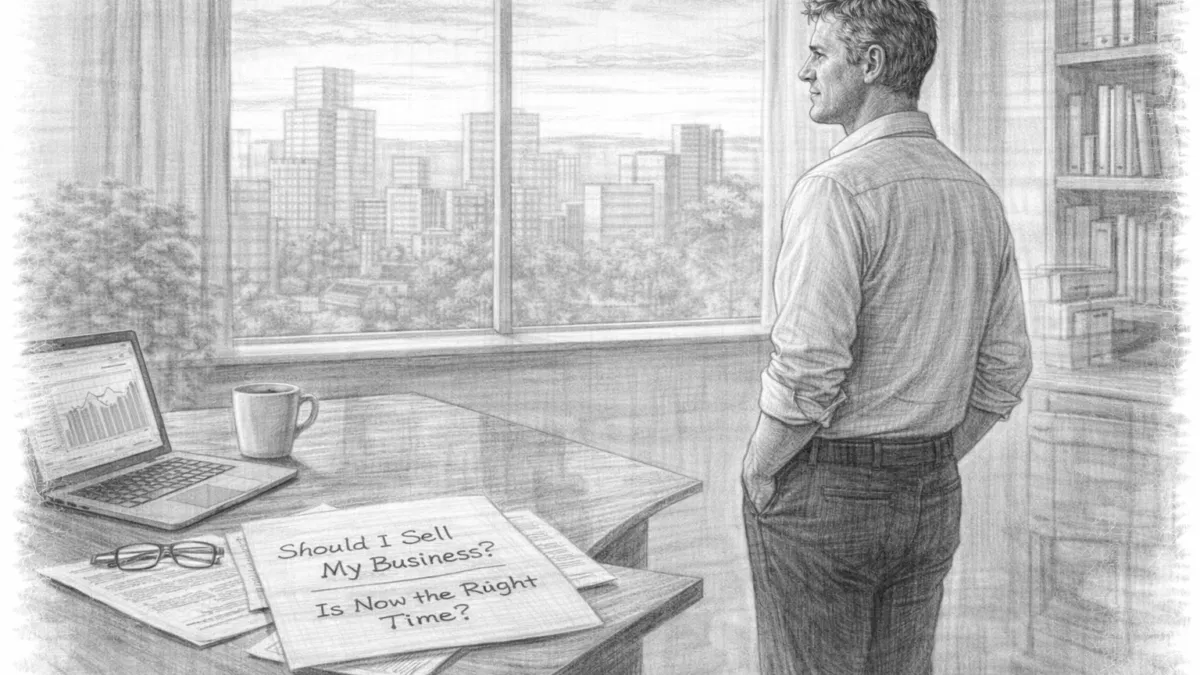
A business sale is not the same as retirement income
Suppose your business sells for $2 million.
That sounds like a strong retirement asset.
Now subtract the items owners often ignore:
- Taxes
- Transaction costs
- Debt payoff
- Working capital adjustments
- Seller financing
- Earnouts
- A transition period
- Delays before all proceeds arrive
For a simple illustration, assume taxes and transaction costs reduce the $2 million sale to $1.6 million.
At a 4% annual withdrawal rate, $1.6 million produces approximately $64,000 per year before taxes and investment changes.
If your retirement lifestyle requires $140,000 per year, the sale leaves an annual gap of $76,000.
That is not a small gap.
It is the difference between the life you pictured and the life your proceeds can actually support.
The math is not complicated:
- Retirement need: $140,000 per year
- Net sale proceeds: $1.6 million
- Illustrative annual income at 4%: $64,000
- Annual shortfall: $76,000
If you have outside investments, rental income, retirement accounts, or other assets, the gap may be manageable.
If you do not, the sale price must carry the entire load.
That is too much pressure to place on one uncertain event.
The market does not care when you want to retire
You may want to sell at 62.
The market may disagree.
Your industry may be slowing. Interest rates may be higher. Buyers may be cautious. A major customer may be leaving. A competitor may be taking market share.
The business that looked highly valuable in one year may be worth far less two years later.
This is why a retirement plan built entirely around a future sale has a single point of failure.
If the sale closes at your preferred price, your plan works.
If the sale takes longer, your plan weakens.
If the sale price drops, your plan changes.
If the sale never happens, you may be forced to keep working: or close.
Research compiled by Kiplinger and other financial planning sources makes the same basic point: owners need liquid, diversified assets outside the company because business value and sale timing are uncertain.
This is not pessimism.
It is responsible planning.
Health can turn a planned exit into a forced exit
Most owners imagine they will choose their departure date.
Many will not.
A health event can compress a five-year plan into five months.
Consider this simple illustration:
Planned scenario
You intend to work five more years.
During that time, you:
- Build $500,000 in liquid investments.
- Reduce owner dependence.
- Strengthen your management team.
- Improve reporting and documentation.
- Increase the business’s market value to $3 million.
- Sell after preparing buyers and advisors.
Assume taxes and costs reduce the sale proceeds to $2.4 million.
Your total retirement capital may then look something like this:
$500,000 outside the business + $2.4 million net sale proceeds = $2.9 million
Forced scenario
Now suppose illness forces you out this year.
The company still depends on you. The systems are incomplete. The management team is thin. Buyers see risk. You need to sell quickly.
The business sells for $2 million, but pressure and weak transferability result in a 25% reduction in net proceeds.
You receive approximately $1.5 million after taxes and costs.
Your retirement capital becomes:
$0 accumulated outside assets + $1.5 million net sale proceeds = $1.5 million
The difference between the two scenarios is $1.4 million.
That difference is not created by one bad decision at the end.
It is created by years of treating the business as the only retirement plan.

Your business may be valuable and still fail your retirement needs
Business value and retirement readiness are different measurements.
A company can be worth $1 million and still fail to fund your lifestyle.
A company can be profitable and still be impossible to sell quickly.
A company can have strong revenue and still depend entirely on its owner.
A company can look successful from the outside while carrying hidden risks that buyers will price aggressively.
Ask yourself:
- What happens to revenue if you disappear for 90 days?
- Who owns the key customer relationships?
- Who makes the decisions only you can make?
- Can a buyer understand your numbers without you explaining them?
- Is your team capable of running the company during a transition?
- How much cash do you have outside the business?
- What happens if you need to exit three years earlier than planned?
These are not theoretical questions.
They are tests of transferability.
Buyers want a business they can operate, understand, and grow.
They do not want to purchase a job with a complicated handoff.
The more the business requires you, the more your retirement depends on your continued health and availability.
Stop measuring retirement by gross business value
Owners often say, “My company is worth $4 million.”
The better question is:
“How much will I actually keep, and how much income will that produce?”
Gross value is not spendable cash.
You need to account for:
-
A realistic valuation.
Not the number you need. The number the market can support. -
The value gap.
What is holding the business back? Owner dependence? Weak records? Customer concentration? Poor management depth? -
Taxes and transaction costs.
The structure of the deal can change the amount you keep. -
Timing and payment terms.
A buyer may not pay everything at closing. -
Your actual lifestyle need.
What will housing, healthcare, travel, family support, and inflation require? -
Your outside assets.
Retirement accounts and investments reduce pressure on the sale.
A business valuation is not just a price estimate.
It is a planning tool.
Vision Fox Business Advisors helps owners understand what their company may be worth and which changes can improve its future options. The first step is often not selling.
It is getting out of the dark.
Build a retirement plan that can survive a bad year
Your company should help fund retirement.
It should not be the only thing standing between you and financial dependence.
That means building assets and options outside the business while you still have time.
The moves are straightforward:
- Save and invest outside the company.
- Use appropriate retirement accounts with guidance from your CPA or financial advisor.
- Maintain personal liquidity.
- Reduce personal debt where possible.
- Create a contingency plan for illness or disability.
- Build a management team that can operate without you.
- Document the systems buyers will need to trust.
- Review business value before you are ready to sell.
A practical planning horizon is often three to five years, although the right timeline depends on the company and your goals.
Starting earlier gives you more choices.
If your business is undervalued, you have time to improve it.
If your outside assets are thin, you have time to build them.
If you are the bottleneck, you have time to become the builder of a company that works without you.
That is the transformation buyers reward.

The goal is not to leave tomorrow
Exit planning does not mean you must sell now.
It means you stop assuming that tomorrow will provide the same options as today.
You may continue operating for ten years.
You may sell next year.
You may transfer the company to family.
You may close it.
The point is to make the decision intentionally instead of allowing health, burnout, market conditions, or a crisis to make it for you.
As Mike Steward explains in *Before the Clock Decides, every business eventually reaches an ending: it closes, it sells, or it is passed down.
The question is whether you will prepare for that ending while you still have leverage.
Your business can be an important part of your retirement.
But it is not your retirement plan until its value is understood, its operations are transferable, and your personal financial future does not depend on a perfect sale.
Your Move
Write down three numbers:
- Your annual retirement income requirement.
- The realistic net proceeds you would keep from a business sale.
- The amount of liquid wealth you currently hold outside the company.
Then subtract number two and number three from number one’s total capital requirement.
If the gap is uncomfortable, do not hide from it.
Get a realistic valuation. Identify what is weakening your company’s value. Start building assets outside the business. Create a plan for the exit you want: and a backup plan for the exit you may be forced to take.
You can learn more about Mike Steward’s approach to valuations, leadership, and exit readiness through Work With Mike or schedule a confidential conversation.
**Your business should fund your next chapter.
It should not decide whether you get one.**