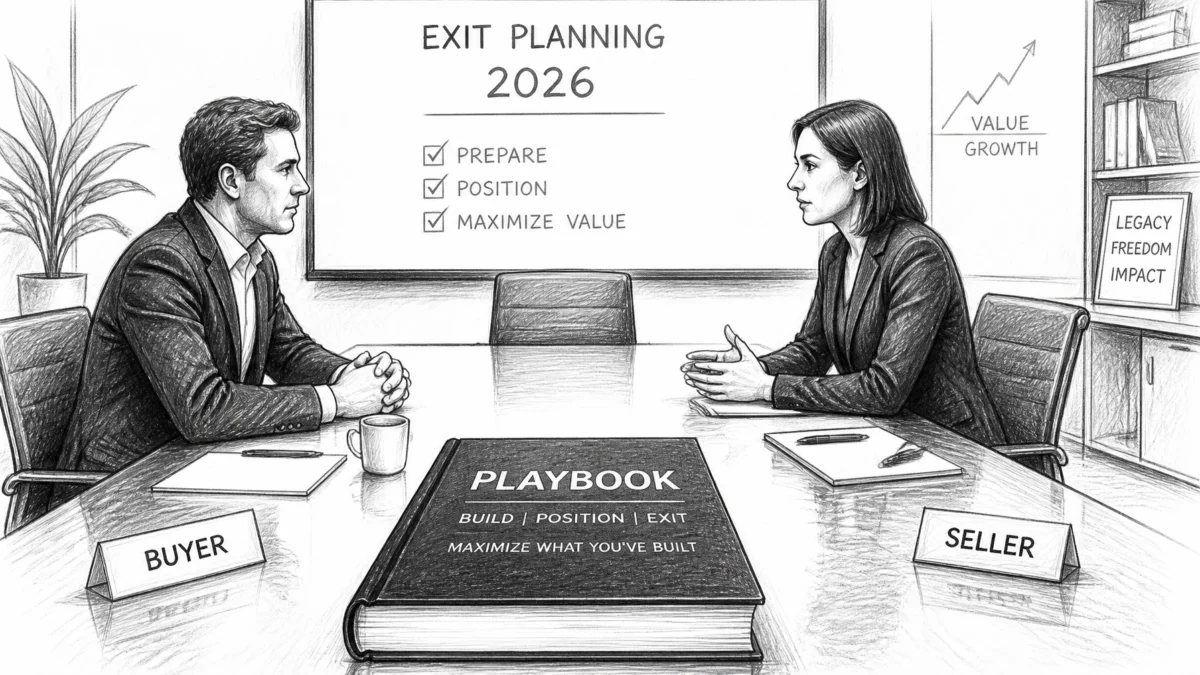
The world changed in 2022, but most business owners are still acting like it’s 2019.
Back then, money was cheap. Buyers were reckless. You could sell a mediocre business for a premium price just by showing up with a halfway-decent P&L.
Those days are dead.
The 2026 M&A landscape is a different animal. It is selective. It is disciplined. And it is increasingly brutal for the unprepared.
If you are planning an exit strategy, you need to understand the new rules of the game before you ever put your company on the market.
The Death of the All-Cash Deal
The era of the "clean break" is fading.
In today’s market, fewer buyers are coming to the table with 100% cash at closing.
Interest rates stabilized, but they didn’t return to the floor. Lenders are more conservative. Risk is being shifted back onto you, the seller.
What you believe: "My business is worth $8 million, and I’ll get a wire for the full amount on closing day."
The reality: Buyers are demanding seller notes, earnouts, and equity rollovers. They want you to have "skin in the game" to ensure the business doesn’t collapse the moment you walk out the door.
If you aren't prepared to finance part of your own exit, you aren't ready to sell.
The SBA’s New $10 Million Ceiling
There is a new reality in business valuation for sale: The SBA has increased its loan limit to $10 million.
On the surface, this looks like a win for sellers. More capital should mean more buyers, right?
Wrong.
Higher loan limits have come with much stricter underwriting. Banks are no longer "checking boxes." They are performing proctology exams on your business operations.
- They are looking for at least three years of clean, accrual-based financials.
- They are scrutinizing customer concentration like never before.
- They are demanding proof that the business can service the debt even in a downturn.
If your books are a mess of personal expenses and "creative" accounting, the SBA will pass. And if the SBA passes, your buyer pool shrinks to almost zero.
The Quality of Earnings (QofE) Trend
Diligence is no longer just about checking tax returns.
The "Quality of Earnings" (QoE) report has become the entry ticket for any serious transaction.

A QoE report doesn't just look at what you made; it looks at how you made it.
It strips away the "owner's perks" and the one-time windfalls to find the true, sustainable earnings of the company.
What breaks if you disappear?
If your earnings are tied to your personal relationships or your 80-hour work weeks, your "quality" is low. Buyers will discount your price: or walk away entirely.
Operational Maturity: The New Gold Standard
In 2026, the most valuable asset you can sell is your absence.
Buyers aren't looking for a job; they are looking for a machine. They want operational maturity.
An operationally mature business has:
- A management team that makes decisions without the owner.
- Documented processes that anyone can follow.
- Cloud-based systems that provide real-time data visibility.
If every major decision still goes through your desk, you don't have a business. You have a very high-paying, high-stress job. And nobody wants to buy your job.
The 12-Month Minimum
Preparing a business for sale is not a weekend project.
You cannot decide to sell on Monday and be on a beach by Friday. If you want a top-tier valuation, you need a minimum of 12 months of intentional preparation.
- Months 1-3: Clean up the balance sheet and exit personal expenses.
- Months 4-6: Build the second-tier management team and delegate key relationships.
- Months 7-9: Commission a sell-side QoE to find the skeletons in your closet before the buyer does.
- Months 10-12: Run the business like you’re keeping it for 20 years, even though you’re selling in 60 days.
Your Move
Success in the 2026 market requires professional guidance. You don't know what you don't know, and what you don't know will cost you millions at the closing table.
Start by understanding what your company is actually worth today. Contact Vision Fox Business Advisors to begin your business exit planning.
Stop guessing. Start preparing.
The $10 Million Ceiling: Navigating the SBA’s New Debt Reality

The SBA recently moved the goalposts.
The $10 million loan limit was supposed to be a gift to the lower-middle market. Instead, it has become a filter that separates the pros from the amateurs.
If you think a higher loan limit means an easier sale, you are dangerously mistaken.
Debt Service is the New Valuation
In the old days, sellers focused on multiples. "I want 5x EBITDA," they would say.
Today, buyers: and more importantly, their lenders: focus on Debt Service Coverage Ratio (DSCR).
If/Then Logic:
- If your business cannot comfortably pay the principal and interest on a $10 million loan while still providing a profit for the buyer…
- Then your business is not worth $10 million.
It doesn't matter what your industry average is. It doesn't matter what your neighbor sold for. If the math doesn't work for the bank, the deal won't happen.
Stricter Underwriting is Not a Suggestion
Banks are no longer taking your word for it.
The new SBA rules require deep-dive audits into your "Add-backs." Every dollar you claim as an "owner's benefit" must be documented, justified, and defensible.
If you can't prove it, the bank won't count it.
Your Move
Check your debt capacity before you set your price. Work with an advisor who understands how lenders view your cash flow.
Don't let a bank's "No" be the first time you hear the truth about your value.
Quality of Earnings: The Audit That Can Make or Break Your Sale
Diligence has evolved.
It used to be that a buyer would look at your tax returns and a few bank statements. Now, they bring in a team of CPAs to perform a Quality of Earnings (QofE) report.
This is the proctology exam of the business world.
What is "Quality"?
Quality isn't about the amount of money you make. It’s about the certainty of that money.
Buyers look for:
- Customer Diversity: If one client is 30% of your revenue, your quality is low.
- Recurring Revenue: If you have to sell every customer from scratch every month, your quality is low.
- Margin Stability: If your costs are rising and you can't pass them on, your quality is low.
The Sell-Side Advantage
Most owners wait for the buyer to do the QoE. This is a massive mistake.
By the time the buyer finds an issue, they already have you under Letter of Intent (LOI). They will use every "red flag" to grind your price down.
The hard truth: It is much cheaper to find your own problems and fix them before you go to market.
Your Move
Commission a sell-side Quality of Earnings report. It is the only way to "pre-approve" your business for a sale and defend your valuation.
The Owner-Independent Business: Why Your Absence Is Your Greatest Asset

What happens if you don't show up for work for 30 days?
If the answer is "everything falls apart," then you don't have an asset. You have a job.
In the 2026 market, owner-independence is the primary driver of your multiple.
The Founder Trap
Most owners take pride in being the smartest person in the room. They are the chief salesperson, the lead engineer, and the final decision-maker.
To a buyer, this is a nightmare.
What you believe: "I am the heart of this company."
The reality: "You are the single point of failure."
A buyer is looking for a business that can grow without you. If the customers only buy because they like you, the value disappears the day you leave.
Building the Machine
To sell for a premium, you must replace yourself with systems and people.
- Standard Operating Procedures (SOPs): If it isn't written down, it doesn't exist.
- Management Layer: Hire people who are better than you at specific tasks.
- Incentives: Align your team's success with the company's performance post-sale.
Your Move
Take a "fire yourself" audit. Identify every task that only you can do, and find a way to delegate it in the next six months.
The 12-Month Rule: Why Preparation Is Not a Weekend Project

Most business owners wait until they are burnt out, bored, or sick to think about an exit strategy.
By then, it's too late.
Exit planning is not about the transaction. It is about the preparation.
Why 12 Months?
You need 12 months because that is how long it takes to change the narrative of your financials.
If you have a "bad year" because you were distracted, you can't fix that in a month. You need four clean quarters of growth to prove to a buyer that the business is trending upward.
Preparation includes:
- Cleaning up legal disputes and messy contracts.
- Upgrading aging equipment or software.
- Normalizing your inventory levels.
- Tidying up the physical appearance of your facility.
The Cost of Waiting
The most expensive mistake you can make is being forced to sell.
When you have to sell, you lose all leverage. You take the first offer. You accept bad terms. You leave millions on the table.
Your Move
Don't wait until you're ready to leave to start the plan. Start the clock today.
Fewer All-Cash Deals: The Rise of the Seller Note and Earnout

Cash is no longer king; structure is.
In 2026, the question isn't "How much is the price?" but "How is the price paid?"
Understanding the Structure
If you are holding out for a 100% cash-at-closing deal, you might be waiting forever.
Modern deals are built like a layer cake:
- Cash at Closing: Usually 60-80% of the total price.
- Seller Note: A loan you give the buyer, paid back with interest over 3-5 years.
- Earnout: Future payments tied to the performance of the business.
- Equity Rollover: You keep a small percentage of the company to sell later when the buyer exits.
Why Buyers Demand It
Buyers use these structures to mitigate risk. If the business underperforms after the sale, they aren't stuck with the bill: you are.
This sounds unfair, but it is the price of admission in today’s market.
If/Then Logic:
- If you want the highest possible price…
- Then you must be willing to accept more risk through a seller note or earnout.
Your Move
Understand your "walk-away number." Know the minimum cash you need to be happy, and be flexible on the rest to get the deal done.
Vision Fox: How to Bridge the Gap Between Your Business and Your Exit

You have spent decades building your business. Don't spend ten minutes planning your exit.
The gap between what you think your business is worth and what a buyer will actually pay is often millions of dollars.
That gap is filled with preparation, documentation, and strategy.
You Don't Have to Do This Alone
You are an expert at running your company. You are likely not an expert at selling one.
The M&A world is full of sharks, traps, and complex math. One wrong move in a contract can cost you more than your entire management team earns in a year.
The Role of an Advisor
A good advisor doesn't just "find a buyer." They:
- Identify the "value killers" in your business before you go to market.
- Help you navigate the new SBA and lending requirements.
- Ensure your financials are "buyer-ready."
- Protect your legacy and your sanity during the process.
Your Move
Don't wait for the clock to decide your future.
Contact Vision Fox Business Advisors today. Let's look at the reality of your business and build a plan that gets you the exit you’ve earned.
{“@type”:”BlogPosting”,”image”:”https://cdn.marblism.com/Zki015lX_d9.webp”,”author”:{“url”:”https://beforetheclockdecides.com/author/mikevisionfox-com”,”name”:”Mike Steward”,”@type”:”Person”},”@context”:”https://schema.org”,”headline”:”The 2026 Buyer’s Playbook: What Sellers Don’t Know About the New Rules of the Game”,”keywords”:”exit strategy, business exit planning, preparing a business for sale, business valuation for sale”,”publisher”:{“logo”:{“url”:”https://beforetheclockdecides.com/logo.png”,”@type”:”ImageObject”},”name”:”Before the Clock Decides”,”@type”:”Organization”},”description”:”Discover the new rules of M&A in 2026. Learn about the $10M SBA loan limit, the necessity of Quality of Earnings reports, and why owner-independence is the gold standard for business exits.”,”datePublished”:”2026-07-24″,”mainEntityOfPage”:{“@id”:”https://beforetheclockdecides.com/the-2026-buyers-playbook”,”@type”:”WebPage”}}