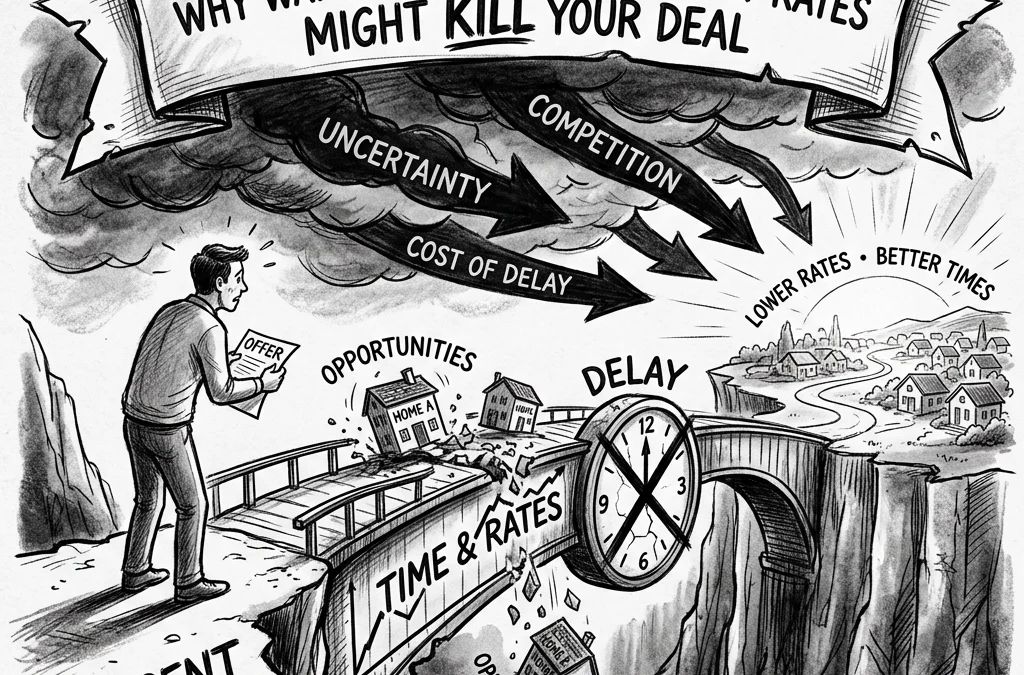
You’re waiting.
You think you’re being smart. You think you’re "reading the market."
You’ve got a deal on the table, or you’re thinking about putting your business on the block, but you’ve decided to hit the brakes.
Why? Because you heard a rumor that interest rates might drop a quarter point in six months.
Let’s be honest: You aren’t being a genius. You’re being a gambler.
And in the world of business exits, the house almost always wins when you play the waiting game.
The Myth of the "Perfect" Entry
Market timing is a ghost.
People spend their whole lives chasing it and end up with nothing to show for it but gray hair and missed opportunities.
Business owners often tell me, "Mike, I just want to wait until the debt is cheaper for the buyer. It’ll drive my price up."
That sounds logical. It isn’t.
Lower rates don’t happen in a vacuum. Usually, when rates drop, it’s because the economy is cooling off or sliding into a ditch.
Do you really want to try to sell your business when the economy is in a ditch?
Market timing isn't a strategy. It's an excuse for indecision.
If the deal makes sense today, it makes sense. If it doesn't, a 0.5% shift in interest rates won't save it.
The True Cost of "Wait and See"
Let’s look at the math, because the math doesn't care about your feelings.
Imagine you have a $5 million deal. You decide to wait twelve months because you’re convinced rates will drop from 7% to 6%.
In that year of waiting, three things happen:
- Fatigue sets in. You’re tired. You’ve already mentally checked out of the business, but now you have to run it for another year at 100% capacity.
- Execution risk increases. A key employee leaves. A major customer pivots. A competitor launches a new product.
- The market shifts. By the time rates drop, the buyer pool has changed, or your industry has lost its "flavor of the month" status.
You might save a few thousand dollars in debt service for your buyer, but you’ve risked the entire $5 million exit.
Is a 1% interest rate swing worth a 100% loss of a deal?

What Buyers Actually Care About
Buyers aren't obsessed with the APR. They are obsessed with Debt Service Coverage Ratio (DSCR) and Cash Flow.
A sophisticated buyer: the kind of buyer you actually want: knows how to model a deal at various interest rates.
They know that if they buy a high-quality asset today, they can always refinance tomorrow.
Your rate isn't their forever rate.
They are looking at your EBITDA. They are looking at your systems. They are looking at whether they can grow the company.
If your business is healthy, they will find a way to fund the deal.
If they walk away because of a minor rate fluctuation, they weren't the right buyer to begin with.
Or worse, your business isn't as strong as you think it is.
The Volatility Reality
Interest rates are not a straight line. They are a jagged mountain range.
You wait for a drop, and instead, a piece of economic data comes out on a Tuesday morning that sends rates climbing.
Now what?
Now you’re chasing a ghost that’s moving in the wrong direction.
Research shows that even professional traders can’t consistently time rate movements. If they can’t do it with billions of dollars and supercomputers, what makes you think you can do it between staff meetings?
Timing is a distraction from preparation.
While you're watching the Fed's next move, you should be watching your inventory levels and your business valuation.
Deal Momentum is a Fragile Thing
A deal is like a fire. It needs oxygen.
The longer a deal sits on the desk, the more likely it is to blow up.
Lawyers get bored. Accountants find "issues." Buyers get cold feet. Sellers get paranoid.
When you pause a deal to wait for better rates, you are effectively throwing a bucket of water on that fire.
You can’t just "restart" momentum whenever you feel like it. Once a buyer moves on to another opportunity, they are gone.
A closed deal at a "bad" rate is infinitely better than a "perfect" deal that never happens.
The "Refi" Fallback
Here is the secret most brokers won't tell you: The interest rate at the time of closing is just a starting point.
In most commercial deals, there are ways to restructure debt down the road.
If rates plummet six months after you sell, the buyer can refinance.
They get the benefit of the lower rate, and you get the benefit of having your money in the bank and your legacy secured.
Why are you taking the risk for a benefit the buyer can achieve on their own later?
Diagnostic Questions for the "Waiters"
If you are currently holding off on a transition because of interest rates, ask yourself these three questions:
- If rates don't drop for another two years, am I prepared to run this business at full speed until then?
- If my biggest customer left tomorrow, would I regret not taking the deal that was on the table today?
- Am I using interest rates as a shield to hide my fear of what comes after the business?
Be honest. Most of the time, "waiting for rates" is just a sophisticated way of procrastinating on a hard decision.
At Before the Clock Decides, we talk a lot about intentionality.
Intentionality is the opposite of waiting for the world to change so you can move.
It’s about moving because you have a plan.
The Harsh Reality of the Market
The market does not care about your timeline.
The market does not care that you wanted to wait for 4%.
The market only cares about the value you have built and the risk associated with that value.
High rates don't kill good deals. They kill mediocre deals that were built on the back of cheap money and lazy management.
If your deal is dying because of a slight interest rate hike, you don't have a rate problem. You have a business model problem.
Stop looking at the ticker tape and start looking at your exit strategy.

What Rate Timing Isn't
- It isn't "prudence." Prudence is having a clean balance sheet.
- It isn't "strategy." Strategy is knowing your walk-away number.
- It isn't "patience." Patience is waiting for the right buyer, not the right percentage point.
Your Move
If you’ve been sitting on the sidelines, it’s time to get off them.
The clock is always ticking. Every day you wait for a "better" rate is a day you are exposed to risks you can't control.
1. Review the numbers. Run your deal at the current rate. If it still yields the life you want after the exit, the rate is irrelevant.
2. Check the resources. Go through our free resources to see if your business is actually ready for a transition, regardless of the economy.
3. Get an outside perspective. Sometimes you’re too close to the fire to see the smoke. Talk to someone who has seen a thousand deals go sideways because of "timing."
4. Lock it in. If the deal is there, take it. The peace of mind that comes with a completed exit is worth more than a few basis points.
Don't let a tiny number on a Fed spreadsheet dictate the rest of your life.
You built the business. You decide when it’s over.
Before the clock decides for you.
Work with Mike Steward to get your exit on track.