The clock is ticking.
Whether you want to admit it or not, your time at the helm of your business is finite. You will eventually walk out that door for the last time. The only variable is whether you walk out with a check, a handshake, or a heavy heart.
Most business owners treat their exit like a distant "someday" problem. They assume that when the time comes, the path will be clear. It won't be.
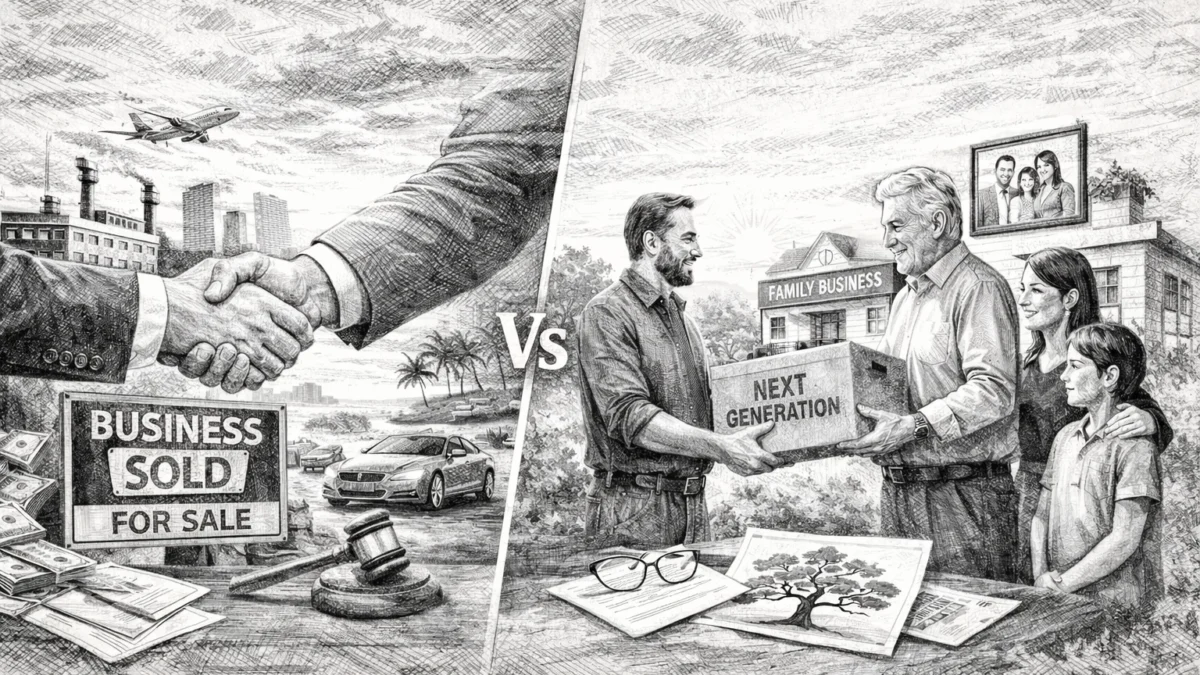
Choosing between selling your family business to an outsider and passing it down to the next generation is the most significant decision you will ever make. It is the difference between securing your family's financial future and potentially destroying your family's personal harmony.
The hard truth is this: Your business is not your legacy. Your legacy is what happens after you are gone.
The Great Misconception: Selling vs. Succession
We need to clear the air on definitions before we go any further.
Many owners think "Selling" and "Succession" are two completely different animals. They aren't. Selling is a form of succession. It is simply a succession to a third party rather than a family member.
The real tension isn't between two different processes. It’s between two different outcomes:
- The Clean Break: You sell the assets, the brand, and the headaches to a buyer who has the cash to pay for it.
- The Slow Burn: You transition leadership and ownership to a family member or employee over a period of years.
One offers immediate liquidity. The other offers the potential for a multi-generational dynasty.
Both can fail spectacularly if you don't understand the "Why" behind the "How."
The Emotional Debt of the Family Hand-off
Let’s be honest. You want your kids to take over.
You want to see your name stay on the building. You want to imagine your grandchildren running the shop fifty years from now. It’s a beautiful vision. It’s also a dangerous one.
A business is not a participation trophy.
If you pass a complex, high-stakes company to a child who isn't ready: or worse, isn't interested: you aren't giving them a gift. You are giving them an anchor.
According to research, while nearly 80% of business leaders say protecting the business is their top goal, only about 34% actually have a documented plan in place. That gap is where family legacies go to die.
If you choose the succession path, you have to ask yourself the diagnostic questions that most owners avoid:
- Does the next generation have the "fire in the belly," or are they just showing up because they feel obligated?
- Can they make the hard decisions: like firing a long-term employee or pivoting in a crisis: when you aren't there to bail them out?
- What breaks if you disappear?
If the answer is "everything," then you don't have a succession plan. You have a wish.

The Reality of Selling to an Outsider
Selling to a third party is often viewed as "giving up" on the family legacy. This is a lie.
Sometimes, the most "honest" thing you can do for your family is to sell the business for its maximum value and distribute that wealth. This removes the "Sunday Dinner" risk: the very real phenomenon where business disagreements bleed into family holidays and ruin relationships for decades.
When you sell to an outsider:
- The Valuation is Objective: A buyer doesn't care about your sentimental attachment to the first warehouse you rented. They care about EBITDA and scalable systems.
- The Risk is Transferred: Once the deal is done, the market volatility, the labor shortages, and the 2:00 AM phone calls belong to someone else.
- The Legacy is Financial: You trade a physical business for the freedom to fund your family’s future without the operational risk.
However, selling requires you to face another hard reality: what your business is really worth. Most owners overestimate their value because they confuse "hard work" with "market value."
A buyer isn't buying your past. They are buying your future: specifically, the future profits they can generate without you.
The Mandatory Requirement: The Owner-Optional Business
Regardless of whether you sell to a private equity firm or hand the keys to your daughter, there is one non-negotiable step: You must make the company owner-optional.
If the business depends on your specific expertise, your personal relationships, or your daily presence to function, it has no value.
- To a buyer, an owner-dependent business is a high-risk liability.
- To a successor, an owner-dependent business is a prison.
You have to build a machine that works while you sleep. This is the core philosophy of Before the Clock Decides. We focus on "finishing well," which means building a business that can survive its founder.
If you want to know why this matters more than you think, you should look at how owner-optionality impacts your exit strategy.

Comparing the Paths: A Direct Breakdown
Let’s look at the math and the "locker room" reality of both choices.
Path A: The Internal Succession
- The Goal: Continuity of culture and family name.
- The Benefit: You stay involved (if you want), and the legacy remains "in-house."
- The Risk: Family infighting, lack of professional management, and the potential for the business to fail under the second or third generation.
- The Truth: You will likely get paid less upfront, often through a long-term buyout or "earn-out" funded by future profits.
Path B: The Third-Party Sale
- The Goal: Maximizing liquidity and ending operational risk.
- The Benefit: A clean break with a significant cash infusion.
- The Risk: The new owner might change the culture, lay off employees, or dismantle what you built.
- The Truth: It is an emotional "death" of your identity as "The Boss." You have to be okay with someone else driving your car.
How to Choose (Before the Clock Decides)
You cannot make this choice while you are in the middle of a crisis. You have to decide while things are going well.
Ask yourself: What do I want my life to look like three years after I leave?
If that vision involves traveling the world and never checking an email, you need a clean sale. If that vision involves mentoring your children and seeing the brand grow for another thirty years, you need a long-term succession plan.
But remember: The market doesn't care about your feelings.
If you want to pass the business to your kids, you must treat them like any other buyer. They should have to prove their competency. They should have to understand the financials. They should have to earn the respect of the staff.
If you wouldn't hire them as a CEO if they were a stranger, don't give them the company just because they share your last name. That isn't love; it's sabotage.

The Cost of Waiting
The biggest mistake I see in business consulting is waiting too long to pick a lane.
The closer you get to your desired exit date, the less leverage you have. If you are forced to sell because of a health scare or a sudden burnout, you will take a "haircut" on the price. You will be a motivated seller in a room full of predatory buyers.
Succession planning is a 5-to-10-year process. Selling a business is a 1-to-3-year process.
If you are 60 years old and haven't started either, you are already behind. The clock is deciding for you.
Your Move
You need to stop "working in" the business and start "working on" the exit. Here is how you start:
- Run the "Hit by a Bus" Test: If you disappeared tomorrow, would the business be worth the same amount in six months? If not, start documenting your processes today.
- Have the Honest Conversation: Sit down with your potential successors. Ask them, honestly: if they want the responsibility. Give them a "no-guilt" out.
- Get a Real Valuation: Don't guess. Don't use a "rule of thumb." Get an objective look at what a third-party buyer would actually pay. You can find more resources on this in our valuation category.
- Read the Manual: My book, Before the Clock Decides, is designed to help you navigate this specific tension. It’s not about theory; it’s about the pragmatism of finishing well. Check it out here.
The legacy you leave is the one you plan for. Don't let the clock decide what happens to everything you've built.
Your Move.