
You think your top-line revenue is your biggest asset.
You’re wrong.
To a serious buyer, your sales are a vanity metric. They represent what happened yesterday. What they really want to know is what will happen tomorrow, without you.
Most business owners spend decades chasing the "next big contract." They stack revenue like a house of cards, hoping that a bigger number automatically equals a bigger exit.
It doesn't.
A $10 million company with no systems is a liability. A $5 million company with operational maturity is a goldmine.
Here is the hard truth: Buyers aren’t buying your past. They are buying your future cash flows. And if those cash flows depend on your personal magic, your intuition, or your 80-hour work weeks, they aren't worth much.
The Lever You’re Ignoring: The Multiple
Every business sale is a math problem.
Value = EBITDA x Multiple.
You spend all your time trying to grow EBITDA (your earnings). That’s the hard way to grow value. If you increase your earnings by 10%, your value goes up by 10%.
But if you increase your multiple by 1x through operational maturity, the impact is exponential.
A buyer looks at two identical companies making $1M in profit.
Company A is a mess. The owner makes every decision. There are no manuals. The staff is "loyal" but has no clear KPIs. The buyer sees high risk. They offer a 3x multiple. Value: $3M.
Company B has documented processes. There is a middle management team that runs the weekly meetings. Every lead is tracked in a CRM. The buyer sees a "plug-and-play" machine. They offer a 5x multiple. Value: $5M.
That $2 million gap wasn't created by working harder on sales. It was created by building a better machine.
What Breaks if You Disappear?
Ask yourself this question today: If you took a six-month vacation with no phone access, what would be left when you came back?
- Would the sales team know how to close a lead?
- Would the operations team know how to fulfill an order?
- Would the bills get paid?
- Would the customers stay?
If the answer is "everything would collapse," you don't own a business. You own a high-paying, high-stress job.
Buyers don't want to buy a job. They want to buy an asset.
Operational maturity is the process of moving from "Owner-Centric" to "System-Centric." It is the transition from being the genius with a thousand helpers to being the architect of a self-sustaining organism.
The Three Pillars of Maturity
Buyers look for three specific things when they audit your operations:
- Repeatability: Do you have a "way" of doing things, or is every project a custom invention? If your processes aren't documented, they aren't repeatable. If they aren't repeatable, they aren't scalable.
- Predictability: Can you forecast next month's revenue with 90% accuracy? Mature businesses have data-driven systems. They don't guess; they know.
- Transferability: Can a stranger step into your shoes and keep the engine running? This is the ultimate test of value. If the "secret sauce" is in your head, it stays with you when you leave. And the buyer won't pay for what stays with you.
Why Documentation is a Profit Center
Most owners think documentation is "administrative fluff." They’d rather be out making deals.
But in the eyes of a professional buyer, the kind of buyers we talk to at Vision Fox Business Advisors, an operations manual is a legal insurance policy. It guarantees that the value they are buying won't evaporate on day two of their ownership.
Documentation isn't about writing a 400-page book no one reads. It’s about creating "Playbooks" for the critical 20% of activities that drive 80% of your results.
- How we find a lead.
- How we onboard a client.
- How we handle a complaint.
- How we close the books.
When you have these Playbooks, you stop being a bottleneck. You start being an owner.
The Harsh Reality of the Market
We are entering a massive shift. As the "Silver Tsunami" of retiring owners hits the market, buyers are going to get pickier. They won't have to settle for messy, owner-dependent businesses because there will be plenty of well-run options to choose from.
If you wait until you're ready to sell to start systematizing, you're already too late. You'll be selling under duress, and the market will punish you for it.
As I discuss in my book, Before the Clock Decides, timing is everything. But timing doesn't just mean "when is the market hot?" It means "when is your business mature enough to be worth the maximum price?"
Don't let the clock decide your exit value. Build the machine now so you have the option to walk away whenever you choose.
Your Move:
- Identify the Bottleneck: For one week, write down every time a staff member asks you for permission or a "how-to" answer.
- Create One Playbook: Take the most frequent question and document the answer. That is your first system.
- Get a Reality Check: Contact Vision Fox for a valuation that doesn't just look at your tax returns, but audits your operational readiness.
The 2030 Exit Wave: Why Waiting for the Crowd is Your Riskiest Move

A storm is coming. It’s not a recession. It’s a demographic inevitability.
By 2030, the youngest Baby Boomers will be 65. Millions of business owners are planning to "retire in a few years."
The problem? They are all planning to do it at the same time.
Supply and demand is a law, not a suggestion. When the market is flooded with businesses for sale, buyers become kings. Prices drop. Terms get harsher.
If you wait until 2029 to "think about" selling, you are stepping into a crowded room where everyone is screaming for attention.
The Illusion of "A Few More Years"
Owners love to say, "I’ll just do five more years and then I'm out."
But five years is an eternity in business valuation. In five years, your industry could change. Your health could change. The interest rate environment could shift.
More importantly, in five years, you will be competing with a million other owners who also waited "five more years."
You shouldn't sell when you have to. You should sell when the market is hungry.
The Cost of Competition
In a buyer's market, "good" isn't good enough.
Buyers will look for any excuse to walk away or grind you down on price. They will look at your customer concentration, your aging equipment, and your lack of a second-tier management team.
If you are just one of ten similar businesses on a broker’s desk, you lose your leverage.
Be the First to the Exit
The smart money moves early.
By preparing your exit now, while others are still coasting, you position yourself as the premium option. You get the best buyers, the highest multiples, and the cleanest exits.
Don't wait for the crowd. The crowd is going to get slaughtered.
Your Move:
- Check the Calendar: Map out your ideal retirement date and subtract three years. That is your "Prepare for Market" date.
- Audit Your Industry: Are your competitors aging out too? If so, you are in the "Danger Zone."
- Read the Warning Signs: Get the book Before the Clock Decides to understand why waiting is the most expensive mistake you can make.
Why Your "Number" Might Be a Fantasy: The Harsh Reality of Market Valuations

Most business owners have a "number" in their head.
"I need $5 million to retire."
"My buddy sold his HVAC company for 6x, so mine is worth at least that."
Here is the truth: The market doesn't care about your retirement needs or your buddy's deal.
Your business is worth exactly what a buyer is willing to pay for it today. Not what it could be worth if you worked harder. Not what you need it to be worth to buy that beach house.
The "Sunk Cost" Trap
You’ve spent 20 years building this company. You’ve sacrificed weekends, missed birthdays, and weathered recessions. You feel the business "owes" you a certain price for all that sweat equity.
It doesn't.
A buyer isn't paying for your past sacrifices. They are paying for future risk-adjusted returns. If your 20 years of work haven't resulted in a systematized, profitable, and growing asset, those years are irrelevant to the valuation.
Multiples are Earned, Not Given
Just because your industry "average" is 4x doesn't mean you get 4x.
- Do you have high customer concentration? Subtract 1.0x.
- Is the owner the main salesperson? Subtract 1.5x.
- Are your financials a mess of personal expenses and "creative" accounting? Subtract another 0.5x.
Suddenly, your "5x" dream is a 2x reality.
The Valuation Gap
The "Valuation Gap" is the difference between what you think your business is worth and what it's actually worth.
Most owners don't find out the size of this gap until they are in due diligence. At that point, it’s too late. The deal collapses, and the owner is left with a business they no longer want to run.
Don't live in a fantasy. Get a professional valuation based on real market data, not ego.
Your Move:
- Kill the Ego: Accept that your business might be worth less than you think.
- Get a Pro Opinion: Stop using "online calculators." Work with Vision Fox to get a real-world assessment.
- Identify the Gaps: Focus on the "Value Killers" identified in your valuation and fix them over the next 12 months.
The Owner-Dependency Trap: Why Buyers Fear Your Personal Brand
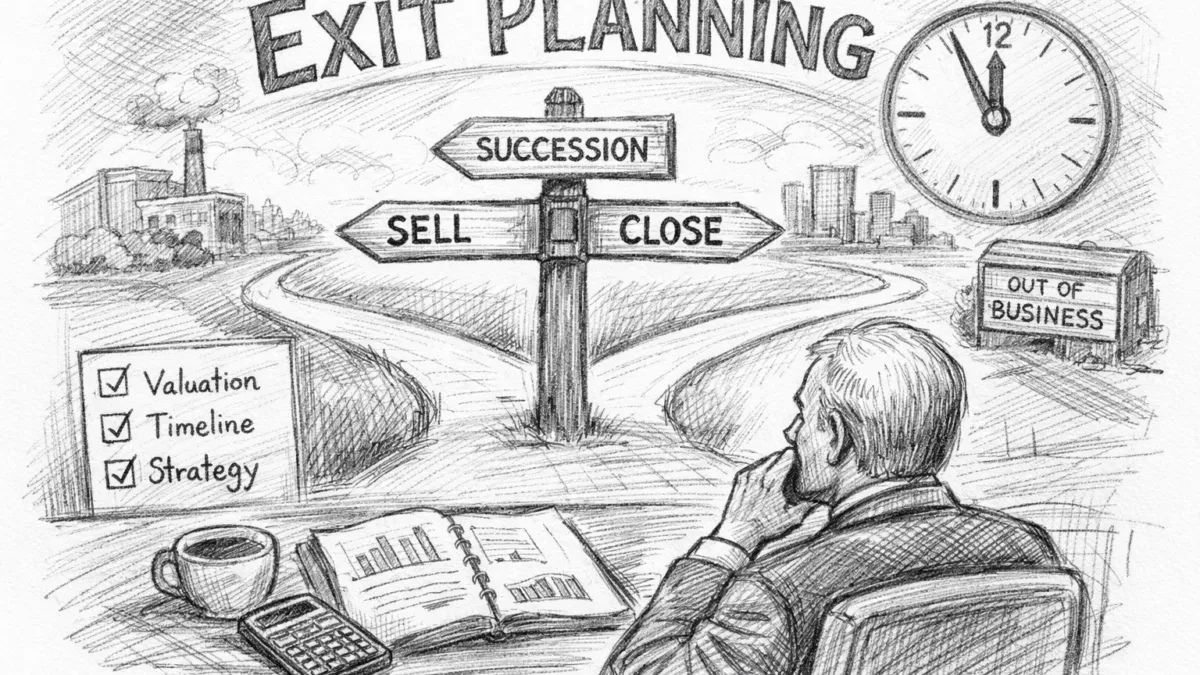
Are you the face of your company?
Do the big clients only want to talk to you? Do you personally sign off on every major project?
If you are the hero of your business, you are also its biggest risk.
To a buyer, you are a "Key Person." And a Key Person who is leaving the business is a disaster waiting to happen.
If the customers are loyal to you rather than the brand, the revenue is likely to walk out the door the day you do.
The "Personal Brand" Liability
In the age of social media, many owners have spent years building their personal profiles. They are the local experts. The "gurus."
This is great for growth. It is terrible for an exit.
A buyer cannot buy your personality. They cannot buy your relationships. They can only buy your systems and your team.
If you are the brand, you are trapping yourself in the business. A buyer will likely demand a 3-5 year "earn-out" just to make sure you don't leave and take the clients with you.
Replacing Yourself
The goal of exit planning isn't to work harder; it's to become obsolete.
- Step 1: Hire someone better than you at your core technical skill.
- Step 2: Hire someone to manage the customers.
- Step 3: Hire someone to run the day-to-day operations.
If you can’t replace yourself, you haven't built a business. You've built a cage.
The Management Premium
Buyers pay a premium for a "Second-Tier Management Team."
They want to see a layer of leaders who are staying after the sale. If the buyer can walk in on Monday morning and talk to a General Manager who knows exactly what to do, the risk of the deal drops significantly.
Lower risk = Higher price.
Your Move:
- The "Off-Grid" Test: Turn off your phone for 48 hours. See what breaks.
- Change the Name: If your name is on the building or in the logo, start the rebranding process now.
- Elevate a Leader: Give one of your top employees real decision-making power. Let them fail small so they can succeed big.
Professional Buyer Secrets: What Experts Don’t Want You to Know About Due Diligence

Due diligence isn't just a "check-up." It’s an interrogation.
Professional buyers, Private Equity groups, strategic competitors, and seasoned entrepreneurs, are experts at finding reasons to lower the price after the Letter of Intent (LOI) is signed.
They aren't looking for what’s right with your business. They are looking for what’s wrong.
The "Retrade" Strategy
The "Retrade" is a common tactic. The buyer offers a high price to get you under contract. Then, during due diligence, they "discover" flaws in your inventory, your contracts, or your margins.
"We found some issues," they say. "We still want to buy, but the price is now 20% lower."
If you haven't prepared your data room in advance, you won't have the evidence to fight back. You’ll be exhausted, deep in the process, and you’ll likely say "yes" just to get it over with.
It’s All About the Data
If it isn't in writing, it didn't happen.
Buyers want to see three years of clean financials. They want to see your customer churn rate. They want to see your employee turnover.
If you have to "dig through folders" to find an answer, the buyer smells blood. Disorganization is a sign of risk. Risk is a reason to discount the price.
Preparation is Your Best Defense
The only way to survive due diligence with your price intact is to perform "Reverse Due Diligence" on yourself first.
You need to find the skeletons in your own closet before the buyer does. If you know where the weaknesses are, you can either fix them or disclose them upfront: which builds trust and prevents retrades.
Your Move:
- Organize Your Data Room: Start a digital folder today. Every contract, every lease, every financial statement goes in there.
- Audit Your Financials: Stop running personal expenses through the business. It makes your "Add-backs" look like a lie.
- Hire a Guide: Work with an advisor like Vision Fox who knows the tricks buyers play and how to block them.
The Emotional Toll of the Exit: Why You’re Not Ready to Say Goodbye

Most exit planning focuses on the money. Very little focuses on the man (or woman).
You have spent 20, 30, maybe 40 years as "The Boss." Your identity is wrapped up in the company. Your social circle is tied to the industry. Your sense of purpose is driven by the daily problems you solve.
What happens to your identity the day after the sale?
If you don't answer this question, you will sabotage your own deal.
The Seller's Remorse
We see it all the time: An owner gets a great offer, everything is ready, and at the last minute, they blow up the deal over a minor detail.
It wasn't about the detail. It was about the fear of "What's next?"
The "void" that follows a business exit is real. If you haven't planned your "Life After Business," you will cling to the business like a life raft, even as it starts to sink.
Defining Your Legacy
Selling your business isn't "quitting." It’s the final act of leadership.
A true leader builds something that can survive without them. A true leader ensures their employees are taken care of and their customers are served long after they are gone.
Think about your exit not as an ending, but as a transition of stewardship.
Retirement is a Trap
For a high-achiever, "traditional" retirement: golf and TV: is a death sentence.
You need a new mountain to climb. Whether it's philanthropy, mentoring, or starting a new (smaller) venture, you need a reason to get out of bed.
Plan your "Post-Exit Life" with the same intensity you used to plan your business growth.
Your Move:
- Write Your "Day 1" Plan: What exactly will you do the day after the wire hits your account?
- Talk to Your Family: Their lives will change too. Are they ready for you to be home all the time?
- Read the Psychology: Check out the resources on the Before the Clock Decides blog about the emotional side of exiting.
7 Mistakes You’re Making with Your Earnings Credibility (and How to Fix Them)
When you tell a buyer your business makes $1 million a year, they don't believe you.
They assume you are hiding costs, inflating revenue, and "normalizing" numbers that aren't actually normal.
Earnings credibility is the foundation of trust in a deal. If the buyer doesn't trust your numbers, the deal is dead before it starts.
Here are the 7 biggest mistakes owners make with their financials:
- Mixing Personal and Business: Running your family's cell phones, cars, and vacations through the company makes your P&L look like a mess.
- Inconsistent Reporting: If your monthly numbers don't tie back to your annual tax returns, you have a credibility problem.
- Aggressive Revenue Recognition: Counting "booked" revenue as "earned" revenue before the work is done is a red flag for any sophisticated buyer.
- Ignoring "Add-backs": You need a clean list of one-time expenses (like a roof repair or a lawsuit) that won't recur for the next owner. But if you try to "add back" your own salary, you'll get laughed at.
- Cash-Basis Accounting: Serious buyers want Accrual-basis financials. If you're still on Cash-basis, your numbers don't show the real health of the business.
- Owner-Dependency in Sales: If 80% of sales come from your personal relationships, those "earnings" aren't transferable.
- Lack of Internal Controls: If one person handles the billing, the collections, and the bank statements, the buyer will assume there is fraud or error.
How to Fix It
The solution is transparency.
Don't wait for a buyer to find your mistakes. Hire a CPA to perform a "Quality of Earnings" (QofE) report now. It’s an investment that pays for itself ten times over by proving to the buyer that your numbers are bulletproof.
Your Move:
- Clean the Books: Starting today, stop putting personal "perks" on the company card.
- Switch to Accrual: Talk to your bookkeeper about moving to accrual-basis accounting for more accurate reporting.
- Get a QofE: If you are within 24 months of an exit, get a professional valuation and financial audit.
{“@type”:”BlogPosting”,”image”:”https://cdn.marblism.com/WLGNjlXBGgL.webp”,”author”:{“name”:”Mike Steward”,”@type”:”Person”},”@context”:”https://schema.org”,”headline”:”Operational Maturity Matters: Why Buyers Care More About Your Systems Than Your Sales”,”publisher”:{“logo”:{“url”:”https://cdn.marblism.com/Jb8J9ee_ZPD.webp”,”@type”:”ImageObject”},”name”:”Before the Clock Decides”,”@type”:”Organization”},”description”:”Learn why operational maturity and systems are more valuable than top-line revenue for a business exit. Discover how to increase your valuation multiple.”,”datePublished”:”2026-06-06″}